Craddock Surname Ancestry ResultsOur indexes 1000-1999 include entries for the spelling 'craddock'. In the period you have requested, we have the following 417 records (displaying 1 to 10): Single Surname Subscription | | | Buying all 417 results of this search individually would cost £2,402.00. But you can have free access to all 417 records for a year, to view, to save and print, for £100. Save £2,302.00. More... |
These sample scans are from the original record. You will get scans of the full pages or articles where the surname you searched for has been found. Your web browser may prevent the sample windows from opening; in this case please change your browser settings to allow pop-up windows from this site. Fine Rolls
(1377-1383)
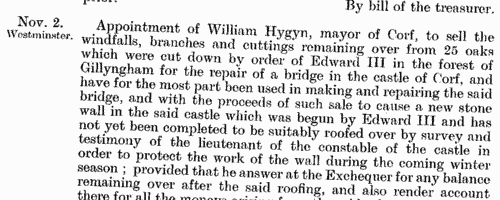
The fine rolls of the 1st to 6th years of the reign of king Richard II record part of the government administration in England, with orders sent out day by day to individual officers, and commitment of particular responsibilities and duties. There is also some material relating to Wales, Scotland, Ireland and the English possessions in France. CRADDOCK. Cost: £4.00.  | Sample scan, click to enlarge
| The English in France
(1419-1420)
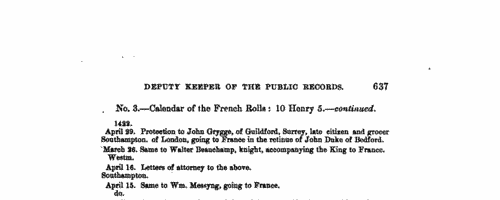
King Henry V of England claimed the throne of France (and quartered the fleurs-de-lis of France with the lions of England on the royal standard) as had his predecessors since Edward III, as descendants of Philip IV of France. He married Katherine, youngest daughter of king Charles VI of France in 1420, and thereafter styled himself 'heir and regent of France'. The English had real power or influence in Brittany, Normandy, Flanders and Gascony, and actual possession of several coastal garrisons, in particular Calais, where the French inhabitants had been replaced by English. The English administration kept a series of records called the French Rolls. On these are recorded royal appointments and commissions in France; letters of protection and safe-conduct to soldiers, merchants, diplomats and pilgrims travelling to France from England and returning, and to foreign legations. There are also licences to merchants to export to the Continent, and to captains to transport pilgrims. This calendar of the French Roll for the 7th year of the reign of Henry V (21 March 1419 to 20 March 1420) was prepared by Alexander Charles Ewald and published in 1883. CRADDOCK. Cost: £6.00. | Sample scan, click to enlarge
| Tenants of Somerset chantries
(1548)
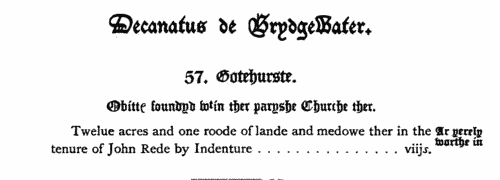
Chantries were established to perform services for the souls of their founders and other faithful dead, including annual obits and anniversaries at which alms were usually distributed. The chantries could be at an existing altar in a parish church, a new altar in a side chapel of an existing church, in a new chapel in the churchyard or some miles from an existing church: few were founded before 1300, and most date from 1450 to 1500. Hospitals were places provided by similar foundations to receive the poor and weak; there were also religious guilds, brotherhoods and fraternities, and colleges (like large chantries at which three or more secular priests lived in common). An Act of Parliament of 1545 gave king Henry VIII the power to dissolve such chantries, chapels, &c., the proceeds to be devoted to the expenses of the wars in France and Scotland. Commissioners were appointed 14 February 1546 to survey the chantries and seize their property, and in 1548 the commissioners in Somerset produced this survey and rental. The individuals named are the tenants whose rents provided the chantry's income: occasionally an incumbent is named. The survey was edited by Emanuel Green for the Somerset Record Society, and published in 1888.CRADDOCK. Cost: £4.00. | Sample scan, click to enlarge
| London and Middlesex Feet of Fines
(1485-1569)
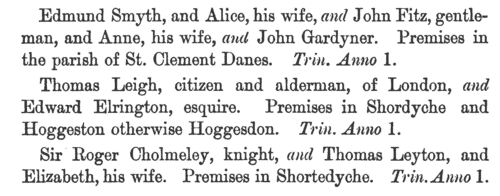
Pedes Finium - law suits, or pretended suits, putting on record the ownership of land in London and Middlesex.CRADDOCK. Cost: £4.00. | Sample scan, click to enlarge
| Secretary of State's Papers
(1602)
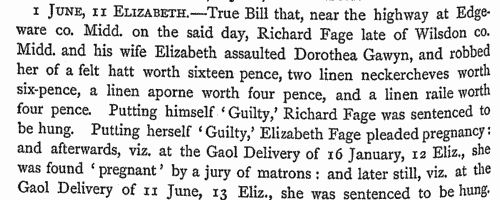
The letters and papers of sir Robert Cecil, Secretary of State, deal with all manner of government business in England, Ireland and abroad.CRADDOCK. Cost: £4.00. | Sample scan, click to enlarge
| Middlesex Sessions
(1549-1603)
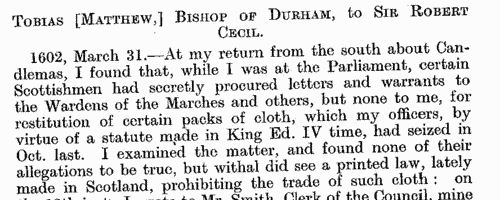
This printed calendar collates a number of surviving records from Middlesex sessions for the period. Principally these are the Gaol Delivery Rolls (G. D. R.) and the General Sessions of the Peace Rolls (G. S. O. P. R.). Both series cover general criminal indictments (bills) together with the recognizances of the witnesses to attend; but the Gaol Delivery Rolls, by their very nature, tend to deal with the more serious cases - felonies where the accused could not be released on bail. The General Sessions rolls also include the sheriff's lists of bailiffs, sub-bailiffs, high and petty constables in the shire; writs of venire facias for production of jurors, writs of capias, lists of jurors, jury-panels &c. The Gaol Delivery Rolls also include coroners' inquests, writs of supersedeas, and memoranda of proclamations. Special inquiries are recorded in separate Sessions of Oyer and Terminer (S. O. T.) rolls and Inquest or Inquisition rolls (I. R.) Although coverage is good, none of the sequences of rolls for this period is complete. A peculiarity of this calendar is that in the case of actual incidents, the date given at the start of each entry is the date that the incident was alleged to have taken place (for instance, 1 June 11 Elizabeth (1569) in the sample scan) rather than the date of the court proceedings. CRADDOCK. Cost: £4.00. | Sample scan, click to enlarge
| Lancashire and Cheshire Marriage Licences
(1606-1616)
Licences for intended marriages in Chester archdeaconry, which covered Cheshire and Lancashire south of the Ribble (by far the most populous part of that county)CRADDOCK. Cost: £4.00. | Sample scan, click to enlarge

| Inhabitants of Cambridge
(1504-1635)
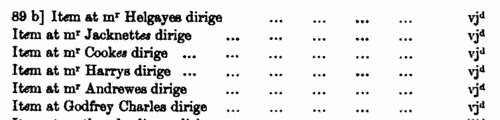
Cambridge comprised fourteen ancient parishes, plus the university (which was extra-parochial), in the diocese of Ely. The church of St Mary the Great (as opposed to St Mary the Less) in the Market Place (juxta forum) has churchwardens' accounts surviving from 1504 onwards. Those from 1504 to 1635 were transcribed by J. E. Foster for the Cambridge Antiquarian Society and published in 1905. The two churchwardens were chosen annually: the previous year's churchwardens each chose another parishioner: those two then each chose three other parishioners: the resulting eight then chose the new year's churchwardens, the wardens of the Light of the Rood, and the wardens of the Mass of Jesus. Auditors were also chosen, usually out of the eight, to examine all the wardens' accounts at the end of the year. The churchwardens' accounts are largely concerned with the costs of repair of the church and its furnishings, and include the names of tradesmen and workmen. Each Easter a rate called Easter money was raised was raised from all householders in the parish, and additional rates are occasionally levied for unusual expenses, such as steeple reconstruction. These 'Easter book' lists give a complete list of householders for the parish, excepting the poor. The church's income also included the rents from some houses in the parish, and the names of the tenants appear. The offices of the Light of the Rood and the Mass of Jesus were abolished during the Reformation. The accounts of the Light of the Rood, i. e., for candles burnt before the crucifix, often include a list of sums received for funerary diriges (dirges) for the year, from which the year of death of the more prosperous parishioners can be traced in this early period. CRADDOCK. Cost: £4.00. | Sample scan, click to enlarge
| English passengers to New England
(1632-1637)
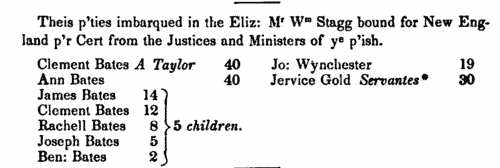
Samuel G. Drake searched British archives from 1858 to 1860 for lists of passengers sent from England to New England, publishing the results in 1860 in Boston, Massachusetts. Adult emigrants transported to New England in the period 1632 to 1637 had to take oaths of allegiance and religious conformity, certified by parish priest, mayor or justices, and these certificates form the core of this book, but it also includes a list of 'Scotch Prisoners sent to Massachusetts in 1652, by Order of the English Government', and various other passenger lists and documents, dating as late as 1671. The early lists included the children, and normally gave the full name and age of each person. This is the index to the passengers.CRADDOCK. Cost: £2.00. | Sample scan, click to enlarge
| PCC Probate Abstracts
(1650-1651)
The Prerogative Court of Canterbury's main jurisdiction was central and southern England and Wales, as well as over sailors &c dying abroad: these brief abstracts usually give address, date of probate and name of executor or administrator
CRADDOCK. Cost: £2.00. | Sample scan, click to enlarge

|
Research your ancestry, family history, genealogy and one-name study by direct access to original records and archives indexed by surname.
|