Cracroft Surname Ancestry ResultsOur indexes 1000-1999 include entries for the spelling 'cracroft'. In the period you have requested, we have the following 104 records (displaying 1 to 10): Single Surname Subscription | | | Buying all 104 results of this search individually would cost £546.00. But you can have free access to all 104 records for a year, to view, to save and print, for £100. Save £446.00. More... |
These sample scans are from the original record. You will get scans of the full pages or articles where the surname you searched for has been found. Your web browser may prevent the sample windows from opening; in this case please change your browser settings to allow pop-up windows from this site. Inhabitants of Cambridge
(1298-1389)
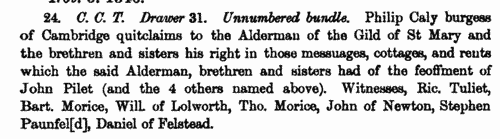
'Cambridge Gild Records' was edited by Mary Bateson for the Cambridge Antiquarian Society, and printed in 1903. Several important records for the town are brought together: minutes of the Gild of St Mary in the church of St Mary in the Market Place, 1298-1319 (pages 1-13); bede rolls of the same of around 1349 (14-25); minutes of the Gild of Corpus Christi in the church of St Bene't (26-62); returns for all the Cambridge gilds in 1389 (63-128); a calendar of deeds connected with the gilds of St Mary and Corpus Christi (129-150); and also a subsidy roll for the borough, listing householders in the 8th year of king Edward II (1314-1315) (151-157). The gild minutes include lists of persons entering the gild, usually paying a certain amount for alms and for wax for lights (candles). The bede rolls list prayers for the souls of the deceased, using the formula 'pro anima ..... (et ..... uxoris ejus)', 'for the soul of ..... (and of ..... his wife)'. Dates are not generally given, but most of the entries in these bede rolls are from 1349 to 1352. CRACROFT. Cost: £4.00.  | Sample scan, click to enlarge
| Common Pleas: Lincolnshire
(1558)
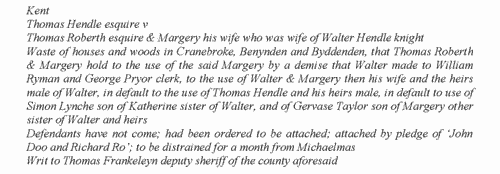
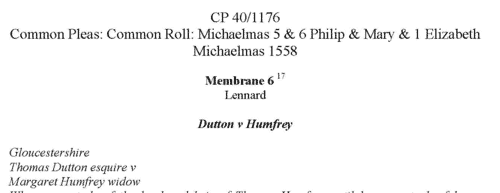
Pleas at Westminster Michaelmas term, 5 & 6 Philip & Mary and 1 Elizabeth, 1558. The court dealt with civil cases: debt, detinue, slander, assault, theft, breach of covenant, formedon, novel disseisin, &c. Each case is marked in the margin with the name of the county to the sheriff of which the writs were issued. Most often, but not necessarily, this would be the county of residence of the defendant. This calendar of the original formulaic record in abbreviated Latin on parchment has been made by David Bethell, preserving all individual detail from each case. The Latin text is translated: English phrases and passages are preserved literatim, in bold. CP 40/1176 mm.1-100CRACROFT. Cost: £8.00. | Sample scan, click to enlarge
| Lincolnshire Entries in the Common Pleas (1558)
The Common Roll of the Common Pleas records litigation before the justices de Banco from throughout England.
CRACROFT. Cost: £8.00. | Sample scan, click to enlarge
| Lawyers and officers of Lincoln's Inn
(1422-1586)
Lincoln's Inn is one of the ancient inns of court in London exclusively invested with the right to call lawyers to the English bar. The Black Books of Lincoln's Inn are the main administrative records of the society, containing the names of those filling the different offices year by year; the annual accounts of the Pensioner and the Treasurer; regulations; punishments and fines for misdemeanours. This edition, printed for the Inn in 1897, covers the first five surviving volumes.CRACROFT. Cost: £6.00. | Sample scan, click to enlarge
| Lord Willoughby in the Netherlands
(1580-1601)
Mrs S. C. Lomas of the Historical Manuscripts Commission prepared this calendar of the manuscripts of the Earl of Ancaster preserved at Grimsthorpe, published in 1907. The records covered are from 1550 to 1737, but the bulk of this volume is given over to an edition of the correspondence of Peregrine lord Willoughby, who was appointed governor of Bergen-op-Zoom in 1586, and spent the next ten years commanding English and Dutch forces against those of Spain. There are also a few pages (449 to 452) dealing with a scattering of ancient deeds (from c.1160 to 1547); some items from inventories (452-459, c.1522 to after 1742) and household accounts (459-482, 1560-1661) which attracted Mrs Lomas's attention; and notes from a muster roll of Baberg hundred, Suffolk, of about 1522, from which some names are given in the text.CRACROFT. Cost: £4.00. | Sample scan, click to enlarge
| Intended Brides in Yorkshire
(1626)
William Paver, a 19th-century Yorkshire genealogist, made brief abstracts of early marriage licences (now lost) in York Registry. His manuscript, which became Additional Manuscripts 29667 in the British Museum, was transcribed by J. W. Clay, F. S. A., and printed in various issues of the Yorkshire Archaeological Journal: this is from the volume for 1903. Paver did not note the dates of the licences, merely listing them by year: his abstracts give the names and addresses of both parties, and the name of the parish church in which it was intended that the wedding would take place.CRACROFT. Cost: £4.00. | Sample scan, click to enlarge

| PCC Probate Abstracts
(1652-1653)
The Prerogative Court of Canterbury's main jurisdiction was central and southern England and Wales, as well as over sailors &c dying abroad: these brief abstracts usually give address, date of probate and name of executor or administrator
CRACROFT. Cost: £2.00. | Sample scan, click to enlarge

| Prerogative Court of Canterbury Wills: Lincolnshire: Strays
(1658)
William Brigg compiled abstracts of all the wills in Register "Wootton" of the Prerogative Court of Canterbury. The abstracts of those proved in 1658 were published by him in 1894. The court's main jurisdiction was central and southern England and Wales, as well as over sailors &c dying abroad. We have re-indexed the whole volume, county by county, for both testators and strays (legatees, witnesses and other persons mentioned in the abstracts). CRACROFT. Cost: £4.00. | Sample scan, click to enlarge
| London Marriage Allegations
(1611-1660)
London, Essex and part of Hertfordshire lay within the diocese of London. In the later 17th century the individual archdeaconry courts issued marriage licences, but for this period the only surviving material is from the overarching London Consistory court. The main series of marriage allegations from the consistory court was extracted by Colonel Joseph Lemuel Chester, and the text was edited by George J. Armytage and published by the Harleian Society in 1887. A typical later entry will give date; name, address and occupation of groom; name, address and condition of his intended bride, and/or, where she is a spinster, her father's name, address and occupation. Lastly we have the name of the church where the wedding was going to take place. For the later years Colonel Chester merely picked out items that he thought were of interest, and his selections continue as late as 1828, but the bulk of the licences abstracted here are from the 17th century.CRACROFT. Cost: £4.00. | Sample scan, click to enlarge
| Allegations for marriages in southern England
(1660-1679)
The province or archbishopric of Canterbury covered all England and Wales except for the northern counties in the four dioceses of the archbishopric of York (York, Durham, Chester and Carlisle). Marriage licences were generally issued by the local dioceses, but above them was the jurisdiction of the archbishop, exercised through his vicar-general. Where the prospective bride and groom were from different dioceses it would be expected that they obtain a licence from the archbishop; in practice, the archbishop residing at Lambeth, and the actual offices of the province being in London, which was itself split into myriad ecclesiastical jurisdictions, and spilled into adjoining dioceses, this facility was particularly resorted to by couples from London and the home counties, although there are quite a few entries referring to parties from further afield. The abstracts of the allegations given here usually state name, address (street in London, or parish), age, and condition of bride and groom; and sometimes the name, address and occupation of the friend or relative filing the allegation. Where parental consent was necessary, a mother's or father's name may be given. The ages shown should be treated with caution; ages above 21 tended to be reduced, doubtless for cosmetic reasons; ages under 21 tended to be increased, particularly to avoid requiring parental consent; a simple statement 'aged 21' may merely mean 'of full age' and indicate any age from 21 upwards. These are merely allegations to obtain licences; although nearly all will have resulted in the issuing of the licence, many licences did not then result in marriage. This index also includes marriage licence allegations for the jurisdiction of the Dean and Chapter of Westminster, 1558 to 1699.CRACROFT. Cost: £4.00. | Sample scan, click to enlarge

|
Research your ancestry, family history, genealogy and one-name study by direct access to original records and archives indexed by surname.
|