Brabazon Surname Ancestry ResultsOur indexes 1000-1999 include entries for the spelling 'brabazon'. In the period you have requested, we have the following 159 records (displaying 1 to 10): Single Surname Subscription | | | Buying all 159 results of this search individually would cost £728.00. But you can have free access to all 159 records for a year, to view, to save and print, for £100. Save £628.00. More... |
These sample scans are from the original record. You will get scans of the full pages or articles where the surname you searched for has been found. Your web browser may prevent the sample windows from opening; in this case please change your browser settings to allow pop-up windows from this site. Close Rolls
(1302-1307)
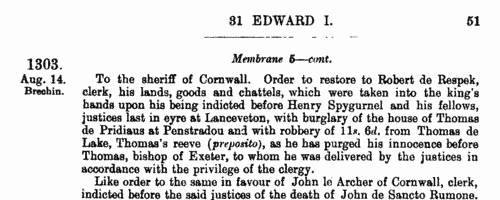
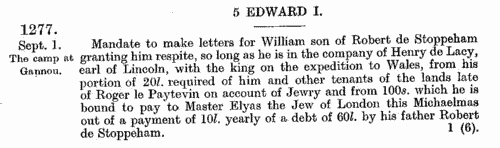
The close rolls of the 31st to 35th years of the reign of king Edward I, that is to the day of his death (7 July 1307), record the main artery of government administration in England, the orders sent out day by day to individual officers, especially sheriffs of shires: they are an exceptionally rich source for so early a period. In amongst this official material, the rolls were also used as a way of recording many acknowledgments of private debts and contracts between individuals. Most of the contents relate to England, but there are also entries concerning Wales, Scotland, Ireland and the English possessions in France.BRABAZON. Cost: £4.00.  | Sample scan, click to enlarge
| Close Rolls
(1313-1318)
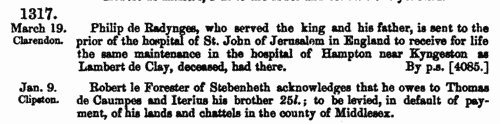
The close rolls of the 7th, 8th, 9th, 10th and 11th years of the reign of king Edward II record the main artery of government administration in England, the orders sent out day by day to individual officers, especially sheriffs of shires: they are an exceptionally rich source for so early a period. In amongst this official material, the rolls were also used as a way of recording many acknowledgments of private debts and contracts between individuals. Most of the contents relate to England, but there are also entries concerning Wales, Scotland, Ireland and the English possessions in France.BRABAZON. Cost: £4.00. | Sample scan, click to enlarge
| Grantees of offices, commissions and pardons
(1317-1321)
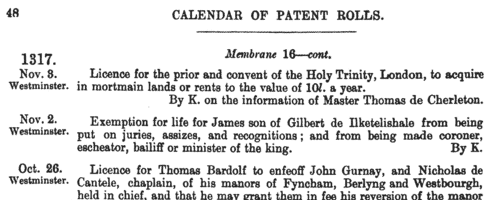
The Patent Rolls are the Chancery enrolments of royal letters patent. Those for the 11th to the 14th years of the reign of king Edward II (8 July 1317 to 7 July 1321) were edited for the Public Record Office by G. F. Handcock, and published in 1903. The main contents are royal commissions and grants; ratifications of ecclesiastical estates; writs of aid to royal servants and purveyors; and pardons. Most extensive are the commissions of oyer and terminer to justices to investigate complaints about specific crimes and wrongs in particular counties.BRABAZON. Cost: £2.00. | Sample scan, click to enlarge
| Charter Rolls
(1050-1326)
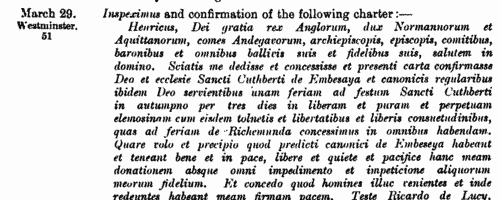
This abstract of the surviving charter rolls for 1300 to 1326, in the reigns of kings Edward I and II, was prepared by C. G. Crump and A. E. Stamp and published in 1908. The charter rolls not only recorded royal grants of lands, liberties and offices, but also enabled landowners to have their existing charters, their deeds of title, registered by the process of inspeximus and confirmation. After the Statute of Mortmain of 1279, this was of particular importance to religious houses, now greatly restricted in their ability to receive new donations of land, and anxious to prove title to their ancient property. Consequently, many charters of great age were copied onto the charter rolls.BRABAZON. Cost: £4.00. | Sample scan, click to enlarge
| Chancery Warrants
(1244-1326)
Warrants were issued by the kings of England to the royal chancery: most of these warrants led to further proceedings which are recorded on the Charter Rolls, Patent Rolls, Fine Rolls, Close Rolls or the Inquisitions: but archivists have identified a large number of warrants for which there are no such equivalent records, and those for the reigns of Edward I and Edward II are gathered here. Most of the entries relate to England and Wales, but with occasional items referring to Ireland and the English possessions in France.BRABAZON. Cost: £4.00. | Sample scan, click to enlarge
| Clerks and Clergy in Cornwall and Devon
(1307-1326)
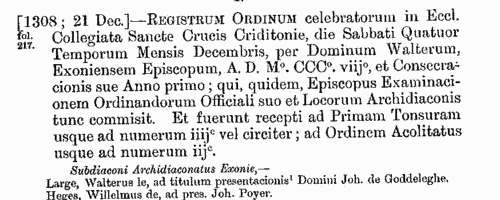
The register of bishop Walter de Stapeldon of Exeter, containing general diocesan business, but in particular including ordination lists for monks and clergy. Only a small proportion of the clerks went on to acquire benefices and remained celibate. LatinBRABAZON. Cost: £6.00. | Sample scan, click to enlarge
| Inhabitants of Leicester
(1103-1327)
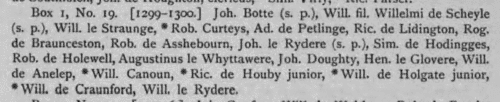
The Corporation of Leicester commissioned the publication (in 1899) of extracts from the earliest borough archives, edited by Mary Bateson. This volume brings together several important sources: the borough charters; the merchant gild rolls (from 1196 onwards); tax returns; court rolls (from about 1260 onwards); mayoral accounts, &c. All the Latin and French texts are accompanied by English translations. Membership of the merchant gild was by right of inheritance (s. p. = sede patris, in his father's seat), or by payment of a fee called a 'bull' (taurus). The sample scan shows part of a gild entrance roll; those marked * paid their bull, and were thus, by implication, not natives, or at least not belonging to gild merchant families. By 1400 membership of the gild merchant had become the equivalent of gaining freedom of the borough (being a free burgess): but at this period the two were not necessarily the same, and some of the merchant gild members were not resident in the borough, merely traded there. Not all the tax rolls surviving for this period are printed: but full lists of names are given for a loan for redemption of pontage and gavelpence of 1252-3 (pp. 44-46); five tallages of 1269 to 1271 brought together in a single table (128-145); and tallages of 1286 (208-211), 1307 (255-257), 1311 (272-274) and 1318 (310-313). The portmanmoot (or portmote) was the borough court dealing with minor infractions and civil suits. Finally, there is a calendar of charters (from c.1232 onwards, 381-400), and a list of mayors, bailiffs (reeves), receivers and serjeants (401-407).
BRABAZON. Cost: £4.00. | Sample scan, click to enlarge
| Staffordshire entries on the Assize, De Banco and Fine Rolls
(1307-1327)
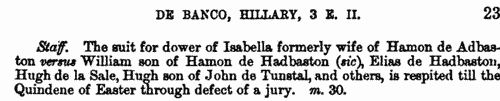
Extracts of Staffordshire entries from these three series of records for the reign of king Edward II were made by Major-General the Hon. G. Wrottesley, and published by the William Salt Society in 1888. The justices in eyre (itinerant) holding assizes not only tried all civil actions outstanding on their advent, pleas of the crown and common pleas, but also interrogated the juries of each hundred and borough as to the Articles of the Eyre, inquiring into the king's proprietary rights, escheats, wardships, and questions of maladministration. The court of King's Bench (de Banco) sat in Westminster, similarly dealing with court cases brought in from throughout the country. The fine rolls record part of the government administration in England, with orders sent out day by day to individual officers, and commitment of particular responsibilities and duties. Wrottesley's extracts are far from exhaustive, as he confined his attention to those landed gentry families that he considered of importance.
BRABAZON. Cost: £4.00. | Sample scan, click to enlarge
| Inhabitants of London
(1314-1337)
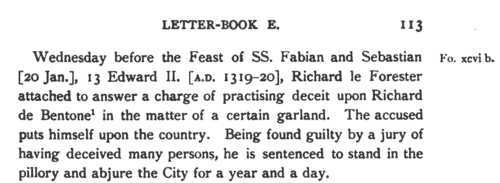
Letter Book E of the City of London contains enrolments of recognizances between inhabitants, particularly citizens, for sums of money lent or due; grants of pieces of land or property; and various records relating to the city administration, minor infractions, &c.
BRABAZON. Cost: £4.00. | Sample scan, click to enlarge
| Clergy, the religious and the faithful in Britain and Ireland
(1305-1342)
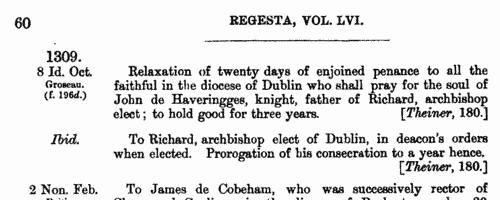
These are abstracts of the entries relating to Great Britain and Ireland from the Regesta of popes Clement V, John XXII and Benedict XII. Many of these entries relate to clerical appointments and disputes, but there are also indults to devout laymen and women for portable altars, remission of sins, &c. This source is particularly valuable for Ireland, for which many of the key government records of this period are lost. Clement V was consecrated and crowned 14 November 1305 (the day from which his pontificate is dated); John XXII was crowned 5 September 1316; Benedict XII 8 January 1335 and died 25 April 1342. From 1309 onwards the papacy was in exile at Avignon. The extracts were made by W. H. Bliss from Regesta lii to cxxxvi, and published in 1895. Bliss remarked that 'although the writing of the Papal Registers of the 14th century is clearer than that of many contemporary English MSS., the entries in them were for the most part founded upon petitions or letters from different countries, and the scribes in the Papal Chancery must have experienced even greater difficulty in copying English proper names than English students experience nowadays in reading the early Chancery Rolls preserved in the Public Record Office. Not having local or personal knowledge, they constantly misread doubtful letters.'BRABAZON. Cost: £4.00. | Sample scan, click to enlarge
|
Research your ancestry, family history, genealogy and one-name study by direct access to original records and archives indexed by surname.
|