Brabant Surname Ancestry ResultsOur indexes 1000-1999 include entries for the spelling 'brabant'. In the period you have requested, we have the following 106 records (displaying 1 to 10): Single Surname Subscription | | | Buying all 106 results of this search individually would cost £550.00. But you can have free access to all 106 records for a year, to view, to save and print, for £100. Save £450.00. More... |
These sample scans are from the original record. You will get scans of the full pages or articles where the surname you searched for has been found. Your web browser may prevent the sample windows from opening; in this case please change your browser settings to allow pop-up windows from this site. Dublin Merchants
(1226)
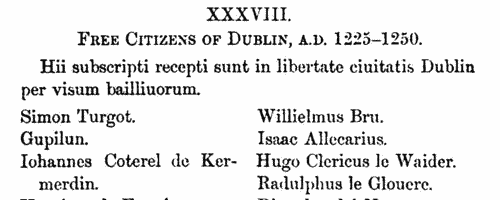
In 1870 documents of the Anglo-Normans in Ireland from 1172 to 1320, edited by J. T. Gilbert, Secretary of the Public Record Office of Ireland, were printed in the Rerum Britannicarum Medii Aevi Scriptores series. These include transcripts of the Dublin guild merchant rolls surviving from that period, which we have now indexed. BRABANT. Cost: £6.00.  | Sample scan, click to enlarge
| Liberate Rolls
(1260-1267)
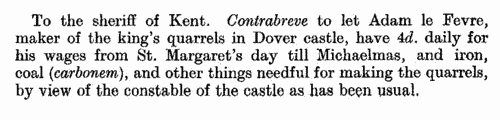
These chancery liberate rolls of the 45th to 51st years of the reign of Henry III of England record the details of payments and allowances as part of the administration of government. Most entries start with the Latin words 'liberate', meaning 'deliver', or 'allocate', meaning allow. There are also 'contrabreves', warrants mainly to sheriffs of shires, assigning them tasks and allowing expenses. Most of the entries relate to England and Wales, but there are occasional references to Ireland and the English possessions in France.BRABANT. Cost: £4.00. | Sample scan, click to enlarge
| Close Rolls
(1313-1318)
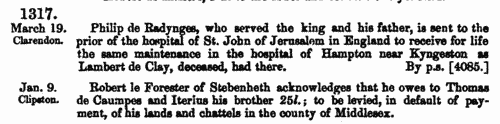
The close rolls of the 7th, 8th, 9th, 10th and 11th years of the reign of king Edward II record the main artery of government administration in England, the orders sent out day by day to individual officers, especially sheriffs of shires: they are an exceptionally rich source for so early a period. In amongst this official material, the rolls were also used as a way of recording many acknowledgments of private debts and contracts between individuals. Most of the contents relate to England, but there are also entries concerning Wales, Scotland, Ireland and the English possessions in France.BRABANT. Cost: £4.00. | Sample scan, click to enlarge
| Hampshire and Surrey clerks, clerics, monks and clergy
(1376)
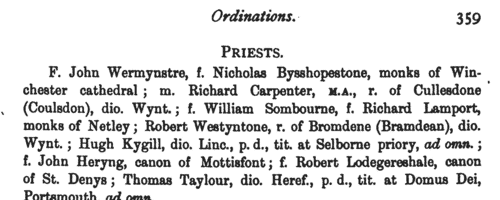
Ordinations as acolytes, subdeacons, deacons and priests, from the register of bishop William de Wykeham of Winchester. Winchester diocese covered Hampshire and Surrey; the ordinations also attracted many persons from distant dioceses bearing letters dimissory from their ordinaries, and these are duly noted in the text. Many of these clerks would not go on to obtain benefices and remain celibate. The lists of subdeacons, deacons and priests state the clerks' respective titles, i. e., give the names of the person or religious house undertaking to support them. Monks and friars are indicated ('f.' = brother). The acolyte lists usually give parish of origin or title. The sample scan is from 1404.BRABANT. Cost: £6.00. | Sample scan, click to enlarge
| Inhabitants of Leicester
(1327-1509)
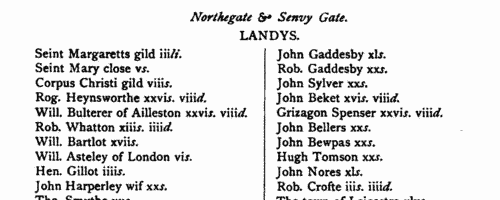
The Corporation of Leicester commissioned the publication (in 1901) of extracts from the borough archives of 1327 to 1509, edited by Mary Bateson. This volume brings together several important sources: a coroner's roll of 1327; the merchant gild rolls; tax returns; court rolls; rentals; mayoral accounts, &c. All the Latin and French texts are accompanied by English translations. Not all the tax rolls surviving for this period are printed: but full lists of names are given for tallages of 1336 (pp. 34-40); 1347-8 (69-71); and 1354 (93-99); subsidy rolls of 1492 (331-334) and 1497 (351-353); and a benevolence roll of 1505 (370-374). There is a calendar of conveyances (388-446), and a list of mayors, bailiffs, and other officials (447-462); and, finally, entrants into the merchant gild
from 1465 to 1510. Membership of the merchant gild was by right of inheritance (s. p. = sede patris, in his father's seat), or by payment of a fee called a 'bull' (taurus). Those marked * paid their bull, and were thus, by implication, not natives, or at least not belonging to gild merchant families. By 1400 membership of the gild merchant had become the equivalent of gaining freedom of the borough (being a free burgess): but thitherto the two were not necessarily the same, and some of the merchant gild members were not resident in the borough, merely traded there.BRABANT. Cost: £4.00. | Sample scan, click to enlarge
| Recipients of grants of land by the Crown; and other grantors and grantees
(1427-1516)
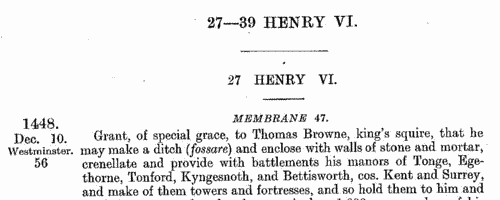
Grants of land by the Crown were enrolled on the Charter Rolls: but this series of records was also used by other magnates and religious houses as a way of having their own deeds inspected, confirmed and registered. It will be seen from this that some of the material described in these inspeximuses dates back to a considerably earlier period. In addition, there is an appendix of fragments of charter roll material from 1215 and 1286 to 1288. The royal grants enrolled relate not only to land, but also to various privileges that were part of the royal prerogative.
Most of the material is from England, the remainder relating to Ireland, Wales and possessions in France, but virtually nothing from Scotland, which was an independent kingdom at this period.BRABANT. Cost: £4.00. | Sample scan, click to enlarge
| Cheshire gentry and their ancestors
(1580-1613)
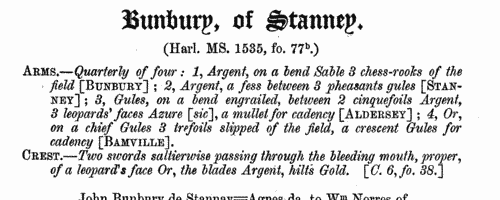
Richard St George, Norroy King of Arms, and Henry St George, Bluemaster Pursuivant of Arms, of the College of Arms, conducted a heraldic visitation of Cheshire in 1612 and 1613, recording pedigrees of gentlemen claiming the right to bear coats of arms. A copy of their visitation was elaborated by the addition of other Cheshire pedigrees in Harleian Manuscript 1535: and this manuscript was edited by sir George J. Armytage and John Paul Rylands for publication by the Harleian Society in 1909. It has a large number of pedigrees of Cheshire gentry, with a few brief abstracts from early documents; and the pedigrees of some offshoots from old Cheshire stocks which had taken root in other counties. The pedigrees largely relate to the period back from 1613 to the previous visitation of 1580, but there is also some older material, particularly back into the 15th century. In most cases each pedigree is prefixed by a heraldic description of the coat of arms. The printed volume also includes (pages 1 to 4) a list of Cheshire men who disclaimed the right to bear a coat of arms at the 1613 visitation, taken from Harleian Manuscript 1070.BRABANT. Cost: £4.00. | Sample scan, click to enlarge
| Official Papers
(1611-1618)
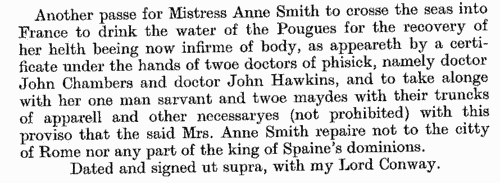
The State Papers Domestic cover all manner of business relating to Britain, Ireland and the colonies, conducted in the office of the Secretary of State as well as other miscellaneous records.
BRABANT. Cost: £4.00. | Sample scan, click to enlarge

| Liegemen and Traitors, Pirates and Spies
(1626)
The Privy Council of Charles I was responsible for internal security in England and Wales, and dealt with all manner of special and urgent matters
BRABANT. Cost: £4.00. | Sample scan, click to enlarge
| English passengers to New England
(1632-1637)
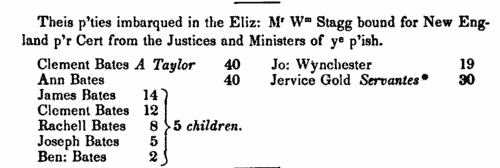
Samuel G. Drake searched British archives from 1858 to 1860 for lists of passengers sent from England to New England, publishing the results in 1860 in Boston, Massachusetts. Adult emigrants transported to New England in the period 1632 to 1637 had to take oaths of allegiance and religious conformity, certified by parish priest, mayor or justices, and these certificates form the core of this book, but it also includes a list of 'Scotch Prisoners sent to Massachusetts in 1652, by Order of the English Government', and various other passenger lists and documents, dating as late as 1671. The early lists included the children, and normally gave the full name and age of each person. This is the index to the passengers.BRABANT. Cost: £2.00. | Sample scan, click to enlarge
|
Research your ancestry, family history, genealogy and one-name study by direct access to original records and archives indexed by surname.
|