Blaby Surname Ancestry ResultsOur indexes 1000-1999 include entries for the spelling 'blaby'. In the period you have requested, we have the following 45 records (displaying 1 to 10): Single Surname Subscription | | | Buying all 45 results of this search individually would cost £230.00. But you can have free access to all 45 records for a year, to view, to save and print, for £100. Save £130.00. More... |
These sample scans are from the original record. You will get scans of the full pages or articles where the surname you searched for has been found. Your web browser may prevent the sample windows from opening; in this case please change your browser settings to allow pop-up windows from this site. Oblata or Fine Rolls
(1200-1216)
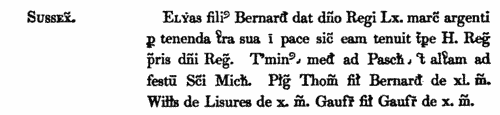
All the surviving oblata or fine rolls of the reign of king John were edited by Thomas Duffus Hardy and printed by the Commissioners of the Public Records in 1835. These are the oblata rolls of the 1st, 2nd and 3rd years of the reign, and the fine rolls of the 6th, 7th, 9th, 15th, 16th and 17th years. These rolls contain notices of the oblations or fines offered to the Crown to procure grants and confirmations of liberties and franchises of markets, fairs, parks and free warren; for exemption from tolls, pontage, passage and murage; to obtain justice and right; to stop, delay or expedite pleas, trials and judgments; and to remove suits and processes from inferior tribunals into the King's Court. Fines were also extracted for licence to trade, or permission to exercise commerce or industry of any kind, and to have the aid, protection, or goodwill of the King; to mitigate his anger or abate his displeasure; to be exempted from knighthood either for a term or for ever, and from attending the King in his foreign expeditions; they were also demanded for seisin or restitution of ancestral lands or chattels; for allowing delinquents to be replevied or bailed; for acquittal of murder; and for pardon of trespasses and misdemeanours; for the 'year and a day' of the lands and goods of felons and fugitives. Almost all entries have the county in question indicated in the left hand margin.BLABY. Cost: £4.00.  | Sample scan, click to enlarge
| Early Charters of St Paul's Cathedral
(1230-1239)
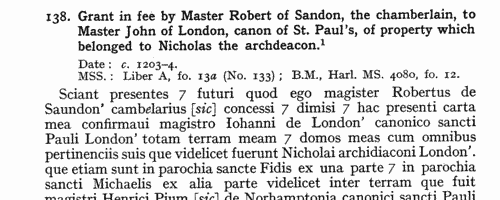
The Liber A or Pilosus of St Paul's cathedral, London, was initiated in 1241 as an attempt at copying all the charters, chirographs and other diverse writings found in the treasury of the church; after that original project was abandoned, the codex came to be used as a general register or cartulary. The first portion was edited for the Royal Historical Society by Marion Gibbs and printed in 1939. Where the original charters also survived, or a better text was found in Liber L, she used these superior sources. Liber A never became a complete register of the cathedral's charters; nor are the charters it contains necessarily the most important, nor were they grouped chronologically or geographically. The text remains as a record of part of the great landed wealth of the church in London and nearby. The persons that appear are the grantors, justices, those named in the descriptions of property, and the witnesses.BLABY. Cost: £4.00. | Sample scan, click to enlarge
| Patent Rolls: entries for Yorkshire
(1275-1276)
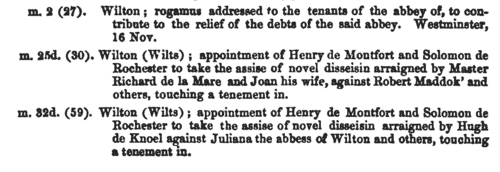
Calendars of the patent rolls of the reign of king Edward I are printed in the Calendars of State Papers: but these cover only a fraction of the material on the rolls. From 1881 to 1889 the reports of the Deputy Keeper of the Public Record Office also include calendars of other material from the rolls - about five times as many entries as in the State Papers - predominantly mandates to the royal justices to hold sessions of oyer and terminer to resolve cases arising locally; but also other general business. The calendar for the 4th year of king Edward I [20 November 1275 to 19 November 1276], hitherto unindexed, is covered here.BLABY. Cost: £6.00. | Sample scan, click to enlarge
| Lancashire Assizes
(1202-1285)
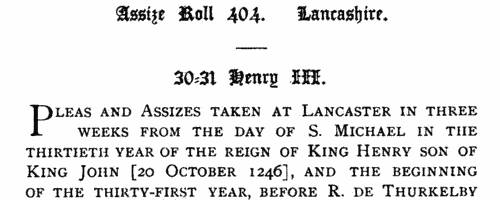
All the surviving records of the assizes held by the royal justices in eyre (itinerant) in Lancashire during this period were extracted by colonel John Parker and published by the Lancashire and Cheshire Record Society from 1904. The justices not only tried all civil actions outstanding on their advent, pleas of the crown and common pleas, but also interrogated the juries of each wapentake and borough as to the Capitula Itineries, the Articles of the Eyre, inquiring into the king's proprietary rights, escheats, wardships, and questions of maladministration. Only a dozen complete rolls survive for this period; but Appendix I (pp. 218-253) gathers together from the Patent Rolls of the reign of Henry III (1216-1272) a schedule of Lancashire assizes for which justices were assigned; and Appendix II (306-342) adds the fines and amercements before the justices during that reign, as recorded on the Pipe Rolls.BLABY. Cost: £4.00. | Sample scan, click to enlarge
| Yorkshire Inquisitions
(1275-1295)
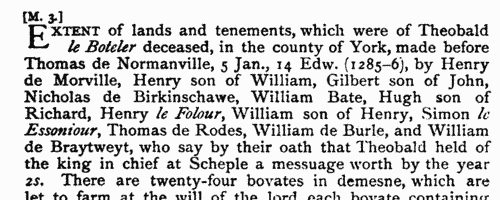
Inquisitions post mortem are inquiries as to the real estate and heir of each person holding in capite or in chief, i. e. directly, from the Crown, or whose estates had been escheated or were in ward. The age and relationship of the heir are usually recorded. Inquisitions ad quod damnum enquired as to any activities (including maladministration by local officials) that had resulted in any material loss to the Crown. Proofs of age are inquiries into the precise date of birth of an heir, usually involving local inhabitants recalling those circumstances which fixed that date in their mind. Yorkshire inquisitions for this period were edited by William Brown for the Yorkshire Archaeological Society, and printed in 1898. This index covers all names mentioned, including jurors, tenants, &c. BLABY. Cost: £4.00. | Sample scan, click to enlarge
| Guisborough Cartulary
(1119-1300)
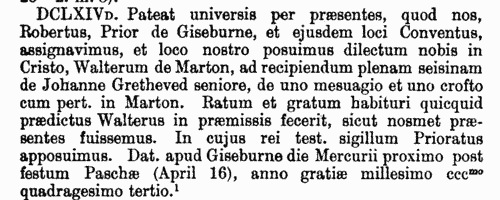
The Augustinian (black canons) priory of the Blessed Virgin Mary at Guisborough (Gyseburne) near Middlesbrough in north Yorkshire, was founded about 1119 by Robert de Brus. The 1100 or so grants of land (mostly in Cleveland) made to the priory from then well into the 13th century were copied into a cartulary or chartulary which survives as Cottonian Manuscript Cleopatra d ii (British Library). This was edited by W. Brown and published by the Surtees Society from 1889. This second part contains the charters numbered DXCIV to MCLXXXIX. The texts have been stripped of repetitious legal formulae, retaining the details of the grantors, the property, and the witnesses: so the individuals named are mainly local landowners and tenants, canons, servants and wellwishers of the monastery. The charters before 1250 are often undated. The charters in this section are arranged by place, under the heads 'Normanby; Martona; Thornaby; Ugthorpe et Pecibiggyng; Levingtona; Jarum; Castle Levington; Kepwyck; Feyceby; Atona; Thresk; Neuton; Estona; Lackenby; Lyum; Cotum; Scheltona; Brottona; Moresom; Glasedale Daneby et Moresum; Kylton; Lofthus; Esingtona; Lyverton; Daneby; Glasdale; Uggethorpe; Percybyggyng; Sletholme; Scalynge; Redker; Merske; Hesele; Lunde super le Walde; Kirkburn; Rotsea; Bainton; Tibthorpe; Ingleby Arncliff; East Harlsey; Sawcock; Scarth; Stokesley; Kirkby-in-Cleveland; Battersby; Stainton-in-Cleveland; Maltby; Ayresome; York; Sinnington; Barningham and Newsham; Aylesby; Kelsterne; Bridekirk and Appleton; Aislaby; Hart and Hartlepool; Castle Eden; and Annandale'. Three further sections are added from other sources: 1. Documents connected with the burning of the priory church in 1289; 2. Extracts from the registers of the archbishops of York relating to the priory, 1238 to 1337; 3. A rent roll of the priory of about 1300 (pp. 412 to 450), giving many names of tenants.BLABY. Cost: £4.00. | Sample scan, click to enlarge
| Guisborough Cartulary
(1119-1300)
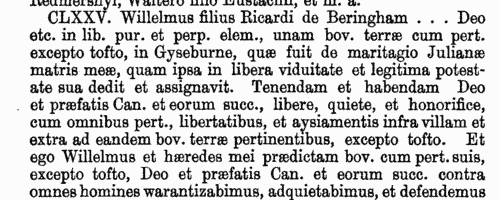
The Augustinian (black canons) priory of the Blessed Virgin Mary at Guisborough (Gyseburne) near Middlesbrough in north Yorkshire, was founded about 1119 by Robert de Brus. The 1100 or so grants of land (mostly in Cleveland) made to the priory from then well into the 13th century were copied into a cartulary or chartulary which survives as Cottonian Manuscript Cleopatra d ii (British Library). This was edited by W. Brown and published by the Surtees Society from 1889. This first part contains the charters from folios 1 to 233, items I to DXCIII. The texts have been stripped of repetitious legal formulae, retaining the details of the grantors, the property, and the witnesses: so the individuals named are mainly local landowners and tenants, canons, servants and wellwishers of the monastery. The charters before 1250 are often undated.BLABY. Cost: £4.00. | Sample scan, click to enlarge
| Yorkshire Inquisitions
(1294-1303)
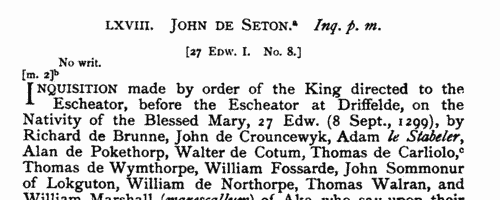
Inquisitions post mortem are inquiries as to the real estate and heir of each person holding in capite or in chief, i. e. directly, from the Crown, or whose estates had been escheated or were in ward. The age and relationship of the heir are usually recorded. Inquisitions ad quod damnum enquired as to any activities (including maladministration by local officials) that had resulted in any material loss to the Crown. Proofs of age are inquiries into the precise date of birth of an heir, usually involving local inhabitants recalling those circumstances which fixed that date in their mind. Yorkshire inquisitions for this period were edited by William Brown for the Yorkshire Archaeological Society, and printed in 1902. This index covers all names mentioned, including jurors, tenants, &c. The volume also includes two stray inquests, from 1245 and 1282.BLABY. Cost: £4.00. | Sample scan, click to enlarge
| Freemen and citizens of London
(1291-1309)
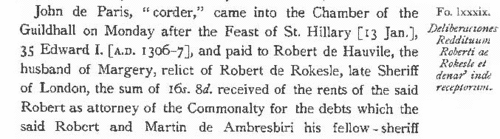
Letter Book C of the City of London contains enrolments of recognizances between inhabitants, particularly citizens, for sums of money lent or due; grants of pieces of land or property; and various records relating to the city administration, minor infractions, &c. The text was edited by Reginald R. Sharpe and printed by order of the Corporation of the City of London in 1901.BLABY. Cost: £4.00. | Sample scan, click to enlarge
| Close Rolls
(1313-1318)
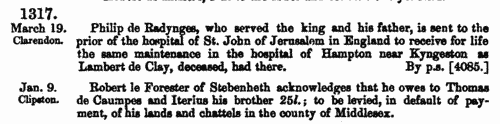
The close rolls of the 7th, 8th, 9th, 10th and 11th years of the reign of king Edward II record the main artery of government administration in England, the orders sent out day by day to individual officers, especially sheriffs of shires: they are an exceptionally rich source for so early a period. In amongst this official material, the rolls were also used as a way of recording many acknowledgments of private debts and contracts between individuals. Most of the contents relate to England, but there are also entries concerning Wales, Scotland, Ireland and the English possessions in France.BLABY. Cost: £4.00. | Sample scan, click to enlarge
|
Research your ancestry, family history, genealogy and one-name study by direct access to original records and archives indexed by surname.
|