Blac Surname Ancestry ResultsOur indexes 1000-1999 include entries for the spelling 'blac'. In the period you have requested, we have the following 13 records (displaying 1 to 10): Buy all | | | Get all 13 records to view, to save and print for £50.00 |
These sample scans are from the original record. You will get scans of the full pages or articles where the surname you searched for has been found. Your web browser may prevent the sample windows from opening; in this case please change your browser settings to allow pop-up windows from this site. Grantees of royal lands and pardons
(1129-1130)
The Great Rolls of the Pipe are the central record of the crown compiling returns of income and expenditure from the sheriffs and farmers of the various English counties or shires. This is the oldest series of public records, and the earliest surviving instances of many surnames are found in the Pipe Rolls. This is the earliest surviving roll, believed to be from the 31st year of the reign of king Henry I, that is, accounting for the year from Michaelmas 1129 to Michaelmas 1130: this is a period for which there are no other general English records, so these rolls give details of many persons and incidents otherwise utterly unknown. Most (but not all) of the entries in which names appear relate to payments for grants of land and pardons. There is a separate return in each year for each shire, the name of the shire being here printed at the top of each page. Wales was still independent, in separate kingdoms, at this period, and is not included, except for 'Herefordshire in Wales'. There is virtually no reference to the palatinates of Chester, Lancaster and Durham, or to Cumberland and Westmoreland in the far northwest.BLAC. Cost: £4.00.  | Sample scan, click to enlarge
| Grantees of royal lands and pardons
(1155-1158)
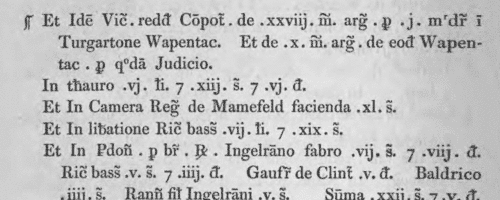
The Great Rolls of the Pipe are the central record of the crown compiling returns of income and expenditure from the sheriffs and farmers of the various English counties or shires. This is the oldest series of public records, and the earliest surviving instances of many surnames are found in the Pipe Rolls. The rolls for the 2nd, 3rd and 4th years of the reign of king Henry II are covered by this volume: this is a period for which there are no other general English records, so these rolls give details of many persons and incidents otherwise utterly unknown. Most (but not all) of the entries in which names appear relate to payments for grants of land and pardons. There is a separate return in each year for each shire, the name of the shire being here printed at the top of each page. Wales was still independent, in separate kingdoms, at this period, and is not included, except for 'Herefordshire in Wales'. There is virtually no reference to the palatinates of Chester, Lancaster and Durham, or to Cumberland and Westmoreland in the far northwest.BLAC. Cost: £4.00. | Sample scan, click to enlarge

| Curia Regis Rolls
(1194-1199)
The Curia Regis, king's court, of mediaeval England took cases from throughout the country, and its records are among the most important surviving from this early period. This transcript of the rolls for October to December 1194 and October 1198 to July 1199 were edited by sir Francis Palgrave for the Commissioners of the Public Records. Most entries have the name of the county in the lefthand margin.BLAC. Cost: £4.00. | Sample scan, click to enlarge
| Curia Regis Rolls
(1196-1201)
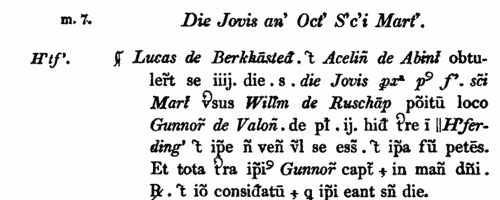
The Curia Regis, king's court, of mediaeval England took cases from throughout the country, and its records are among the most important surviving from this early period.BLAC. Cost: £4.00. | Sample scan, click to enlarge
| Curia Regis Rolls
(1219-1220)
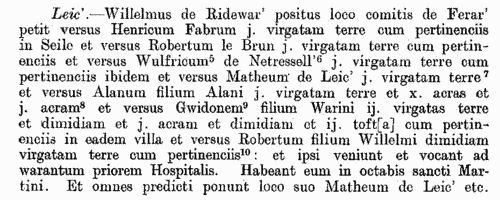
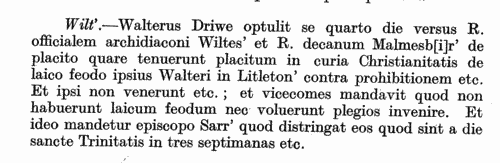
The Curia Regis, king's court, of mediaeval England took cases from throughout the country, and its records are among the most important surviving from this early period. Rolls 71 and 71B for Michaelmas term of the 3rd and 4th years, and 72 and 73 for Hilary term and Easter term of the 4th year of the reign of king Henry III (Michaelmas 1219 to Easter 1220) were edited by C. T. Flower of the Public Record Office and published in 1938. Each entry is copied in full, the Latin extended from the abbreviated original, the personal and place names given as in the original; where these vary between duplicate rolls, variant spellings are given in the footnotes. The county of each case was marked in the margin in the originals, and this is shown in italics at the start of each entry in the printed edition. BLAC. Cost: £4.00. | Sample scan, click to enlarge
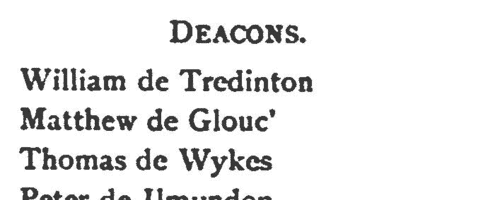
| Clerks and Clergy in Worcestershire and southwest Warwickshire.
(1268-1301)
The register of bishop Godfrey Giffard of Worcester, containing general diocesan business, mostly relating to clergy, but with some parochial affairs and disputes with names of parishioners. The diocese of Worcester at this period was almost exactly coextensive with the county of Worcester (minus its western finger), plus southwest Warwickshire (including Warwick itself). The register also includes ordination lists (as in the sample scan) of subdeacons, deacons and priests.BLAC. Cost: £4.00. | Sample scan, click to enlarge
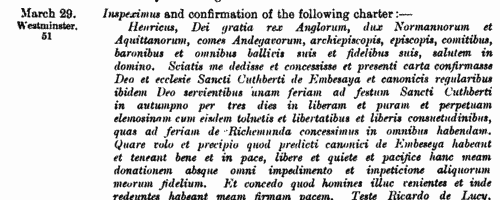
| Charter Rolls
(1050-1326)
This abstract of the surviving charter rolls for 1300 to 1326, in the reigns of kings Edward I and II, was prepared by C. G. Crump and A. E. Stamp and published in 1908. The charter rolls not only recorded royal grants of lands, liberties and offices, but also enabled landowners to have their existing charters, their deeds of title, registered by the process of inspeximus and confirmation. After the Statute of Mortmain of 1279, this was of particular importance to religious houses, now greatly restricted in their ability to receive new donations of land, and anxious to prove title to their ancient property. Consequently, many charters of great age were copied onto the charter rolls.BLAC. Cost: £4.00. | Sample scan, click to enlarge
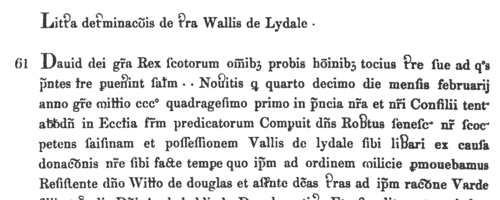
| Douglas family charters
(1150-1400)
The register of the more ancient writs of the Douglases of Dalkeith, Midlothian, Earls of Morton is probably the oldest chartulary of lay possessions in Scotland, and contains about 300 charters. It was edited by C. Innes and published by the Bannatyne Club in 1853 as part II of the Registrum Honoris de Morton. The names that occur are principally those of grantors, grantees and witnesses, mostly from Midlothian.BLAC. Cost: £4.00. | Sample scan, click to enlarge
| Clergy, the religious and the faithful in Britain and Ireland
(1362-1404)
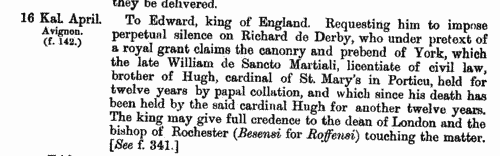
These are abstracts of the entries relating to Great Britain and Ireland from the Regesta of popes Urban V, Gregory XI, (Anti-Pope) Clement VII, Urban VI and Boniface IX, and the Lateran Regesta of Boniface IX. Many of these entries relate to clerical appointments and disputes, but there are also indults to devout laymen and women for portable altars, remission of sins, &c. This source is particularly valuable for Ireland, for which many of the key government records of this period are lost. Urban V was consecrated and crowned 6 November 1362 (the day from which his pontificate is dated); Gregory XI was crowned 5 January 1371; Clement VII 31 October 1378; Urban VI 18 April 1378; Boniface IX 9 November 1389 and died 1 October 1404. Until 1376 the papacy was in exile at Avignon. The extracts were made by W. H. Bliss from Regesta ccxlv to cccxx and Lateran Regesta i to xliii, and published in 1902. Bliss remarked that 'although the writing of the Papal Registers of the 14th century is clearer than that of many contemporary English MSS., the entries in them were for the most part founded upon petitions or letters from different countries, and the scribes in the Papal Chancery must have experienced even greater difficulty in copying English proper names than English students experience nowadays in reading the early Chancery Rolls preserved in the Public Record Office. Not having local or personal knowledge, they constantly misread doubtful letters.'BLAC. Cost: £4.00. | Sample scan, click to enlarge
| Grantees of offices, commissions and pardons
(1413-1416)
The Patent Rolls are the Chancery enrolments of royal letters patent. Those for the 1st, 2nd and 3rd years of the reign of king Henry V (21 March 1413 to 20 March 1416) were edited for the Public Record Office by R. C. Fowler, and published in 1910. The main contents are royal commissions and grants; ratifications of ecclesiastical estates; writs of aid to royal servants and purveyors; and pardons. The commissions of the peace issued for the English towns and counties and entered on the rolls, being largely repetitive, have been consolidated in a single appendix.BLAC. Cost: £2.00. | Sample scan, click to enlarge

|
| 1 | 2 |  |
Research your ancestry, family history, genealogy and one-name study by direct access to original records and archives indexed by surname.
|