Beadle Surname Ancestry ResultsOur indexes 1000-1999 include entries for the spelling 'beadle'. In the period you have requested, we have the following 287 records (displaying 1 to 10): Single Surname Subscription | | | Buying all 287 results of this search individually would cost £1,590.00. But you can have free access to all 287 records for a year, to view, to save and print, for £100. Save £1,490.00. More... |
These sample scans are from the original record. You will get scans of the full pages or articles where the surname you searched for has been found. Your web browser may prevent the sample windows from opening; in this case please change your browser settings to allow pop-up windows from this site. Inhabitants of London
(1314-1337)
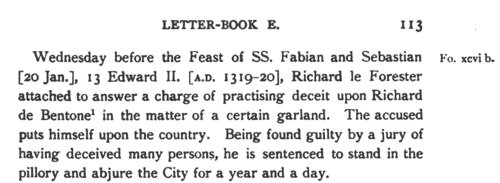
Letter Book E of the City of London contains enrolments of recognizances between inhabitants, particularly citizens, for sums of money lent or due; grants of pieces of land or property; and various records relating to the city administration, minor infractions, &c.
BEADLE. Cost: £4.00.  | Sample scan, click to enlarge
| Officers of the Royal Household
(1553)
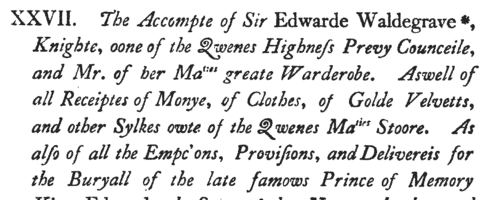
King Edward VI died 6 July 1553 and was buried 8 August following. The accounts of the funeral expenses were prepared by sir Edward Waldegrave, knight, one of queen Mary's privy coucil, and master of her Majesty's great wardrobe. The expenses included the purchase of 'blacke clothe boughte for the buriall' to furnish mourning for every officer and servant of the late king's household, and these accounts list all the officers, department by department, by name. Most officers were provided with 4 yards of cloth, and their clerks and servants 3 yards each: greater dignitaries were allowed from 7 to 16 yards; sir Edward himself received 10. The total cost of the 9,376 and a half yards of cloth was £5946 9s 9d.BEADLE. Cost: £6.00. | Sample scan, click to enlarge
| London Marriage Allegations
(1521-1610)
London, Essex and part of Hertfordshire lay within the diocese of London. In the later 17th century the individual archdeaconry courts issued marriage licences, but for this period the only surviving material is from the overarching London Consistory court. The main series of marriage allegations from the consistory court starts 7 December 1597, and these were extracted by Colonel Joseph Lemuel Chester; Colonel Chester then discovered earlier material, back to 5 January 1521, in Vicar-General's Books of the Principal Probate Registry. The notices in these books were much briefer, but as well as extending back so much earlier, they included additional material for 1597 onwards. All this he collated with the consistory court extracts, and the text was edited by George J. Armytage and published by the Harleian Society in 1887. A typical later entry will give date; name, address and occupation of groom; name, address and condition of his intended bride, and/or, where she is a spinster, her father's name, address and occupation. Lastly we have the name of the church where the wedding was going to take place; or the words Gen. Lic. signifying a general or open licence.BEADLE. Cost: £4.00. | Sample scan, click to enlarge

| Wandsworth Baptisms
(1620)
The ancient parish of Wandsworth in Surrey comprised the single township of Wandsworth, including the hamlets of Garratt, Half Farthing and Summers Town. It lay in the archdeaconry of Surrey of the diocese of Winchester: unfortunately, few bishop's transcripts of Surrey parish registers survive earlier than 1800. Although the original parish registers of Wandsworth doubtless commenced in 1538, the volume(s) before 1603 had been lost by the 19th century. In 1889 a careful transcript by John Traviss Squire of the first three surviving registers was printed, and we have now indexed it year by year. The baptism registers from 1603 to 1726 normally give date of baptism, and the names of the child and its father, but do not give date of birth or the mother's christian name.BEADLE. Cost: £2.00. | Sample scan, click to enlarge
| Wandsworth Baptisms
(1622)
The ancient parish of Wandsworth in Surrey comprised the single township of Wandsworth, including the hamlets of Garratt, Half Farthing and Summers Town. It lay in the archdeaconry of Surrey of the diocese of Winchester: unfortunately, few bishop's transcripts of Surrey parish registers survive earlier than 1800. Although the original parish registers of Wandsworth doubtless commenced in 1538, the volume(s) before 1603 had been lost by the 19th century. In 1889 a careful transcript by John Traviss Squire of the first three surviving registers was printed, and we have now indexed it year by year. The baptism registers from 1603 to 1726 normally give date of baptism, and the names of the child and its father, but do not give date of birth or the mother's christian name.BEADLE. Cost: £2.00. | Sample scan, click to enlarge
| Wandsworth Baptisms
(1623)
The ancient parish of Wandsworth in Surrey comprised the single township of Wandsworth, including the hamlets of Garratt, Half Farthing and Summers Town. It lay in the archdeaconry of Surrey of the diocese of Winchester: unfortunately, few bishop's transcripts of Surrey parish registers survive earlier than 1800. Although the original parish registers of Wandsworth doubtless commenced in 1538, the volume(s) before 1603 had been lost by the 19th century. In 1889 a careful transcript by John Traviss Squire of the first three surviving registers was printed, and we have now indexed it year by year. The baptism registers from 1603 to 1726 normally give date of baptism, and the names of the child and its father, but do not give date of birth or the mother's christian name.BEADLE. Cost: £2.00. | Sample scan, click to enlarge
| Wandsworth Baptisms
(1626)
The ancient parish of Wandsworth in Surrey comprised the single township of Wandsworth, including the hamlets of Garratt, Half Farthing and Summers Town. It lay in the archdeaconry of Surrey of the diocese of Winchester: unfortunately, few bishop's transcripts of Surrey parish registers survive earlier than 1800. Although the original parish registers of Wandsworth doubtless commenced in 1538, the volume(s) before 1603 had been lost by the 19th century. In 1889 a careful transcript by John Traviss Squire of the first three surviving registers was printed, and we have now indexed it year by year. The baptism registers from 1603 to 1726 normally give date of baptism, and the names of the child and its father, but do not give date of birth or the mother's christian name.BEADLE. Cost: £2.00. | Sample scan, click to enlarge
| Wandsworth Baptisms
(1630)
The ancient parish of Wandsworth in Surrey comprised the single township of Wandsworth, including the hamlets of Garratt, Half Farthing and Summers Town. It lay in the archdeaconry of Surrey of the diocese of Winchester: unfortunately, few bishop's transcripts of Surrey parish registers survive earlier than 1800. Although the original parish registers of Wandsworth doubtless commenced in 1538, the volume(s) before 1603 had been lost by the 19th century. In 1889 a careful transcript by John Traviss Squire of the first three surviving registers was printed, and we have now indexed it year by year. The baptism registers from 1603 to 1726 normally give date of baptism, and the names of the child and its father, but do not give date of birth or the mother's christian name.BEADLE. Cost: £2.00. | Sample scan, click to enlarge
| Wandsworth Burials
(1631)
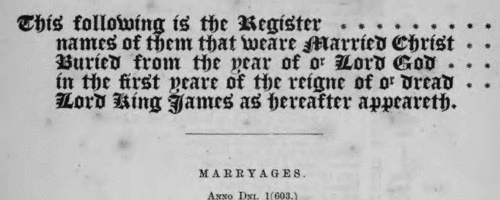
The ancient parish of Wandsworth in Surrey comprised the single township of Wandsworth, including the hamlets of Garratt, Half Farthing and Summers Town. It lay in the archdeaconry of Surrey of the diocese of Winchester: unfortunately, few bishop's transcripts of Surrey parish registers survive earlier than 1800. Although the original parish registers of Wandsworth doubtless commenced in 1538, the volume(s) before 1603 had been lost by the 19th century. In 1889 a careful transcript by John Traviss Squire of the first three surviving registers was printed, and we have now indexed it year by year. The early burial registers contain little detail - date of burial, and full name. For the burial of children, the father's name is also stated; for the burial of wives, the husband's. Such details as date or cause of death, age, address or occupation are almost never given. On the other hand, the Wandsworth burial registers of the early 17th century are particularly important because they contain the names of adults born well back into the 16th century, a period for which the parish registers no longer survive. Moreover, the burial registers are considerably more bulky than the baptism registers, because the burying ground was used by Dissenters, who formed a large part of the population. BEADLE. Cost: £4.00. | Sample scan, click to enlarge
| British in the East
(1630-1634)
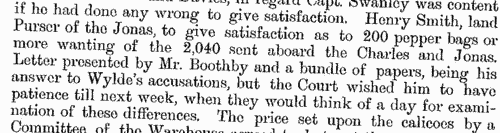
The East India State Papers centre on the records of the East India Company, trading to India, the East Indies, Persia and China. They include the Court Minutes of the East India Company.BEADLE. Cost: £4.00. | Sample scan, click to enlarge
|
Research your ancestry, family history, genealogy and one-name study by direct access to original records and archives indexed by surname.
|