Gomer Surname Ancestry ResultsOur indexes 1000-1999 include entries for the spelling 'gomer'. In the period you have requested, we have the following 32 records (displaying 1 to 10): Single Surname Subscription | | | Buying all 32 results of this search individually would cost £178.00. But you can have free access to all 32 records for a year, to view, to save and print, for £100. Save £78.00. More... |
These sample scans are from the original record. You will get scans of the full pages or articles where the surname you searched for has been found. Your web browser may prevent the sample windows from opening; in this case please change your browser settings to allow pop-up windows from this site. Yorkshire Inquisitions
(1275-1295)
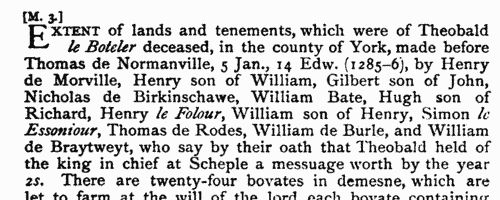
Inquisitions post mortem are inquiries as to the real estate and heir of each person holding in capite or in chief, i. e. directly, from the Crown, or whose estates had been escheated or were in ward. The age and relationship of the heir are usually recorded. Inquisitions ad quod damnum enquired as to any activities (including maladministration by local officials) that had resulted in any material loss to the Crown. Proofs of age are inquiries into the precise date of birth of an heir, usually involving local inhabitants recalling those circumstances which fixed that date in their mind. Yorkshire inquisitions for this period were edited by William Brown for the Yorkshire Archaeological Society, and printed in 1898. This index covers all names mentioned, including jurors, tenants, &c. GOMER. Cost: £4.00.  | Sample scan, click to enlarge
| Yorkshire Inquisitions
(1294-1303)
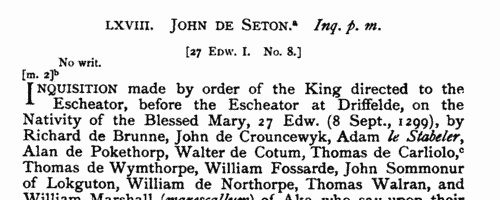
Inquisitions post mortem are inquiries as to the real estate and heir of each person holding in capite or in chief, i. e. directly, from the Crown, or whose estates had been escheated or were in ward. The age and relationship of the heir are usually recorded. Inquisitions ad quod damnum enquired as to any activities (including maladministration by local officials) that had resulted in any material loss to the Crown. Proofs of age are inquiries into the precise date of birth of an heir, usually involving local inhabitants recalling those circumstances which fixed that date in their mind. Yorkshire inquisitions for this period were edited by William Brown for the Yorkshire Archaeological Society, and printed in 1902. This index covers all names mentioned, including jurors, tenants, &c. The volume also includes two stray inquests, from 1245 and 1282.GOMER. Cost: £4.00. | Sample scan, click to enlarge
| Aliens in London (1571)
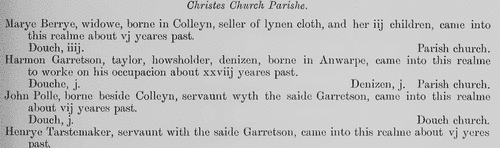
'The Reporte of the Searche of all the Straungers wythin London and Southwerk and the Liberties therof, made the xth daye of November, 1571'. The search found a total of 4,631 aliens living in the city, the great majority (3,643) being Dutch, 657 Frenchmen, 233 Italians &c. Arranged by parish and ward the report lists each householder by full name, where born, whether a denizen, (often) additional details, and how many aliens were in the household, and religion. This index includes also persons mentioned incidentally, such as employers. SP 12/82. Where there is a pair of scans for a single entry, the first gives the heading for the ward or parish.
GOMER. Cost: £6.00. | Sample scan, click to enlarge
| Liegemen and Traitors, Pirates and Spies
(1590)
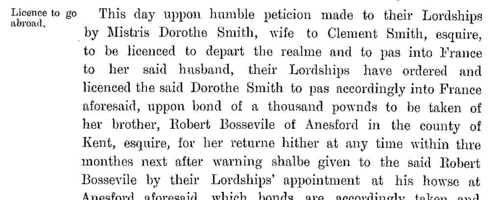
The Privy Council of queen Elizabeth was responsible for internal security in England and Wales, and dealt with all manner of special and urgent matters
GOMER. Cost: £4.00. | Sample scan, click to enlarge
| Inhabitants of Manchester, and travellers
(1633-1666)
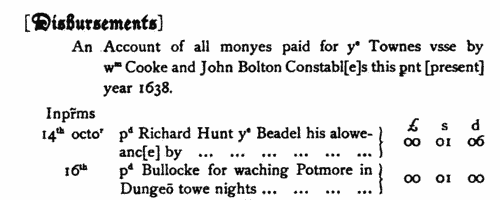
The constables' accounts of the manor of Manchester in Lancashire from 1633 to 1647 were edited by J. P. Earwaker and published in 1892. The accounts largely consist of details of disbursements by the constables, and as such include payments to paupers and soldiers with passes to help them on their journeys to and from other parts of the country. Earwaker added nine 'important appendices' to the work: 1. Disbursements and Receipts during the Plague of Manchester, 1605-6 and 1606 (from State Papers Domestic in the Public Record Office); 2. List of the Books of Assessment, Charity Money Accounts, &c., now in the Possession of the Corporation; 3. List of the Inhabitants of Manchester in 1648 (pages 181 to 201); 4. List of the Inhabitants of Manchester in 1651 (202-221); 5. Disbursements of the Constables in 1651-2; 6. List of the Inhabitants of Manchester assessed in 1659 (225-246); 7. A Second List of the Inhabitants of Manchester in 1659 (247-260); 8. List of the Inhabitants of Manchester assessed in 1666 (261-283); and 9. List of Uncommon, Obsolete, and Dialect Words to be found in the Preceding Pages.GOMER. Cost: £4.00. | Sample scan, click to enlarge
|  Masters of apprentices registered in Dorset
(1792) Masters of apprentices registered in Dorset
(1792)
Apprenticeship indentures and clerks' articles were subject to a 6d or 12d per pound stamp duty: the registers of the payments usually give the master's trade, address, and occupation, and the apprentice's name, as well as details of the date and length of the apprenticeship. There are central registers for collections of the stamp duty in London, as well as returns from collectors in the provinces. These collectors generally received duty just from their own county, but sometimes from further afield. The indentures themselves can date from a year or two earlier than this return. (The sample entry shown on this scan is taken from a Bristol return. Each entry has two scans, the other being the facing page with the details of the indenture, length of service, and payment of duty.) IR 1/66GOMER. Cost: £8.00. | Sample scan, click to enlarge

| Apprentices and clerks
(1795)
Apprenticeship indentures and clerks' articles were subject to a 6d or 12d per pound stamp duty: the registers of the payments usually give the master's trade, address, and occupation, and the apprentice's name, as well as details of the date and length of the apprenticeship. 2 January to 31 December 1795. IR 1/36GOMER. Cost: £8.00. | Sample scan, click to enlarge

| French prisoners on board H. M. S. Zealous
(1798)
His Majesty's ship the Zealous took part in the destruction of the French fleet in Aboukir Bay at the mouth of the Nile ('the Battle of the Nile') on the evening of the 1st and morning of the 2nd August 1798. The muster book for 1 August to 30 September 1798 includes the French prisoners taken on board after the battle and given two-thirds rations until they could be transferred to Alexandria.GOMER. Cost: £8.00. | Sample scan, click to enlarge
| Dissolutions of Partnerships
(1835)
Trade partnerships dissolved, or the removal of one partner from a partnership of several traders
GOMER. Cost: £6.00. | Sample scan, click to enlarge

| Pupil Teachers in Dorsetshire: Girls
(1851)
The Committee of Council on Education awarded annual grants for the training and support of pupil teachers and stipendiary monitors in schools in England, Wales, Scotland, the Isle of Man and the Channel Islands. Pupil teachers started training between the ages of 13 and 15, and 'must not be subject to any bodily infirmity likely to impair their usefulness as Pupil Teachers, such as scrofula, fits, asthma, deafness, great imperfections in the sight or voice, the loss of an eye from constitutional disease, or the loss of an arm or leg, or the permanent disability of either arm or leg, curvature of the spine, or a hereditary tendency to insanity'.
They also had to obtain certificates from the managers of the school (and their clergyman, in the case of Church of England schools) as to their moral character and that of their family; good conduct; punctuality, diligence, obedience, and attention to duty; and attentiveness to their religious duties.
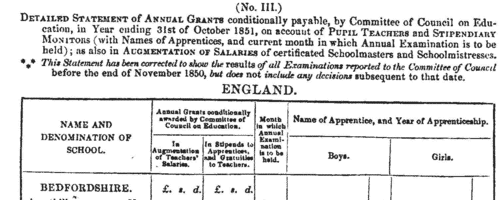
This detailed statement in the annual report of the committee for the year ending 31 October 1851 lists schools by county, giving:
1. Name and Denomination of School, with these abbreviations - B, British and Foreign School Society; F. C., Free Church of Scotland; H. C., Home and Colonial School Society; N., National Society, or connected with the Church of England; R. C., Roman Catholic Poor-School Committee; Wesn., Wesleyan Methodist.
2. Annual grants conditionally awarded by the committee in augmentation of teachers' salaries, and in stipends to apprentices, and gratuities to teachers.
3. Month in which annual examination was to be held.
4. Names of apprentices, giving surname and initials, and year of apprenticeship. Stipendiary monitors are indicated by (S. M.).GOMER. Cost: £6.00. | Sample scan, click to enlarge
|
Research your ancestry, family history, genealogy and one-name study by direct access to original records and archives indexed by surname.
|