Dixson Surname Ancestry ResultsOur indexes 1000-1999 include entries for the spelling 'dixson'. In the period you have requested, we have the following 112 records (displaying 1 to 10): Single Surname Subscription | | | Buying all 112 results of this search individually would cost £654.00. But you can have free access to all 112 records for a year, to view, to save and print, for £100. Save £554.00. More... |
These sample scans are from the original record. You will get scans of the full pages or articles where the surname you searched for has been found. Your web browser may prevent the sample windows from opening; in this case please change your browser settings to allow pop-up windows from this site. Close Rolls
(1441-1447)
The close rolls of the 20th to 25th years of the reign of king Henry VI record the main artery of government administration in England, the orders sent out day by day to individual officers, especially sheriffs of shires: they are an exceptionally rich source for so early a period. There is also some material relating to Wales, Scotland, Ireland and the English possessions in France. DIXSON. Cost: £4.00.  | Sample scan, click to enlarge
| Close Rolls
(1447-1454)
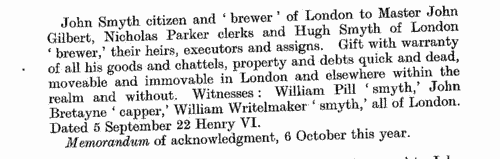
The close rolls of the 26th to 32nd years of the reign of king Henry VI record the main artery of government administration in England, the orders sent out day by day to individual officers, especially sheriffs of shires: they are an exceptionally rich source for so early a period. There is also some material relating to Wales, Scotland, Ireland and the English possessions in France. DIXSON. Cost: £4.00. | Sample scan, click to enlarge
| Lichfield Diocese Ordinations: Deacons Secular
(1505)
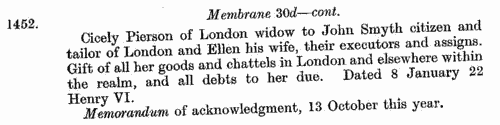
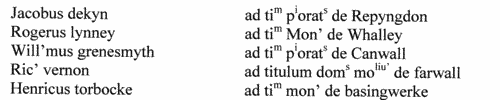
The diocese of Coventry and Lichfield at this period included the whole of Cheshire, Staffordshire and Derbyshire; all Lancashire south of the Ribble; northern Shropshire (including Shrewsbury); and northern Warwickshire (including Birmingham and Coventry). Ordinations took place on the four Ember Saturdays in the year, and on certain other occasions; lists of ordinands to the degrees of acolyte, subdeacon, deacon and priest were preserved in the ordination registers, a distinction being made between those clerks who were 'regular', i. e., monks, friars, &c., and those who were 'secular', the main body of the clergy. All ordinands were celibate, and those regular, and the secular who obtained benefices, remained so, but only a minority of the secular ordinands ever obtained benefices, and most will doubtless have married later in life. No man might be ordained to subdeacon or higher without proving either that he was of independent means or that he was sponsored by an institution or a gentleman. Most entries in the register of such ordinations therefore have the words 'ad titulum' followed by the name of the religious house that was the sponsor. This is an important indication of the man's origins - boys whose families were monastic tenants, and who were educated by the monks, would naturally be sponsored by the abbey. Only men who were born and bred in the diocese could be ordained by the bishop, unless producing letters dimissory from the bishop of the diocese of their birth. These are the ordinations celebrated on Ember Saturday, 20 September 1505 by bishop Geoffrey Blythe, in Repton priory church.DIXSON. Cost: £8.00. | Sample scan, click to enlarge
| Lichfield Diocese Ordinations: Subdeacons Secular
(1505)
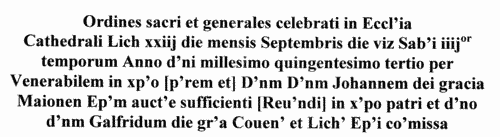
The diocese of Coventry and Lichfield at this period included the whole of Cheshire, Staffordshire and Derbyshire; all Lancashire south of the Ribble; northern Shropshire (including Shrewsbury); and northern Warwickshire (including Birmingham and Coventry). Ordinations took place on the four Ember Saturdays in the year, and on certain other occasions; lists of ordinands to the degrees of acolyte, subdeacon, deacon and priest were preserved in the ordination registers, a distinction being made between those clerks who were 'regular', i. e., monks, friars, &c., and those who were 'secular', the main body of the clergy. All ordinands were celibate, and those regular, and the secular who obtained benefices, remained so, but only a minority of the secular ordinands ever obtained benefices, and most will doubtless have married later in life. No man might be ordained to subdeacon or higher without proving either that he was of independent means or that he was sponsored by an institution or a gentleman. Most entries in the register of such ordinations therefore have the words 'ad titulum' followed by the name of the religious house that was the sponsor. This is an important indication of the man's origins - boys whose families were monastic tenants, and who were educated by the monks, would naturally be sponsored by the abbey. Only men who were born and bred in the diocese could be ordained by the bishop, unless producing letters dimissory from the bishop of the diocese of their birth. These are the ordinations celebrated on Ember Saturday, 17 May 1505 by Thomas bishop of Panados (Pavados), suffragan of bishop Geoffrey Blythe, in Lichfield cathedral.DIXSON. Cost: £8.00. | Sample scan, click to enlarge
| Lichfield Diocese Ordinations: Acolytes Secular
(1507)
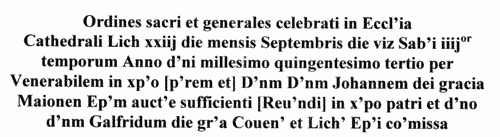
The diocese of Coventry and Lichfield at this period included the whole of Cheshire, Staffordshire and Derbyshire; all Lancashire south of the Ribble; northern Shropshire (including Shrewsbury); and northern Warwickshire (including Birmingham and Coventry). Ordinations took place on the four Ember Saturdays in the year, and on certain other occasions; lists of ordinands to the degrees of acolyte, subdeacon, deacon and priest were preserved in the ordination registers, a distinction being made between those clerks who were 'regular', i. e., monks, friars, &c., and those who were 'secular', the main body of the clergy. All ordinands were celibate, and those regular, and the secular who obtained benefices, remained so, but only a minority of the secular ordinands ever obtained benefices, and most will doubtless have married later in life. No man might be ordained to subdeacon or higher without proving either that he was of independent means or that he was sponsored by an institution or a gentleman. Most entries in the register of such ordinations therefore have the words 'ad titulum' followed by the name of the religious house that was the sponsor. This is an important indication of the man's origins - boys whose families were monastic tenants, and who were educated by the monks, would naturally be sponsored by the abbey. Only men who were born and bred in the diocese could be ordained by the bishop, unless producing letters dimissory from the bishop of the diocese of their birth. These are the ordinations celebrated on Ember Saturday, 18 September 1507, by Thomas bishop of Panados (Pavados), suffragan of bishop Geoffrey Blythe, in Lichfield cathedral.DIXSON. Cost: £8.00. | Sample scan, click to enlarge
| Lichfield Diocese Ordinations: Subdeacons Secular
(1509)
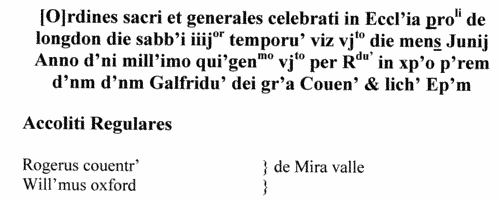
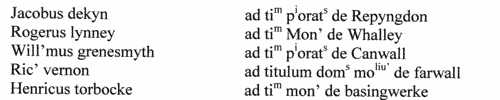
The diocese of Coventry and Lichfield at this period included the whole of Cheshire, Staffordshire and Derbyshire; all Lancashire south of the Ribble; northern Shropshire (including Shrewsbury); and northern Warwickshire (including Birmingham and Coventry). Ordinations took place on the four Ember Saturdays in the year, and on certain other occasions; lists of ordinands to the degrees of acolyte, subdeacon, deacon and priest were preserved in the ordination registers, a distinction being made between those clerks who were 'regular', i. e., monks, friars, &c., and those who were 'secular', the main body of the clergy. All ordinands were celibate, and those regular, and the secular who obtained benefices, remained so, but only a minority of the secular ordinands ever obtained benefices, and most will doubtless have married later in life. No man might be ordained to subdeacon or higher without proving either that he was of independent means or that he was sponsored by an institution or a gentleman. Most entries in the register of such ordinations therefore have the words 'ad titulum' followed by the name of the religious house that was the sponsor. This is an important indication of the man's origins - boys whose families were monastic tenants, and who were educated by the monks, would naturally be sponsored by the abbey. Only men who were born and bred in the diocese could be ordained by the bishop, unless producing letters dimissory from the bishop of the diocese of their birth. These are the ordinations celebrated on Ember Saturday, 22 December 1509, by Thomas bishop of Panados (Pavados), suffragan of bishop Geoffrey Blythe, in Lichfield cathedral.DIXSON. Cost: £8.00. | Sample scan, click to enlarge
| Patent Roll 1 Henry VIII
(1509-1510)
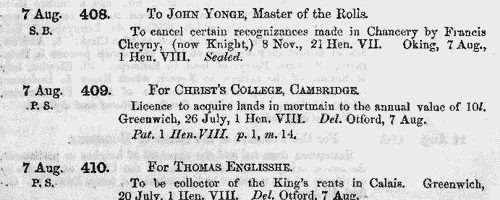
Royal grants of all kinds were enrolled on the Patent Rolls of England. Many of these grants originated as signed bills (S. B.) or privy seals (P. S.). J. S. Brewer calendared the rolls for the first year of the reign of king Henry VIII (22 April 1509-21 April 1510) for the Master of the Rolls, including all the surviving signed bills and privy seals (some of which had never led to enrolment), in this volume published in 1862. We have reindexed this: most of the names that occur are of those granted royal offices, or wardships or ecclesiastical preferments that were in the hands of the Crown, and often the names of those whom they superseded. DIXSON. Cost: £6.00. | Sample scan, click to enlarge
| Lichfield Diocese Ordinations: Deacons Secular
(1510)
The diocese of Coventry and Lichfield at this period included the whole of Cheshire, Staffordshire and Derbyshire; all Lancashire south of the Ribble; northern Shropshire (including Shrewsbury); and northern Warwickshire (including Birmingham and Coventry). Ordinations took place on the four Ember Saturdays in the year, and on certain other occasions; lists of ordinands to the degrees of acolyte, subdeacon, deacon and priest were preserved in the ordination registers, a distinction being made between those clerks who were 'regular', i. e., monks, friars, &c., and those who were 'secular', the main body of the clergy. All ordinands were celibate, and those regular, and the secular who obtained benefices, remained so, but only a minority of the secular ordinands ever obtained benefices, and most will doubtless have married later in life. No man might be ordained to subdeacon or higher without proving either that he was of independent means or that he was sponsored by an institution or a gentleman. Most entries in the register of such ordinations therefore have the words 'ad titulum' followed by the name of the religious house that was the sponsor. This is an important indication of the man's origins - boys whose families were monastic tenants, and who were educated by the monks, would naturally be sponsored by the abbey. Only men who were born and bred in the diocese could be ordained by the bishop, unless producing letters dimissory from the bishop of the diocese of their birth. These are the ordinations celebrated on Ember Saturday, 23 February 1510, by Thomas bishop of Panados (Pavados), suffragan of bishop Geoffrey Blythe, in Lichfield cathedral.DIXSON. Cost: £8.00. | Sample scan, click to enlarge
| Murderers sheltering in Durham Cathedral: and their victims
(1464-1524)
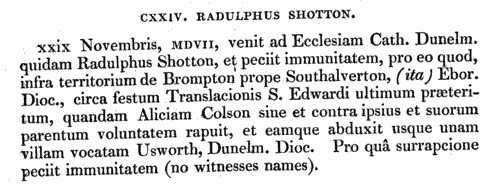
Criminals could evade pursuit by claiming sanctuary in Durham Cathedral. Persons who took refuge fled to the north door of the cathedral, and knocked for admission. There were two chambers over the door in which men slept, for the purpose of admitting fugitives at any hour of the night. As soon as anyone was so admitted, the Galilee bell was immediately tolled, to give notice that someone had taken sanctuary. The offender was required to declare before witnesses the nature of his offence, and to toll a bell in token of his demanding the privilege of sanctuary. He was then provided with a gown of black cloth with a yellow cross, called St Cuthbert's Cross, upon the left shoulder. A grate was provided near the south door to sleep upon, and for 37 days sufficient provisions and bedding were provided. But within 40 days he had to appear before the coroner, clothed in sackcloth, and be branded on his right hand with the sign of the letter A. This signified that he was swearing to abjure the realm: he was then free to leave the country unhindered. The petitions for immunity were entered in the diocesan registers, usually with the marginal note 'Peticio Immunitatis': those from 18 June 1464 to 10 September 1524 (the privilege was finally abolished in 1624) were edited and printed by the Surtees Society in 1837 under the title Sanctuarium Dunelmense. Some of the criminals came from a considerable distance: the great majority were murderers or homicides. Each entry usually gives full name, original address, (often) trade, a brief description of the crime, often with date, and usually the name of the victim, as well as the witnesses to the petition. This index covers all the surnames given.DIXSON. Cost: £4.00. | Sample scan, click to enlarge
| Inhabitants of Suffolk
(1524)
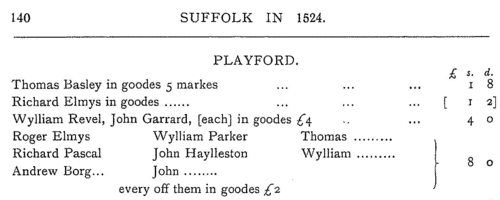
The lay subsidy granted by Act of Parliament in 1523 was a tax on the laymen (as opposed to clergy), levied on householders, landowners, those possessing moveable goods worth £1 or more, and all workmen aged 16 or over earning £1 or more per annum. Real estate was taxed at a shilling in the pound; moveable goods worth £1 to £2 at fourpence a pound; £2 to £20 at sixpence a pound; and over £20 at a shilling in the pound. Wages were taxed at fourpence in the pound. Aliens were charged double; aliens not chargeable in the above categories had to pay a poll tax of eightpence. The records of the assessment for the county of Suffolk, mostly made in 1524, survive in 64 rolls in the National Archives. From 42 of these a compilation for the whole shire was printed in 1910 as Suffolk Green Book x. This includes a list of defaulters of 1526 and a subsidy roll of 1534 for Bury St Edmunds.DIXSON. Cost: £4.00. | Sample scan, click to enlarge
|
Research your ancestry, family history, genealogy and one-name study by direct access to original records and archives indexed by surname.
|