Deverell Surname Ancestry ResultsOur indexes 1000-1999 include entries for the spelling 'deverell'. In the period you have requested, we have the following 258 records (displaying 1 to 10): Single Surname Subscription | | | Buying all 258 results of this search individually would cost £1,482.00. But you can have free access to all 258 records for a year, to view, to save and print, for £100. Save £1,382.00. More... |
These sample scans are from the original record. You will get scans of the full pages or articles where the surname you searched for has been found. Your web browser may prevent the sample windows from opening; in this case please change your browser settings to allow pop-up windows from this site. Fine Rolls
(1377-1383)
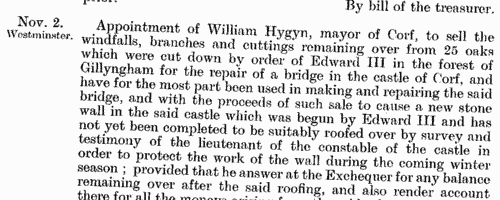
The fine rolls of the 1st to 6th years of the reign of king Richard II record part of the government administration in England, with orders sent out day by day to individual officers, and commitment of particular responsibilities and duties. There is also some material relating to Wales, Scotland, Ireland and the English possessions in France. DEVERELL. Cost: £4.00.  | Sample scan, click to enlarge
| Churchwardens and other parishioners in Buckinghamshire
(1552)
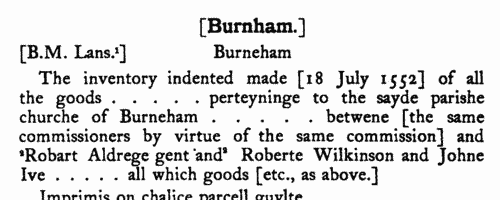
In accordance with a royal commission of 16 May 1552, inventories were taken of the valuables held by individual parishes throughout England. These records survived in the Public Record Office, and were transcribed by the Reverend J. E. Brown, vicar of Studham, edited for the Alcuin Club by F. C. Eeles, and published in 1908. Some additional material from Additional MS 34,741 and Lansdowne MS 1045, in the British Museum, was incorporated. The people whose names appear in these records are mostly the churchwardens and those respectable parishioners to whose custody some of the valuables had been entrusted.DEVERELL. Cost: £4.00. | Sample scan, click to enlarge
| Militia in Catsash hundred, Somerset
(1569)
A muster of the ablemen, gunners, light horsemen, pikemen, archers and billmen available from this hundred, compiled by sir Hugh Paulet, sir Maurice Barkeley, sir Ralph Hopton and John Horner in answer to a royal commission of the 11th year of queen Elizabeth. The returns are arranged by tithing. The hundred consisted of the parishes of Alford, Almsford (Ansford), Babcary, Barton St David, (the market town of) Castle Cary, Compton Pauncefoot, Keinton Mansfield, Kingweston, Lovington, Maperton, North Barrow, North Cadbury, Queen Camel, South Barrow, South Cadbury, Sparkford, Sutton Montis (Montague), West Lydford and Weston Bampfylde. (The sample shown is from the return for the borough of Axbridge)DEVERELL. Cost: £6.00. | Sample scan, click to enlarge
| Militia in Wells Forum hundred, Somerset
(1569)
A muster of the ablemen, gunners, light horsemen, pikemen, archers and billmen available from this hundred, compiled by sir Hugh Paulet, sir Maurice Barkeley, sir Ralph Hopton and John Horner in answer to a royal commission of the 11th year of queen Elizabeth. The returns are arranged by tithing. The hundred consisted of the parishes of Binegar, Dinder, Evercreech, Litton, Priddy, (the city of) Wells, Westbury, West Cranmore and Wookey. (The sample shown is from the return for the borough of Axbridge)DEVERELL. Cost: £6.00. | Sample scan, click to enlarge
| London Marriage Allegations
(1521-1610)
London, Essex and part of Hertfordshire lay within the diocese of London. In the later 17th century the individual archdeaconry courts issued marriage licences, but for this period the only surviving material is from the overarching London Consistory court. The main series of marriage allegations from the consistory court starts 7 December 1597, and these were extracted by Colonel Joseph Lemuel Chester; Colonel Chester then discovered earlier material, back to 5 January 1521, in Vicar-General's Books of the Principal Probate Registry. The notices in these books were much briefer, but as well as extending back so much earlier, they included additional material for 1597 onwards. All this he collated with the consistory court extracts, and the text was edited by George J. Armytage and published by the Harleian Society in 1887. A typical later entry will give date; name, address and occupation of groom; name, address and condition of his intended bride, and/or, where she is a spinster, her father's name, address and occupation. Lastly we have the name of the church where the wedding was going to take place; or the words Gen. Lic. signifying a general or open licence.DEVERELL. Cost: £4.00. | Sample scan, click to enlarge

| Official Papers
(1627-1628)
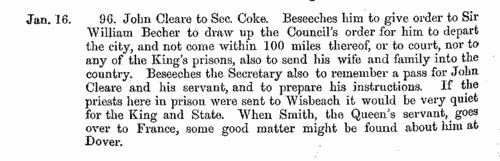
The State Papers Domestic cover all manner of business relating to Britain, Ireland and the colonies, conducted in the office of the Secretary of State as well as other miscellaneous records.
DEVERELL. Cost: £4.00. | Sample scan, click to enlarge
| Wills proved at York: Names of Testators
(1627-1637)
The diocese of York comprised most of Yorkshire, and Nottinghamshire: the York Exchequer court was the ordinary probate jurisdiction for the Yorkshire part of the diocese, but some wills from Nottinghamshire and other parts of the province of York were also proved there. Dr Francis Collins compiled this index to the transcribed wills of the Prerogative and Exchequer Courts in the York registry proved from 1627 to 1637. The date on the left is that of probate; the testator's full name is then given (surname first), parish or place of abode, and sometimes occupation, and date that the will was executed; and volume and folio number where it the transcript commences. The Act Books were used by Dr Collins to supply deficiencies in the information from the transcripts.DEVERELL. Cost: £2.00. | Sample scan, click to enlarge

| Wiltshire freeholders
(1625-1645)
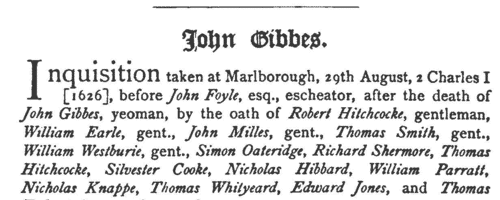
Inquisitions post mortem were held after the death of freeholders who held their estates in capite or in chief, i. e., directly from the crown. The inquisition, held by the royal escheator upon the oath of jurors from the county who were also normally freeholders, recorded what estates the deceased had held, by what tenure, what they were worth, the date of death, who was the next heir, and whether the heir was of age. The sample scan shows an unusually brief inquisition: these abstracts usually run to two or three pages of print. DEVERELL. Cost: £4.00. | Sample scan, click to enlarge
| PCC Probates and Administrations
(1647)
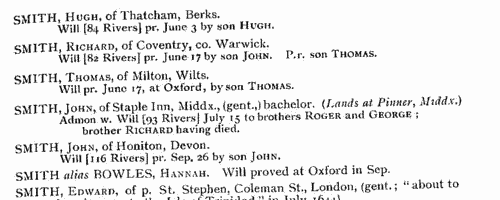
The Prerogative Court of Canterbury's main jurisdiction was central and southern England and Wales, as well as over sailors &c dying abroad: these brief abstracts, compiled under the title "Year Books of Probates", and printed in 1906, usually give address, date of probate and name of executor or administrator. They are based on the Probate Act Books, cross-checked with the original wills, from which additional details are, occasionally, added. The original spelling of surnames was retained, but christian and place names have been modernised where necessary.DEVERELL. Cost: £2.00. | Sample scan, click to enlarge
| Besiegers of Colchester
(1648)
The siege of Colchester was one of the most severe of the Civil War, and lasted from 14 June to 28 August 1648. Kent and Essex Royalists on their way into Norfolk and Suffolk turned aside into Colchester, hoping to get recruits there. Fairfax pursued from his headquarters in London, and when on 12 June he appeared with 5,000 men they were obliged to make hasty preparations for defence. The town was ill-fitted to stand a siege, and the 4,000 Royalist troops were most of them newly levied and ill-armed, but after a repulse on 14 June 14, Fairfax realized that a long siege was inevitable, and busied himself with raising forts to completely isolate the town. On 2 July the work of circumvallation was finished, and though meeting with fierce resistance, Fairfax gained post after post. Early in August famine added to the misery of the besieged, and the citizens began to clamour for surrender. On 19 August, Norwich, the Royalist leader, asked for terms; negotiations went on for some days, and finally on 28 August, Fairfax occupied the town. Three of the Royalist leaders were shot, and the soldiers were sent to labour in the West Indies, or to enforced military service under the Venetian Republic. The townsmen were made to pay a heavy fine.
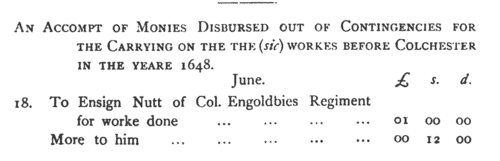
These accounts list disbursements to workmen digging the fortifications and to artificers, soldiers and officers involved in the siege. The total sum paid was about £1,695.
DEVERELL. Cost: £4.00. | Sample scan, click to enlarge
|
Research your ancestry, family history, genealogy and one-name study by direct access to original records and archives indexed by surname.
|