Deakins Surname Ancestry ResultsOur indexes 1000-1999 include entries for the spelling 'deakins'. In the period you have requested, we have the following 86 records (displaying 1 to 10): Single Surname Subscription | | | Buying all 86 results of this search individually would cost £462.00. But you can have free access to all 86 records for a year, to view, to save and print, for £100. Save £362.00. More... |
These sample scans are from the original record. You will get scans of the full pages or articles where the surname you searched for has been found. Your web browser may prevent the sample windows from opening; in this case please change your browser settings to allow pop-up windows from this site. Official Papers
(1648)
The State Papers Domestic cover all manner of business relating to Britain, Ireland and the colonies, conducted in the Committee of Both Houses held at Derby House, as well as other miscellaneous records. These records are from January 1648 to January 1649.
DEAKINS. Cost: £4.00.  | Sample scan, click to enlarge

| PCC Probates and Administrations
(1648)
The Prerogative Court of Canterbury's main jurisdiction was central and southern England and Wales, as well as over sailors &c dying abroad: these brief abstracts, compiled under the title "Year Books of Probates", and printed in 1906, usually give address, date of probate and name of executor or administrator. They are based on the Probate Act Books, cross-checked with the original wills, from which additional details are, occasionally, added. The original spelling of surnames was retained, but christian and place names have been modernised where necessary.DEAKINS. Cost: £2.00. | Sample scan, click to enlarge
| Leicester Hearth Tax
(1664)
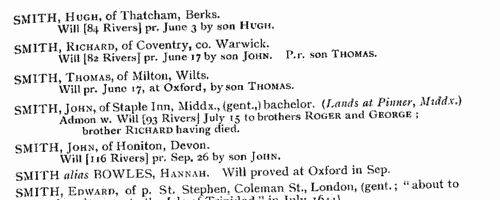
The Michaelmas 1664 hearth tax returns for the city of Leicester, transcribed by Henry Hartopp mainly from the original collectors' books in the Public Record Office (Exchequer Lay Subsidy county Leicester 251/4). The names are listed by ward, with the number of hearths. The latter part of the list for each ward consists of the names of those not chargeable by reason of poverty. Hartopp annotated the heading for each ward with a list of the streets comprised.DEAKINS. Cost: £6.00. | Sample scan, click to enlarge
| Middlesex Recusants
(1625-1666)
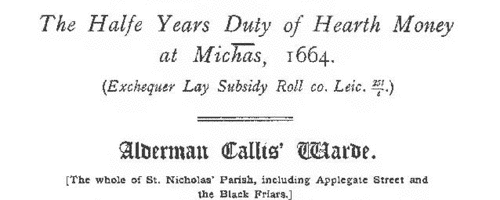
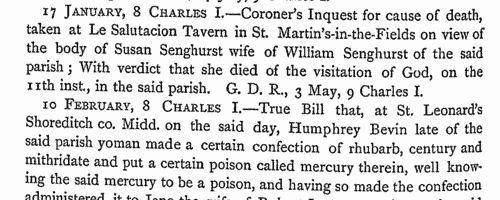
Incidents from the Middlesex Sessions Books. These are abstracts of sessional orders, minutes of criminal cases, memoranda and other entries of record taken from the volumes of Gaol Delivery Register, Books and Rolls, Sessions of Peace Register, and Process Books of Indictments for the county of Middlesex from the death of king James I to the Great Fire of London. The references at the end of each item indicate the volume in question, the abbreviations being G. D. for Gaol Delivery, S. P. for Sessions of Peace, and S. O. T. for Session of Oyer and Terminer; occasionally preceded by S. for Special or G. for general, or followed by R. for Roll or Reg. for Register. It should be noted that, in the case of 'true bills' or indictments, the abstract starts with the date on which the offence took place, the date of the conviction &c. being at the end of the entry. There are many records of recusants, that is Protestants and Roman Catholics who failed to attend Church of England services. These abstracts, prepared by John Cordy Jeaffreson for the Middlesex County Record Society, are far from being a complete calendar of these extensive records; his purpose was, in part, to notice 'every parchment that should exhibit a famous person's name or any other feature of personal interest'. Being unable to print in full the longer lists of the conventiclers and recusants recorded, he ignores 'those persons who appear from their descriptions to have been of humble degree'.DEAKINS. Cost: £4.00. | Sample scan, click to enlarge
| Middlesex Sessions
(1625-1666)
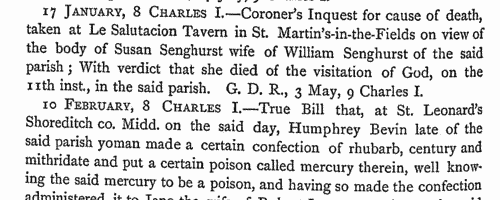
Incidents from the Middlesex Sessions Books. These are abstracts of sessional orders, minutes of criminal cases, memoranda and other entries of record taken from the volumes of Gaol Delivery Register, Books and Rolls, Sessions of Peace Register, and Process Books of Indictments for the county of Middlesex from the death of king James I to the Great Fire of London. The references at the end of each item indicate the volume in question, the abbreviations being G. D. for Gaol Delivery, S. P. for Sessions of Peace, and S. O. T. for Session of Oyer and Terminer; occasionally preceded by S. for Special or G. for general, or followed by R. for Roll or Reg. for Register. It should be noted that, in the case of 'true bills' or indictments, the abstract starts with the date on which the offence took place, the date of the conviction &c. being at the end of the entry. These abstracts, prepared by John Cordy Jeaffreson for the Middlesex County Record Society, are far from being a complete calendar of these extensive records; his purpose was, in part, to notice 'every parchment that should exhibit a famous person's name or any other feature of personal interest'.DEAKINS. Cost: £4.00. | Sample scan, click to enlarge
| Inhabitants of Manchester, and travellers
(1633-1666)
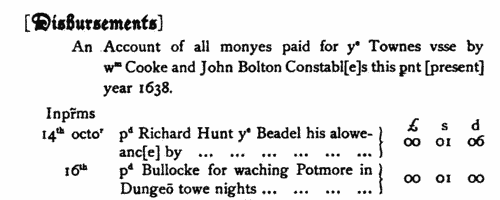
The constables' accounts of the manor of Manchester in Lancashire from 1633 to 1647 were edited by J. P. Earwaker and published in 1892. The accounts largely consist of details of disbursements by the constables, and as such include payments to paupers and soldiers with passes to help them on their journeys to and from other parts of the country. Earwaker added nine 'important appendices' to the work: 1. Disbursements and Receipts during the Plague of Manchester, 1605-6 and 1606 (from State Papers Domestic in the Public Record Office); 2. List of the Books of Assessment, Charity Money Accounts, &c., now in the Possession of the Corporation; 3. List of the Inhabitants of Manchester in 1648 (pages 181 to 201); 4. List of the Inhabitants of Manchester in 1651 (202-221); 5. Disbursements of the Constables in 1651-2; 6. List of the Inhabitants of Manchester assessed in 1659 (225-246); 7. A Second List of the Inhabitants of Manchester in 1659 (247-260); 8. List of the Inhabitants of Manchester assessed in 1666 (261-283); and 9. List of Uncommon, Obsolete, and Dialect Words to be found in the Preceding Pages.DEAKINS. Cost: £4.00. | Sample scan, click to enlarge
| Wandsworth Brides
(1666)
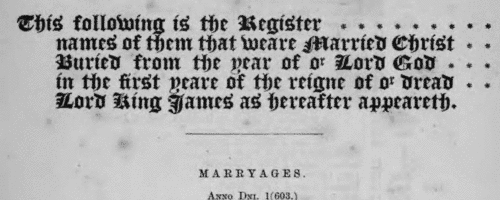
The ancient parish of Wandsworth in Surrey comprised the single township of Wandsworth, including the hamlets of Garratt, Half Farthing and Summers Town. It lay in the archdeaconry of Surrey of the diocese of Winchester: unfortunately, few bishop's transcripts of Surrey parish registers survive earlier than 1800. Although the original parish registers of Wandsworth doubtless commenced in 1538, the volume(s) before 1603 had been lost by the 19th century. In 1889 a careful transcript by John Traviss Squire of the first three surviving registers was printed, and we have now indexed it year by year. The marriage registers rarely give more information than the date of the wedding, and the names of bride and groom. From 1662 onwards it was normally indicated whether a marriage was by banns or by licence. Surrey archdeaconry marriage bonds &c. survive from 1674 onwards.DEAKINS. Cost: £2.00. | Sample scan, click to enlarge
| Allegations for marriages in southern England
(1660-1669)
The province or archbishopric of Canterbury covered all England and Wales except for the northern counties in the four dioceses of the archbishopric of York (York, Durham, Chester and Carlisle). Marriage licences were generally issued by the local dioceses, but above them was the jurisdiction of the archbishop, exercised through his vicar-general. Where the prospective bride and groom were from different dioceses it would be expected that they obtain a licence from the archbishop; in practice, the archbishop residing at Lambeth, and the actual offices of the province being in London, which was itself split into myriad ecclesiastical jurisdictions, and spilled into adjoining dioceses, this facility was particularly resorted to by couples from London and the home counties, although there are quite a few entries referring to parties from further afield. The abstracts of the allegations given here usually state name, address (street in London, or parish), age, and condition of bride and groom; and sometimes the name, address and occupation of the friend or relative filing the allegation. Where parental consent was necessary, a mother's or father's name may be given. The ages shown should be treated with caution; ages above 21 tended to be reduced, doubtless for cosmetic reasons; ages under 21 tended to be increased, particularly to avoid requiring parental consent; a simple statement 'aged 21' may merely mean 'of full age' and indicate any age from 21 upwards. These are merely allegations to obtain licences; although nearly all will have resulted in the issuing of the licence, many licences did not then result in marriage. DEAKINS. Cost: £4.00. | Sample scan, click to enlarge

| Allegations for marriages in southern England
(1660-1679)
The province or archbishopric of Canterbury covered all England and Wales except for the northern counties in the four dioceses of the archbishopric of York (York, Durham, Chester and Carlisle). Marriage licences were generally issued by the local dioceses, but above them was the jurisdiction of the archbishop, exercised through his vicar-general. Where the prospective bride and groom were from different dioceses it would be expected that they obtain a licence from the archbishop; in practice, the archbishop residing at Lambeth, and the actual offices of the province being in London, which was itself split into myriad ecclesiastical jurisdictions, and spilled into adjoining dioceses, this facility was particularly resorted to by couples from London and the home counties, although there are quite a few entries referring to parties from further afield. The abstracts of the allegations given here usually state name, address (street in London, or parish), age, and condition of bride and groom; and sometimes the name, address and occupation of the friend or relative filing the allegation. Where parental consent was necessary, a mother's or father's name may be given. The ages shown should be treated with caution; ages above 21 tended to be reduced, doubtless for cosmetic reasons; ages under 21 tended to be increased, particularly to avoid requiring parental consent; a simple statement 'aged 21' may merely mean 'of full age' and indicate any age from 21 upwards. These are merely allegations to obtain licences; although nearly all will have resulted in the issuing of the licence, many licences did not then result in marriage. This index also includes marriage licence allegations for the jurisdiction of the Dean and Chapter of Westminster, 1558 to 1699.DEAKINS. Cost: £4.00. | Sample scan, click to enlarge

| Allegations for marriages in southern England
(1679-1687)
The province or archbishopric of Canterbury covered all England and Wales except for the northern counties in the four dioceses of the archbishopric of York (York, Durham, Chester and Carlisle). Marriage licences were generally issued by the local dioceses, but above them was the jurisdiction of the archbishop, exercised through his vicar-general. Where the prospective bride and groom were from different dioceses it would be expected that they obtain a licence from the archbishop; in practice, the archbishop residing at Lambeth, and the actual offices of the province being in London, which was itself split into myriad ecclesiastical jurisdictions, and spilled into adjoining dioceses, this facility was particularly resorted to by couples from London and the home counties, although there are quite a few entries referring to parties from further afield. The abstracts of the allegations given here usually state name, address (street in London, or parish), age, and condition of bride and groom; and sometimes the name, address and occupation of the friend or relative filing the occupation. Where parental consent was necessary, a mother's or father's name may be given. The ages shown should be treated with caution; ages above 21 tended to be reduced, doubtless for cosmetic reasons; ages under 21 tended to be increased, particularly to avoid requiring parental consent; a simple statement 'aged 21' may merely mean 'of full age' and indicate any age from 21 upwards. These are merely allegations to obtain licences; although nearly all will have resulted in the issuing of the licence, many licences did not then result in marriage. DEAKINS. Cost: £4.00. | Sample scan, click to enlarge

|
Research your ancestry, family history, genealogy and one-name study by direct access to original records and archives indexed by surname.
|