Crabb Surname Ancestry ResultsOur indexes 1000-1999 include entries for the spelling 'crabb'. In the period you have requested, we have the following 487 records (displaying 1 to 10): Single Surname Subscription | | | Buying all 487 results of this search individually would cost £2,852.00. But you can have free access to all 487 records for a year, to view, to save and print, for £100. Save £2,752.00. More... |
These sample scans are from the original record. You will get scans of the full pages or articles where the surname you searched for has been found. Your web browser may prevent the sample windows from opening; in this case please change your browser settings to allow pop-up windows from this site. Aliens in London (1571)
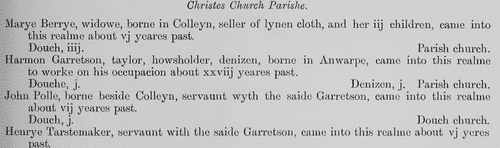
'The Reporte of the Searche of all the Straungers wythin London and Southwerk and the Liberties therof, made the xth daye of November, 1571'. The search found a total of 4,631 aliens living in the city, the great majority (3,643) being Dutch, 657 Frenchmen, 233 Italians &c. Arranged by parish and ward the report lists each householder by full name, where born, whether a denizen, (often) additional details, and how many aliens were in the household, and religion. This index includes also persons mentioned incidentally, such as employers. SP 12/82. Where there is a pair of scans for a single entry, the first gives the heading for the ward or parish.
CRABB. Cost: £6.00.  | Sample scan, click to enlarge
| Citizens of Oxford
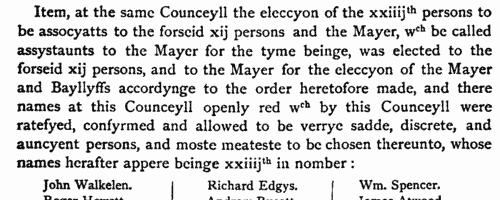
(1509-1583)
These selections from the Oxford city records were printed in 1880 under the direction of the Town Clerk. Much of the material comes from the council minutes: 24 common councillors were elected out of the citizens at large each 30 September. Apart from the general administration of the city, a large number of cases involve people brought before the Council for using improper language, or other misbehaviour. There is an almost unbroken series of hanasters, or admissions to freedom of the city, listing the names of those who by purchase, birth or apprenticeship were admitted to the guild merchant.CRABB. Cost: £4.00. | Sample scan, click to enlarge
| Cecil Manuscripts
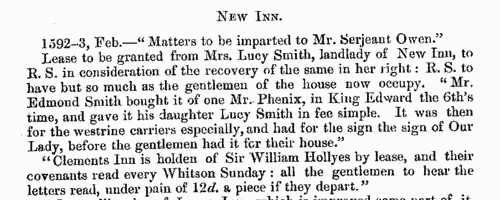
(1590-1594)
Letters and papers of William Cecil lord Burghley, Lord Treasurer of England.CRABB. Cost: £4.00. | Sample scan, click to enlarge
| Middlesex Sessions
(1549-1603)
This printed calendar collates a number of surviving records from Middlesex sessions for the period. Principally these are the Gaol Delivery Rolls (G. D. R.) and the General Sessions of the Peace Rolls (G. S. O. P. R.). Both series cover general criminal indictments (bills) together with the recognizances of the witnesses to attend; but the Gaol Delivery Rolls, by their very nature, tend to deal with the more serious cases - felonies where the accused could not be released on bail. The General Sessions rolls also include the sheriff's lists of bailiffs, sub-bailiffs, high and petty constables in the shire; writs of venire facias for production of jurors, writs of capias, lists of jurors, jury-panels &c. The Gaol Delivery Rolls also include coroners' inquests, writs of supersedeas, and memoranda of proclamations. Special inquiries are recorded in separate Sessions of Oyer and Terminer (S. O. T.) rolls and Inquest or Inquisition rolls (I. R.) Although coverage is good, none of the sequences of rolls for this period is complete. A peculiarity of this calendar is that in the case of actual incidents, the date given at the start of each entry is the date that the incident was alleged to have taken place (for instance, 1 June 11 Elizabeth (1569) in the sample scan) rather than the date of the court proceedings. CRABB. Cost: £4.00. | Sample scan, click to enlarge
| St Albans Archdeaconry Marriage Licences: Bridegrooms
(1609)
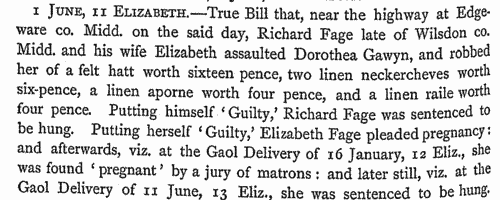
Southern Hertfordshire lay in the archdeaconry of St Albans. Marriage licences registered in the archdeaconry act books from 1584 to 1639, and surviving bonds and allegations from 1611 to 1620, 1625 to 1627, 1633 to 1637 and 1661 to 1668 were abstracted by A. E. Gibbs and printed in volume 1 of the Herts Genealogist and Antiquary published in 1895. Both the act books and the bonds normally give full name and parish of bride and groom, and state whether the bride was maiden or widow. A widow's previous married surname is given, not her maiden surname. Occasionally (doubtless when a party was under age) a father's name is given. The later act books sometimes stated at what church the wedding was intended to be celebrated. The marriage bonds give the name of the bondsman or surety. The surety's surname is often the same as the bride or groom, and doubtless in most cases the bondsman was a father or close relative; but a few innkeepers and other tradesmen of St Albans also undertook this duty.CRABB. Cost: £4.00. | Sample scan, click to enlarge
| Worcestershire Quarter Sessions
(1609)
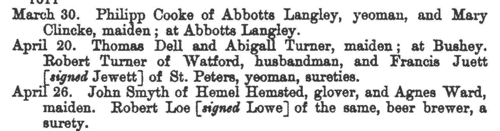
J W Willis Bund compiled this abstract of surviving records from the Worcestershire quarter session rolls for the Records and Charities Committee of the Worcestershire County Council. This text, extending as far as 1621, was published in 1899: the entries are arranged by year under the headings Recognizances, Indictments, and Miscellaneous. CRABB. Cost: £4.00. | Sample scan, click to enlarge
| London Marriage Allegations
(1521-1610)
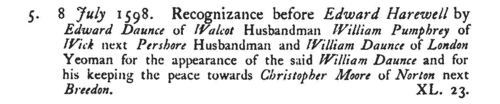
London, Essex and part of Hertfordshire lay within the diocese of London. In the later 17th century the individual archdeaconry courts issued marriage licences, but for this period the only surviving material is from the overarching London Consistory court. The main series of marriage allegations from the consistory court starts 7 December 1597, and these were extracted by Colonel Joseph Lemuel Chester; Colonel Chester then discovered earlier material, back to 5 January 1521, in Vicar-General's Books of the Principal Probate Registry. The notices in these books were much briefer, but as well as extending back so much earlier, they included additional material for 1597 onwards. All this he collated with the consistory court extracts, and the text was edited by George J. Armytage and published by the Harleian Society in 1887. A typical later entry will give date; name, address and occupation of groom; name, address and condition of his intended bride, and/or, where she is a spinster, her father's name, address and occupation. Lastly we have the name of the church where the wedding was going to take place; or the words Gen. Lic. signifying a general or open licence.CRABB. Cost: £4.00. | Sample scan, click to enlarge

| Inhabitants of Cambridge
(1504-1635)
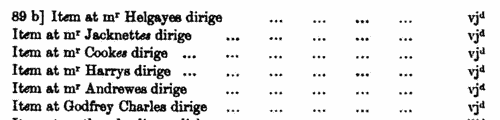
Cambridge comprised fourteen ancient parishes, plus the university (which was extra-parochial), in the diocese of Ely. The church of St Mary the Great (as opposed to St Mary the Less) in the Market Place (juxta forum) has churchwardens' accounts surviving from 1504 onwards. Those from 1504 to 1635 were transcribed by J. E. Foster for the Cambridge Antiquarian Society and published in 1905. The two churchwardens were chosen annually: the previous year's churchwardens each chose another parishioner: those two then each chose three other parishioners: the resulting eight then chose the new year's churchwardens, the wardens of the Light of the Rood, and the wardens of the Mass of Jesus. Auditors were also chosen, usually out of the eight, to examine all the wardens' accounts at the end of the year. The churchwardens' accounts are largely concerned with the costs of repair of the church and its furnishings, and include the names of tradesmen and workmen. Each Easter a rate called Easter money was raised was raised from all householders in the parish, and additional rates are occasionally levied for unusual expenses, such as steeple reconstruction. These 'Easter book' lists give a complete list of householders for the parish, excepting the poor. The church's income also included the rents from some houses in the parish, and the names of the tenants appear. The offices of the Light of the Rood and the Mass of Jesus were abolished during the Reformation. The accounts of the Light of the Rood, i. e., for candles burnt before the crucifix, often include a list of sums received for funerary diriges (dirges) for the year, from which the year of death of the more prosperous parishioners can be traced in this early period. CRABB. Cost: £4.00. | Sample scan, click to enlarge
| Besiegers of Colchester
(1648)
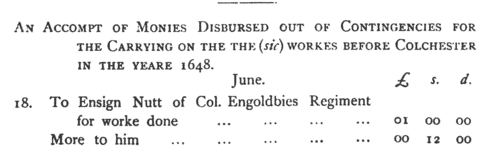
The siege of Colchester was one of the most severe of the Civil War, and lasted from 14 June to 28 August 1648. Kent and Essex Royalists on their way into Norfolk and Suffolk turned aside into Colchester, hoping to get recruits there. Fairfax pursued from his headquarters in London, and when on 12 June he appeared with 5,000 men they were obliged to make hasty preparations for defence. The town was ill-fitted to stand a siege, and the 4,000 Royalist troops were most of them newly levied and ill-armed, but after a repulse on 14 June 14, Fairfax realized that a long siege was inevitable, and busied himself with raising forts to completely isolate the town. On 2 July the work of circumvallation was finished, and though meeting with fierce resistance, Fairfax gained post after post. Early in August famine added to the misery of the besieged, and the citizens began to clamour for surrender. On 19 August, Norwich, the Royalist leader, asked for terms; negotiations went on for some days, and finally on 28 August, Fairfax occupied the town. Three of the Royalist leaders were shot, and the soldiers were sent to labour in the West Indies, or to enforced military service under the Venetian Republic. The townsmen were made to pay a heavy fine.
These accounts list disbursements to workmen digging the fortifications and to artificers, soldiers and officers involved in the siege. The total sum paid was about £1,695.
CRABB. Cost: £4.00. | Sample scan, click to enlarge
| Purchasers of Bishops' Lands: Somerset
(1647-1651)
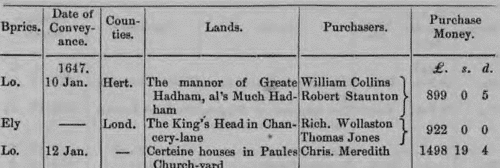
16 November 1646 Parliament ordained the sale of all the lands and estates of the bishops and archbishops for the service of the Commonwealth. This account, printed in 1834, is a transcript from a manuscript presented to the British Museum by William Bray (Add. 9049). It gives in tabular form the details of the conveyances of the lands to private individuals, showing the name of the bishopric; the date of the conveyance; county; description of the lands; purchaser; and purchase money. A total of over £624,158 was raised: after the restoration of the monarchy these estates were returned to the Church, with compensation.CRABB. Cost: £6.00. | Sample scan, click to enlarge
|
Research your ancestry, family history, genealogy and one-name study by direct access to original records and archives indexed by surname.
|