Clague Surname Ancestry ResultsOur indexes 1000-1999 include entries for the spelling 'clague'. In the period you have requested, we have the following 67 records (displaying 1 to 10): Single Surname Subscription | | | Buying all 67 results of this search individually would cost £322.00. But you can have free access to all 67 records for a year, to view, to save and print, for £100. Save £222.00. More... |
These sample scans are from the original record. You will get scans of the full pages or articles where the surname you searched for has been found. Your web browser may prevent the sample windows from opening; in this case please change your browser settings to allow pop-up windows from this site.  Apprentices registered at Liverpool in Lancashire
(1741-1745) Apprentices registered at Liverpool in Lancashire
(1741-1745)
Apprenticeship indentures and clerks' articles were subject to a 6d or 12d per pound stamp duty: the registers of the payments usually give the master's trade, address, and occupation, and the apprentice's father's name and address, as well as details of the date and length of the apprenticeship. There are central registers for collections of the stamp duty in London, as well as returns from collectors in the provinces. These collectors generally received duty just from their own county, but sometimes from further afield. (The sample entry shown on this scan is taken from a Norfolk return)CLAGUE. Cost: £8.00.  | Sample scan, click to enlarge

| Masters of Merchantmen
(1804)
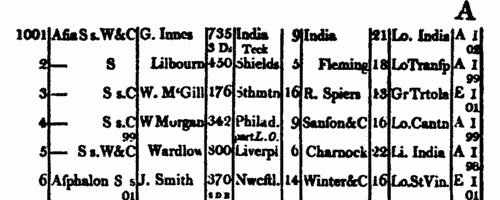
The Society for the Registry of Shipping was instituted in 1760, and published an annual register and supplement. The annual register consisted of an alphabetical list of ships surveyed for insurance in Britain and Ireland, together with an alphabetical supplement. The society maintained a Registry Office at which alterations and additions were notified, and members delivering their registers when called for had them updated and returned on the following or the ensuing day. Each ship was given a number within each letter of the alphabet: ships' names were not unique, so within each name a ship was identified by the name of the captain or master at the time of the last survey. Then abbreviations indicate the type of vessel (Bg, brig; Cr, cutter; Dr, dogger; G, galliott; H, hoy; K, ketch; S, ship; Sk, smack; Sp, sloop; Sr, schooner; St, schoot; Sw, snow), and whether sheathed (s) and/or doubled (d) with copper (C) and iron bolts (I B) or over boards (W & C), or copper fastened (c f) or copper bolted (c b), sometimes with a date, such as (17)88. The third column, reserved for masters' names, is not particularly wide; with short surnames, an initial will be given; but longer surnames omit the initials, and even longer surnames are abbreviated. It will be borne in mind that these are the names of the masters not (necessarily) in 1804, but at the time of the last survey. Often new masters had been appointed by the time of re-survey, and their names are added in slightly smaller type under the original master's names in the third column. In the fourth column is the tonnage: where there is a blank under the number this indicates that the ship had two decks; more often the letters S D (B) for single deck (with beams); D W for deep waist; S D W single deck with deep waist; B D W single deck with beams and deep waist. Underneath the entry may run references to recent repairs: Cl. clincher built; Drp. damages repaired; grp. good repairs; len. lengthened; lrp. large repairs; N. (new) B. bottom, D. deck, Kl. keel, Sds. sides or UW. upper-works; rb. rebuilt; rsd. raised; S. rprs. some repairs; or trp. thorough Repair. In italics, the timber of the ship is described - B. B., black birch; C., cedar; H., hazel; J., juniper; L. O., live oak; M., mahogany; P., pine; P. P., pitch pine; S., spruce; W. H., witch hazel. Where the vessel was armed, the number of guns is given, and occasionally a remark such as 'captured' will appear. The fifth column gives the place that the ship was built. For foreign ships this may be as vague as 'Dutch' or 'French'; but nothing in this record specifically indicates the nationality of ship, master or owners, except that an A. under the owner's name indicates that the vessel was United States property. The sixth column gives the year of the ship's age; some were still sailing after 30 or 40 years. The seventh column gives the owner's name, abbreviated in the same way as the master's name. Where the master was the owner, the word Capt. will appear. With vessels owned abroad, the name in this column is sometimes that of the port of origin, not the surname of the owner. Where there has been a change of owner by the time of re-survey, the new name is put underneath in smaller type. The printer sought to avoid confusion by aligning names of ports to the left and surnames to the right, but that leaves longer names doubtful. The eighth column gives the feet of the draught of water when loaded. The ninth column shows the destined voyage for which the survey took place, with the port of survey abbreviated (Be., Belfast; Br., Bristol; Co., Cork; Cs, Cowes; Da., Dartmouth; Du., Dublin; Eh, Exmouth; Ex., Exeter; Fa., Falmouth; Gr., Greenock; Hl, Hull; La., Lancaster; Lh, Leith; Li., Liverpool; Lo., London; Ly., Lynn; Po., Poole; Ph, Portsmouth; Sc., Star-Cross; Tn., Teignmouth; Tp., Topsham; Wa., Waterford; Wn, Whitehaven; Ya., Yarmouth), and the letter C where the vessel was a constant trader between the two ports. The tenth column gives the classification of the vessel (A, first; E, second; I., third - O and U for fourth and fifth are never used) and its stores (1, first; 2, second; 3, third) and the year of survey, e. g. 00 for 1800, or, if surveyed during 1803, the month, e. g. 3 for March. Where the vessel has been re-surveyed, the classification letter and number will be repeated or revised in the final column. The sample scan is from the main list. This is the index to masters in the main list.CLAGUE. Cost: £6.00. | Sample scan, click to enlarge
| Deaths, Marriages, News and Promotions
(1816)
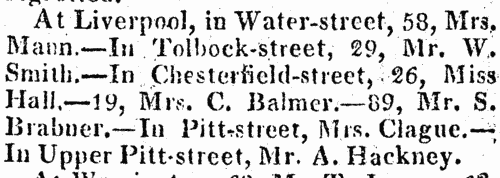
Death notices and obituaries, marriage and birth notices, civil and military promotions, clerical preferments and domestic occurrences, as reported in the Gentleman's Magazine. Mostly from England and Wales, but items from Ireland, Scotland and abroad.
CLAGUE. Cost: £4.00. | Sample scan, click to enlarge

| Deaths, Marriages, Bankrupts, Dividends and Patents
(1820)
Death notices and obituaries, marriage and birth notices, bankrupts and dividends, and patents, as reported in the Monthly Magazine or British Register. Includes some marriages and deaths from Ireland, Scotland and abroad.
CLAGUE. Cost: £6.00. | Sample scan, click to enlarge
| Liverpool Voters: Burgesses and Freemen
(1832)
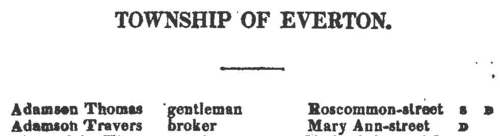
A poll for the election of Members of Parliament for the Borough of Liverpool, between William Ewart esquire (E), Lord Viscount Sandon (S), Thomas Thornely esquire (T) and Major-General Sir Howard Douglas, baronet (D), took place on 12 and 13 December 1832. The poll book lists all voters with full name (surname first), occupation, address, and initials indicating for whom they voted. The lists are in six sections: Everton, Kirkdale, the parish of Liverpool, Toxteth Park, West Derby, and Liverpool burgesses and freemen. All householders of property worth £10 a year of more were entitled to vote.CLAGUE. Cost: £6.00. | Sample scan, click to enlarge
| Masters of British Merchantmen
(1834)
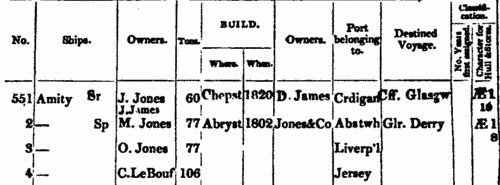
Lloyd's Register of British and Foreign Shipping was established in 1834, following the demise of two earlier societies for registering shipping in Britain. The new register in 1834 was created from an alphabetical list of British ships with no more detail than name, master's name, tonnage, and port to which they belonged. Lloyd's insurance syndicate provided £1000 for the establishment of a new system of surveyors, and as the year progressed many of the entries in the register were then annotated with additional information - type of vessel (Bk, barque; Bg, brig; Cr, cutter; Dr, dogger; G, galliott; H, hoy; K, ketch; Lr, lugger; S, ship; Sk, smack; Sp, sloop; Sr, schooner; St, schoot; Sw, snow; Yt, yacht), place and year of build, owners, destined voyage, and classification of the vessel and its stores, with the month (indicated by the final number in the last column) of inspection. Underneath each of these amended entries details were given of construction and repair, with year - s., sheathed; d., doubled; C., coppered; I. B., iron bolts; s. M., sheathed with marine metal; s. Y. M., sheathed with yellow metal; F., felt; PH., patent hair; Cl., clincher; len., lengthened; lrp., large repairs; trp., thorough repairs; ND., new deck; M. TSds., new top-sides; W. C., wales cased; NW., new wales; Srprs, some repairs - and, in italics, the timber of the ship is described - B. B., black birch; Bh, beech; C., cedar; E., elm; F., fir; G., gum; Ght., greenheart; Hk., hackmatack; L., locust; L. O., live oak; P., pine; P. P., pitch pine; R. P., red pine; Y. P., yellow pine; S., spruce; T., teak; W. O., white oak. The sample scan is from the main list. The third column, reserved for masters' names, is not particularly wide; with short surnames, an initial will be given; but longer surnames omit the initials, and even longer surnames are abbreviated. This is the index to masters in the main list. Often new masters had been appointed by the time of survey, and their names are added in slightly smaller type under the original master's names in the third column. These new masters are also included in this index.CLAGUE. Cost: £6.00. | Sample scan, click to enlarge
| British merchant seamen
(1835-1836)
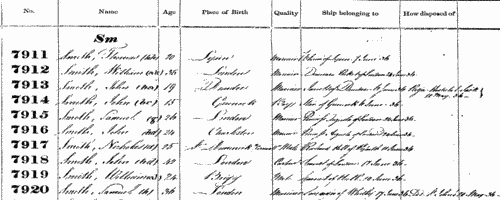
At this period, the foreign trade of ships plying to and from the British isles involved about 150,000 men on 15,000 ships; and the coasting trade about a quarter as many more. A large proportion of the seamen on these ships were British subjects, and so liable to be pressed for service in the Royal Navy; but there was no general register by which to identify them, so in 1835 parliament passed a Merchant Seamen's Registration Bill. Under this act this large register of British seamen was compiled, based on ships' crew lists gathered in British and Irish ports, and passed up to the registry in London. Each seaman was assigned a number, and the names were arranged in the register by first two letters of the surname (our sample scan shows one of the pages for 'Sm'); in addition, an attempt was made to separate out namesakes by giving the first instance of a name (a), the second (b), and so on. But no effective method was devised to prevent the same man being registered twice as he appeared in a second crew list; moreover, the original crew lists were clearly difficult for the registry clerks to copy, and some of the surname spellings appear to be corrupted. A parliamentary committee decided that the system devised did not answer the original problem, and this register was abandoned after less than two years: but it is an apparently comprehensive source for British merchant seamen in 1835 to 1836. The register records the number assigned to each man; his name; age; birthplace; quality (master, captain, mate, 2nd mate, mariner, seaman, fisherman, cook, carpenter, boy &c.); and the name and home port of his ship, with the date of the crew list (usually at the end of a voyage). Most of the men recorded were born in the British Isles, but not all (for instance, Charleston and Stockholm appear in the sample scan). The final column 'How disposed of' is rarely used, and indicates those instances where a man died, was discharged, or deserted his ship during the voyage.CLAGUE. Cost: £8.00. | Sample scan, click to enlarge
| Pupil Teachers in Lancashire: Girls
(1851)
The Committee of Council on Education awarded annual grants for the training and support of pupil teachers and stipendiary monitors in schools in England, Wales, Scotland, the Isle of Man and the Channel Islands. Pupil teachers started training between the ages of 13 and 15, and 'must not be subject to any bodily infirmity likely to impair their usefulness as Pupil Teachers, such as scrofula, fits, asthma, deafness, great imperfections in the sight or voice, the loss of an eye from constitutional disease, or the loss of an arm or leg, or the permanent disability of either arm or leg, curvature of the spine, or a hereditary tendency to insanity'.
They also had to obtain certificates from the managers of the school (and their clergyman, in the case of Church of England schools) as to their moral character and that of their family; good conduct; punctuality, diligence, obedience, and attention to duty; and attentiveness to their religious duties.
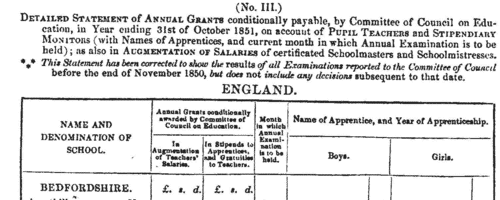
This detailed statement in the annual report of the committee for the year ending 31 October 1851 lists schools by county, giving:
1. Name and Denomination of School, with these abbreviations - B, British and Foreign School Society; F. C., Free Church of Scotland; H. C., Home and Colonial School Society; N., National Society, or connected with the Church of England; R. C., Roman Catholic Poor-School Committee; Wesn., Wesleyan Methodist.
2. Annual grants conditionally awarded by the committee in augmentation of teachers' salaries, and in stipends to apprentices, and gratuities to teachers.
3. Month in which annual examination was to be held.
4. Names of apprentices, giving surname and initials, and year of apprenticeship. Stipendiary monitors are indicated by (S. M.).CLAGUE. Cost: £6.00. | Sample scan, click to enlarge
| Pupil Teachers in the Isle of Man: Boys
(1851)
The Committee of Council on Education awarded annual grants for the training and support of pupil teachers and stipendiary monitors in schools in England, Wales, Scotland, the Isle of Man and the Channel Islands. Pupil teachers started training between the ages of 13 and 15, and 'must not be subject to any bodily infirmity likely to impair their usefulness as Pupil Teachers, such as scrofula, fits, asthma, deafness, great imperfections in the sight or voice, the loss of an eye from constitutional disease, or the loss of an arm or leg, or the permanent disability of either arm or leg, curvature of the spine, or a hereditary tendency to insanity'.
They also had to obtain certificates from the managers of the school (and their clergyman, in the case of Church of England schools) as to their moral character and that of their family; good conduct; punctuality, diligence, obedience, and attention to duty; and attentiveness to their religious duties.
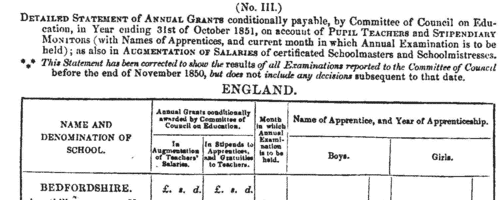
This detailed statement in the annual report of the committee for the year ending 31 October 1851 lists schools by county, giving:
1. Name and Denomination of School, with these abbreviations - B, British and Foreign School Society; F. C., Free Church of Scotland; H. C., Home and Colonial School Society; N., National Society, or connected with the Church of England; R. C., Roman Catholic Poor-School Committee; Wesn., Wesleyan Methodist.
2. Annual grants conditionally awarded by the committee in augmentation of teachers' salaries, and in stipends to apprentices, and gratuities to teachers.
3. Month in which annual examination was to be held.
4. Names of apprentices, giving surname and initials, and year of apprenticeship. Stipendiary monitors are indicated by (S. M.).CLAGUE. Cost: £6.00. | Sample scan, click to enlarge
| Dissolutions of Partnerships
(1854)
Trade partnerships dissolved, or the removal of one partner from a partnership of several traders: in England and Wales
CLAGUE. Cost: £6.00. | Sample scan, click to enlarge

|
Research your ancestry, family history, genealogy and one-name study by direct access to original records and archives indexed by surname.
|