Somerset Feet of Fines
(1400-1484)
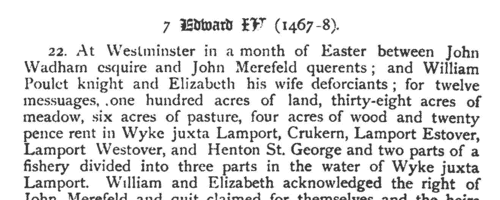
Pedes Finium - law suits, or pretended suits, putting on record the ownership of land in Somerset. These abstracts were prepared by Emanuel Green for the Somerset Record Society and published in 1906. They cover material for the county from the reigns of Henry IV, Henry V, Henry VI, Edward IV and Richard III.CHEWE. Cost: £4.00.  | Sample scan, click to enlarge
|
Landowners and tenants in Somerset
(1345-1485)
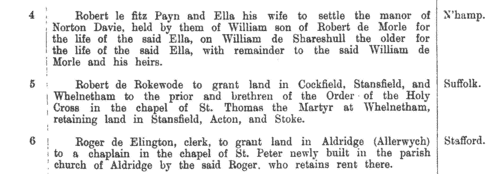
Inquisitions ad quod damnum were held by the appropriate sheriff or escheator (or other officer in whose bailiwick the matter in question might lie) to investigate cases in which the royal or public interest might be damaged by proposed alienation or settlement of land (especially alienation to religious uses, into mortmain). The key findings from these inquisitions were as to the tenure of the land and the service due from it; its yearly value; the lands remaining to the grantor, and whether they sufficed to discharge all duties and customs due from him; and whether he can still be put upon juries, assizes and recognitions, so that the country be not burdened by his withdrawal from them. Generally speaking, this process had the makings of a system of licensing such alienations, and raising money in proportion to the valuations. Equally, there are many items that deal with subjects such as the closing of public roads, the felling or inclosing of woods, or the proposed grant of liberties or immunities. A calendar of these inquisitions from the 19th year of the reign of king Edward III to the 2nd year of Richard III was prepared by the Public Record Office and published in 1906. We have now indexed this calendar by surname and county. Most of the individuals appearing in the calendar are either pious individuals seeking to make grants to religious bodies for the sake of their souls; or landowners securing the disposition and settling of their real estate. But some other names do appear - tenants, trustees, chaplains and clerks.CHEWE. Cost: £6.00. | Sample scan, click to enlarge
|
Somerset testators and legatees
(1501-1530)
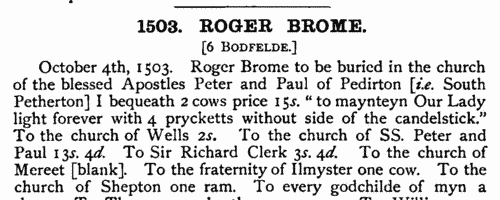
Somerset was almost coextensive with the diocese of Bath and Wells, which exercised local probate jurisdiction through its consistory and archdeaconry courts: but superior to the diocese was the province of Canterbury. Somerset testators who also had property outside the county had their wills proved in the Prerogative Court of Canterbury (PCC). The Somerset Record Society embarked on a program of publishing genealogical abstracts of the registered copy wills of Somerset testators in the PCC archives, and in 1903 (volume xvi) printed abstracts edited by the Reverend F. W. Weaver from the PCC registers 1501-1503 (register Blamyr), 1504-1506 (Holgrave), 1506-1508 (Adeane), 1508-1511 (Bennett), 1511-1514 (Fetiplace), 1514-1517 (Holder), 1517-1520 (Ayloffe), 1520-1522 (Maynwaryng), 1523-1525 (Bodfelde), 1525-1528 (Porch) and 1529-1530 (Jankyn). In addition, the volume includes abstracts of 48 Somerset copy wills in the registers of the Archbishops of Canterbury at Lambeth Palace Library from 1363 to 1491. The heading of each abstract gives the year of making the will (not the year of probate) and the testator's name in bold. Below that is the quire number and name of the PCC register. Date and details of probate are given at the foot of each abstract. Spellings of surnames are preserved as they appear in the registered copy wills, and may vary within a single document.CHEWE. Cost: £4.00. | Sample scan, click to enlarge
|
Yorkshire Marriage Licences
(1596)
William Paver, a 19th-century Yorkshire genealogist, made brief abstracts of early marriage licences (now lost) in York RegistryCHEWE. Cost: £4.00. | Sample scan, click to enlarge

|
Lancashire and Cheshire Marriage Licences
(1616-1624)
Licences for intended marriages in Chester archdeaconry, which covered Cheshire and Lancashire south of the Ribble (by far the most populous part of that county)CHEWE. Cost: £4.00. | Sample scan, click to enlarge

|
Liegemen and Traitors, Pirates and Spies
(1626)
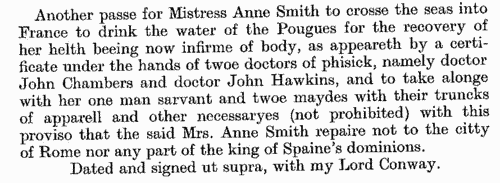
The Privy Council of Charles I was responsible for internal security in England and Wales, and dealt with all manner of special and urgent matters
CHEWE. Cost: £4.00. | Sample scan, click to enlarge
|
British in the East
(1630-1634)
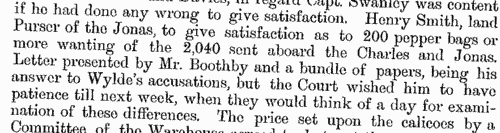
The East India State Papers centre on the records of the East India Company, trading to India, the East Indies, Persia and China. They include the Court Minutes of the East India Company.CHEWE. Cost: £4.00. | Sample scan, click to enlarge
|
Wills proved at York: Names of Testators
(1627-1637)
The diocese of York comprised most of Yorkshire, and Nottinghamshire: the York Exchequer court was the ordinary probate jurisdiction for the Yorkshire part of the diocese, but some wills from Nottinghamshire and other parts of the province of York were also proved there. Dr Francis Collins compiled this index to the transcribed wills of the Prerogative and Exchequer Courts in the York registry proved from 1627 to 1637. The date on the left is that of probate; the testator's full name is then given (surname first), parish or place of abode, and sometimes occupation, and date that the will was executed; and volume and folio number where it the transcript commences. The Act Books were used by Dr Collins to supply deficiencies in the information from the transcripts.CHEWE. Cost: £2.00. | Sample scan, click to enlarge

|
PCC Probate Abstracts
(1650-1651)
The Prerogative Court of Canterbury's main jurisdiction was central and southern England and Wales, as well as over sailors &c dying abroad: these brief abstracts usually give address, date of probate and name of executor or administrator
CHEWE. Cost: £2.00. | Sample scan, click to enlarge

|
PCC Probate Abstracts
(1652-1653)
The Prerogative Court of Canterbury's main jurisdiction was central and southern England and Wales, as well as over sailors &c dying abroad: these brief abstracts usually give address, date of probate and name of executor or administrator
CHEWE. Cost: £2.00. | Sample scan, click to enlarge

|
Research your ancestry, family history, genealogy and one-name study by direct access to original records and archives indexed by surname.