Bywell Surname Ancestry ResultsOur indexes 1000-1999 include entries for the spelling 'bywell'. In the period you have requested, we have the following 21 records (displaying 1 to 10): Buy all | | | Get all 21 records to view, to save and print for £92.00 |
These sample scans are from the original record. You will get scans of the full pages or articles where the surname you searched for has been found. Your web browser may prevent the sample windows from opening; in this case please change your browser settings to allow pop-up windows from this site. Northumberland Assize Rolls for the General Eyre
(1256-1279)
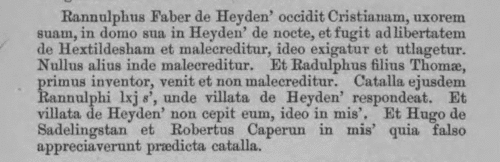
The royal justices made periodic general eyres through all the shires of England, hearing civil and criminal cases that had accrued from the lower courts. Here we have the assize rolls of three Northumberland eyres, 24 April to 7 May 1256; 25 June to 15 July 1269; and 20 January to 9 February 1279. The bulk of the text relates to civil pleas from the county of Northumberland and the town of Newcastle upon Tyne; finishing with abstracts of the pedes finium, or feet of fines (lawsuits or pretended lawsuits establishing the ownership of land) arising at the three eyres. But there are also criminal cases (as in the scan here), lists of bailiffs, &c.BYWELL. Cost: £4.00.  | Sample scan, click to enlarge
| Close Rolls
(1313-1318)
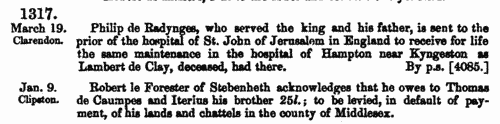
The close rolls of the 7th, 8th, 9th, 10th and 11th years of the reign of king Edward II record the main artery of government administration in England, the orders sent out day by day to individual officers, especially sheriffs of shires: they are an exceptionally rich source for so early a period. In amongst this official material, the rolls were also used as a way of recording many acknowledgments of private debts and contracts between individuals. Most of the contents relate to England, but there are also entries concerning Wales, Scotland, Ireland and the English possessions in France.BYWELL. Cost: £4.00. | Sample scan, click to enlarge
| Chancery Warrants
(1244-1326)
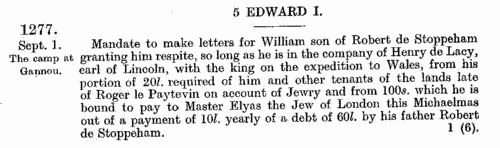
Warrants were issued by the kings of England to the royal chancery: most of these warrants led to further proceedings which are recorded on the Charter Rolls, Patent Rolls, Fine Rolls, Close Rolls or the Inquisitions: but archivists have identified a large number of warrants for which there are no such equivalent records, and those for the reigns of Edward I and Edward II are gathered here. Most of the entries relate to England and Wales, but with occasional items referring to Ireland and the English possessions in France.BYWELL. Cost: £4.00. | Sample scan, click to enlarge
| Close Rolls
(1333-1337)
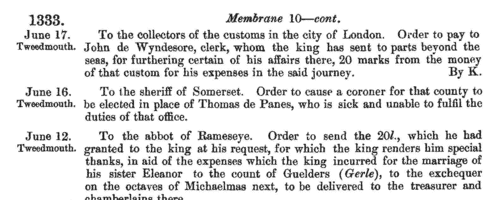
The close rolls of the 7th to 10th years of the reign of king Edward III, that is from 25 January 1333 to 24 January 1337, record the main artery of government administration in England, the orders sent out day by day to individual officers, especially sheriffs of shires: they are an exceptionally rich source for so early a period. In amongst this official material, the rolls were also used as a way of recording many acknowledgments of private debts and contracts between individuals. Most of the contents relate to England, but there are also entries concerning Wales, Scotland, Ireland and the English possessions in France: particularly Scotland, where the king was campaigning during this period. This calendar was prepared by A. B. Hinds of the Public Record Office and published in 1898.BYWELL. Cost: £4.00. | Sample scan, click to enlarge
| Court rolls of manors held by Durham priory
(1296-1384)
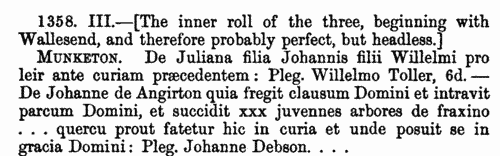
The cathedral priory of Benedictines (black monks) of St Cuthbert at Durham possessed many manors in the county. These were administered by halmotes, or manor courts, held in three sessions (tourns or turns) each year (here marked I., II. and III.), before the terrar (obedientiary), steward, bursar, and/or the prior himself. The court rolls recording proceedings in these courts survive from 1296, 1300, 1309, and from 1333, but with years missing, until becoming fairly continuous from 1365 onwards. Extracts from the rolls from 1296 to 1384 were edited by John Booth and published by the Surtees Society in 1886. The manors under this jurisdiction were Aycliffe, Bellasis, (Newton) Bewley, Billingham, Burdun, Chilton, Coupon, Dalton, Edmondbyers, Ferry (Hill, or Ferrycliffe), Fulwell, Harton, Hebburn, Hedworth, Hesledon, Heworth, Jarrow, Kirk Merrington, East Merrington, West Merrington and Mid Merrington, Monkton, Moorsley, Newton Ketton, Nunstanton, North and South Pittington, East and West Rainton, Ravensflat, Shields, Southwick, Spen, Usworth, Wallsend, Wardley, Wearmouth, Westoe, Willington and Wolviston. The main contents of the records are demises of land held by the bond tenants, neifs, cotmen and others, and of the demesne lands; and bye-laws and pains (penalties) for breach of these; and other minor delinquencies.
Normally, when a farm, cottage or piece of land was let to a new tenant, the name of the last tenant is also given, as well as the amount of the rent, and the amount of the gersum (fine on entry). These court rolls contain some of the only surviving evidence for the inhabitants of these townships in this period: but this publication was of extracts, and was not comprehensive. It should also be noted that the third tourn each year (III.) usually took place in January to March, and so by modern dating in the following year. Thus, the third tourn of 1296 was held on 4 March 1297.BYWELL. Cost: £4.00. | Sample scan, click to enlarge
| London Cutlers: Masters
(1467-1468)
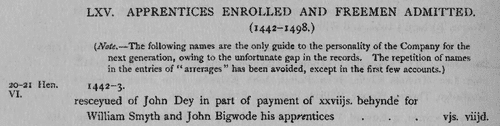
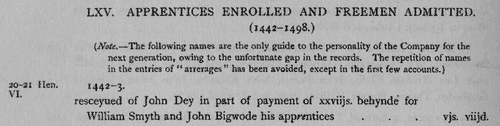
The 15th-century accounts of the Worshipful Company of Cutlers include lists of payments (or part-payments or arrears) for entry (entresse or interesse) into the company. Some bladesmiths appear among the apprentices.
BYWELL. Cost: £6.00. | Sample scan, click to enlarge
| London Cutlers: Apprentices
(1468-1469)
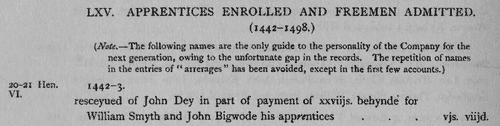
The 15th-century accounts of the Worshipful Company of Cutlers include lists of payments (or part-payments or arrears) for entry (entresse or interesse) into the company. Some bladesmiths appear among the apprentices.
BYWELL. Cost: £6.00. | Sample scan, click to enlarge
| London Cutlers: Apprentices
(1469-1470)
The 15th-century accounts of the Worshipful Company of Cutlers include lists of payments (or part-payments or arrears) for entry (entresse or interesse) into the company. Some bladesmiths appear among the apprentices.
BYWELL. Cost: £6.00. | Sample scan, click to enlarge
| Clergy, the religious and the faithful in Britain and Ireland
(1471-1484)
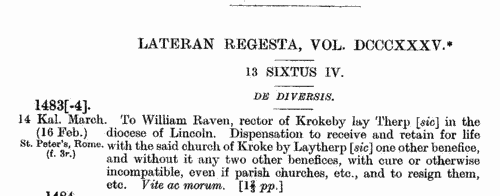
These are abstracts of the entries relating to Great Britain and Ireland from the Lateran and Vatican Regesta of pope Sixtus IV. Many of these entries relate to clerical appointments and disputes, but there are also indults to devout laymen and women for portable altars, remission of sins, &c. This source is particularly valuable for Ireland, for which many of the key government records of this period are lost. Many of the names in the text were clearly a puzzle to the scribes in Rome, and spelling of British and Irish placenames and surnames is chaotic. Sixtus IV was consecrated and crowned 25 August 1471 (the day from which his pontificate is dated) and died at Rome 12 August 1484. The extracts were made by J. A. Twemlow from Vatican Regesta dxlvi to dclxxxi and Lateran Regesta dccxiii to dcccxxxviii, and published in 1955. Not all the Lateran registers survive from this pontificate, but were still in existence in the 18th century, when indexes were compiled giving rubricelle, or brief summaries of the papal bulls; nor, indeed, have all these indexes now survived, but Twemlow added an appendix listing all the rubricelle relating to the British Isles extant for the reign of Sixtus IV.BYWELL. Cost: £4.00. | Sample scan, click to enlarge
| Tradesmen of York
(1272-1558)
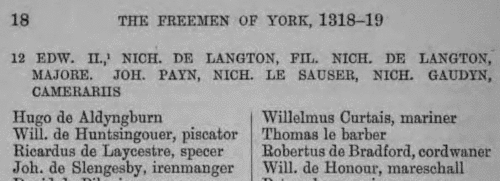
No man or woman could trade in the city of York without having obtained 'freedom' of the city.Their names were recorded on the 'Freemen's Roll', or Register of the Freemen of the City of York, which contains about 19,900 names for this period. A list of names was prepared for each year, the year being here reckoned as starting at Michaelmas (29 September) until 1373, and thence at Candlemas (2 February). Each annual list starts with the name of the mayor and the camerarii or chamberlains. The chamberlains were freemen charged with the duty of receiving the fees of the new freemen; of seeing that only freemen traded in the city; and of preparing this roll, which was compiled from the names on their own account books from the receipts for the fees. There are three groups of freemen: those who obtained freedom after serving out an apprenticeship to a freeman; the children of freemen; and those who claimed freedom by 'redemption', i. e. by purchase or gift from the Mayor and Court of Aldermen.
BYWELL. Cost: £2.00. | Sample scan, click to enlarge
|
Research your ancestry, family history, genealogy and one-name study by direct access to original records and archives indexed by surname.
|