Byam Surname Ancestry ResultsOur indexes 1000-1999 include entries for the spelling 'byam'. In the period you have requested, we have the following 118 records (displaying 1 to 10): Single Surname Subscription | | | Buying all 118 results of this search individually would cost £578.00. But you can have free access to all 118 records for a year, to view, to save and print, for £100. Save £478.00. More... |
These sample scans are from the original record. You will get scans of the full pages or articles where the surname you searched for has been found. Your web browser may prevent the sample windows from opening; in this case please change your browser settings to allow pop-up windows from this site. Inhabitants of Yorkshire: Tickhill wapentake
(1379)
The poll tax returns for this wapentake, the area around Tickhill.BYAM. Cost: £6.00.  | Sample scan, click to enlarge

| Ambassadors, ministers, soldiers and spies
(1589)
The State Papers Foreign of queen Elizabeth consist mainly of letters and reports concerning England's relations with continental Europe, particularly the Netherlands and France. January to July 1589. BYAM. Cost: £4.00. | Sample scan, click to enlarge
| Lancashire and Cheshire Marriage Licences
(1616-1624)
Licences for intended marriages in Chester archdeaconry, which covered Cheshire and Lancashire south of the Ribble (by far the most populous part of that county)BYAM. Cost: £4.00. | Sample scan, click to enlarge

| British in the East
(1625-1629)
The East India State Papers centre on the records of the East India Company, trading to India, the East Indies, Persia and China. They include the Court Minutes of the East India Company.BYAM. Cost: £4.00. | Sample scan, click to enlarge
| PCC Probates and Administrations
(1632)
The Prerogative Court of Canterbury's main jurisdiction was central and southern England and Wales, as well as over sailors &c dying abroad: these brief abstracts, compiled under the title "Year Books of Probates", and printed in 1902, usually give address, date of probate and name of executor or administrator. They are based on the Probate Act Books, cross-checked with the original wills, from which additional details are, occasionally, added. The original spelling of surnames was retained, but christian and place names have been modernised where necessary.BYAM. Cost: £2.00. | Sample scan, click to enlarge
| Inhabitants of Cambridge
(1504-1635)
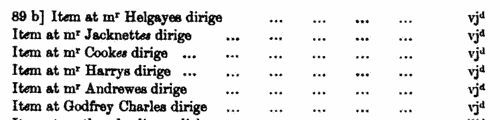
Cambridge comprised fourteen ancient parishes, plus the university (which was extra-parochial), in the diocese of Ely. The church of St Mary the Great (as opposed to St Mary the Less) in the Market Place (juxta forum) has churchwardens' accounts surviving from 1504 onwards. Those from 1504 to 1635 were transcribed by J. E. Foster for the Cambridge Antiquarian Society and published in 1905. The two churchwardens were chosen annually: the previous year's churchwardens each chose another parishioner: those two then each chose three other parishioners: the resulting eight then chose the new year's churchwardens, the wardens of the Light of the Rood, and the wardens of the Mass of Jesus. Auditors were also chosen, usually out of the eight, to examine all the wardens' accounts at the end of the year. The churchwardens' accounts are largely concerned with the costs of repair of the church and its furnishings, and include the names of tradesmen and workmen. Each Easter a rate called Easter money was raised was raised from all householders in the parish, and additional rates are occasionally levied for unusual expenses, such as steeple reconstruction. These 'Easter book' lists give a complete list of householders for the parish, excepting the poor. The church's income also included the rents from some houses in the parish, and the names of the tenants appear. The offices of the Light of the Rood and the Mass of Jesus were abolished during the Reformation. The accounts of the Light of the Rood, i. e., for candles burnt before the crucifix, often include a list of sums received for funerary diriges (dirges) for the year, from which the year of death of the more prosperous parishioners can be traced in this early period. BYAM. Cost: £4.00. | Sample scan, click to enlarge
| PCC Probates and Administrations
(1647)
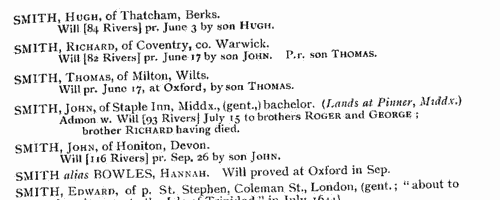
The Prerogative Court of Canterbury's main jurisdiction was central and southern England and Wales, as well as over sailors &c dying abroad: these brief abstracts, compiled under the title "Year Books of Probates", and printed in 1906, usually give address, date of probate and name of executor or administrator. They are based on the Probate Act Books, cross-checked with the original wills, from which additional details are, occasionally, added. The original spelling of surnames was retained, but christian and place names have been modernised where necessary.BYAM. Cost: £2.00. | Sample scan, click to enlarge
| Massachusetts Bay freemen
(1642-1649)
The Company of the Massachusetts Bay in New England was established by royal charter in 1629, the area being settled from 1630 onwards; the charter was withdrawn in 1684. The colony at this period did not include Plymouth or Maine. This court book, compiled by the Increase Nowell, company secretary, also includes memoranda concerning land grants and disputes, official appointments, &c. It was edited by Nathaniel B. Shurtleff, and printed by order of the legislature of the Commonwealth of Massachusetts in 1853. Months are given in the dating in Puritan fashion, i. e. March is 1mo, April 2mo, &c. The lists of names of those taking oaths as freemen of the colony were printed separately, and are listed here.BYAM. Cost: £4.00. | Sample scan, click to enlarge

| The Founders of New Plymouth
(1620-1651)
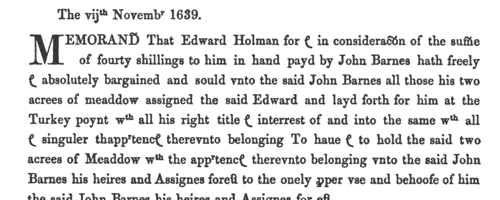
(New) Plymouth colony was settled 120 Puritan families from England who landed there in 1620. New Plymouth and Massachusetts Bay were united in 1692 as Massachusetts. The manuscript volume in which the earliest records of the colony are entered is entitled "Plymouth Colony Records, Deeds, &c., Vol. I, 1627-1661" and "Book of Indian Records for their Lands". This book was edited by David Pulsifer and published in 1861 by order of the legislature of the Commonwealth of Massachusetts. The principal contents are records of the establishment of the colony, the initial land grants, distribution of the few cattle brought across the Atlantic, and the subsequent deeds by which land transfers took place, and servants were indentured.BYAM. Cost: £4.00. | Sample scan, click to enlarge
| Official Papers
(1655-1656)
The State Papers Domestic cover all manner of business relating to Britain, Ireland and the colonies, conducted in the office of the Secretary of State as well as other miscellaneous records. These records are from November 1655 to June 1656: there is also a set of abstracts of navy correspondence.
BYAM. Cost: £4.00. | Sample scan, click to enlarge

|
Research your ancestry, family history, genealogy and one-name study by direct access to original records and archives indexed by surname.
|