Boardman Surname Ancestry ResultsOur indexes 1000-1999 include entries for the spelling 'boardman'. In the period you have requested, we have the following 511 records (displaying 1 to 10): Single Surname Subscription | | | Buying all 511 results of this search individually would cost £3,032.00. But you can have free access to all 511 records for a year, to view, to save and print, for £100. Save £2,932.00. More... |
These sample scans are from the original record. You will get scans of the full pages or articles where the surname you searched for has been found. Your web browser may prevent the sample windows from opening; in this case please change your browser settings to allow pop-up windows from this site. Inhabitants of Manchester
(1603)
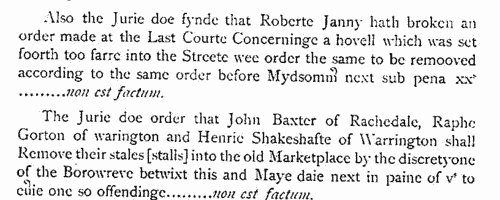
The Court Leet and View of Frankpledge of the manor of Manchester in Lancashire was held twice a year on the first Thursdays after Easter and Michaelmas. The record of each court starts with a list of the jurors, and then records the deaths of tenants and burgesses, with the names of their heirs, who were to do suit to the court; and transfers of burgages by sale, and homage of new burgesses. Then there are presentments of all manner of minor enroachments and misdemeanours, such as blocking of ditches, stopping of highways, noisome drains, &c. Finally there are new general ordinances, often with the appointment of officers to see that they are enforced. The sample scan is taken from 1597. This index covers the court of 28 April 1603.BOARDMAN. Cost: £6.00.  | Sample scan, click to enlarge
| Inhabitants of Manchester
(1613)
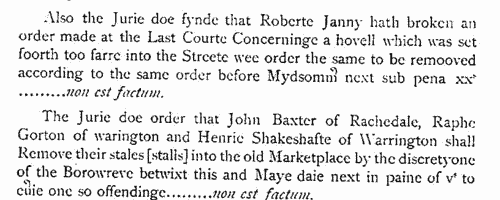
The Court Leet and View of Frankpledge of the manor of Manchester in Lancashire was held twice a year on the first Thursdays after Easter and Michaelmas. The record of each court starts with a list of the jurors, and then records the deaths of tenants and burgesses, with the names of their heirs, who were to do suit to the court; and transfers of burgages by sale, and homage of new burgesses. Then there are presentments of all manner of minor enroachments and misdemeanours, such as blocking of ditches, stopping of highways, noisome drains, &c. Finally there are new general ordinances, often with the appointment of officers to see that they are enforced. Every Michaelmas saw the swearing in of a long list of officers for the coming year, including the borough reeve, constables, market lookers, mise layers and gatherers, sealers of leather, officers for fruit and wholesome bread and (the prevention of) football, aletasters, bylawmen (burleymen), scavengers, (ap)praisers, catchpole, swineherd, and also the affeerers, who judged the fines to be levied by the court. These posts were filled by householders or their appointees. The sample scan is taken from 1597. This index covers the court of 30 September 1613.BOARDMAN. Cost: £6.00. | Sample scan, click to enlarge
| Inhabitants of Manchester
(1614)
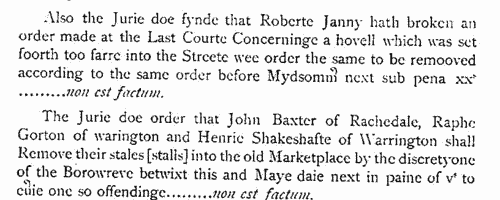
The Court Leet and View of Frankpledge of the manor of Manchester in Lancashire was held twice a year on the first Thursdays after Easter and Michaelmas. The record of each court starts with a list of the jurors, and then records the deaths of tenants and burgesses, with the names of their heirs, who were to do suit to the court; and transfers of burgages by sale, and homage of new burgesses. Then there are presentments of all manner of minor enroachments and misdemeanours, such as blocking of ditches, stopping of highways, noisome drains, &c. Finally there are new general ordinances, often with the appointment of officers to see that they are enforced. Every Michaelmas saw the swearing in of a long list of officers for the coming year, including the borough reeve, constables, market lookers, mise layers and gatherers, sealers of leather, officers for fruit and wholesome bread and (the prevention of) football, aletasters, bylawmen (burleymen), scavengers, (ap)praisers, catchpole, swineherd, and also the affeerers, who judged the fines to be levied by the court. These posts were filled by householders or their appointees. The sample scan is taken from 1597. This index covers the court of 5 October 1614.BOARDMAN. Cost: £6.00. | Sample scan, click to enlarge
| Inhabitants of Manchester
(1615)
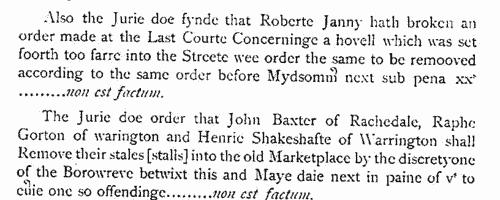
The Court Leet and View of Frankpledge of the manor of Manchester in Lancashire was held twice a year on the first Thursdays after Easter and Michaelmas. The record of each court starts with a list of the jurors, and then records the deaths of tenants and burgesses, with the names of their heirs, who were to do suit to the court; and transfers of burgages by sale, and homage of new burgesses. Then there are presentments of all manner of minor enroachments and misdemeanours, such as blocking of ditches, stopping of highways, noisome drains, &c. Finally there are new general ordinances, often with the appointment of officers to see that they are enforced. Every Michaelmas saw the swearing in of a long list of officers for the coming year, including the borough reeve, constables, market lookers, mise layers and gatherers, sealers of leather, officers for fruit and wholesome bread and (the prevention of) football, aletasters, bylawmen (burleymen), scavengers, (ap)praisers, catchpole, swineherd, and also the affeerers, who judged the fines to be levied by the court. These posts were filled by householders or their appointees. The sample scan is taken from 1597. This index covers the court of 5 October 1615.BOARDMAN. Cost: £6.00. | Sample scan, click to enlarge
| Lancashire and Cheshire Marriage Licences
(1606-1616)
Licences for intended marriages in Chester archdeaconry, which covered Cheshire and Lancashire south of the Ribble (by far the most populous part of that county)BOARDMAN. Cost: £4.00. | Sample scan, click to enlarge

| Inhabitants of Manchester
(1616)
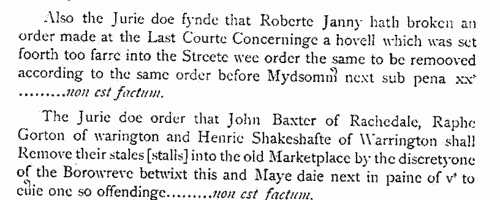
The Court Leet and View of Frankpledge of the manor of Manchester in Lancashire was held twice a year on the first Thursdays after Easter and Michaelmas. The record of each court starts with a list of the jurors, and then records the deaths of tenants and burgesses, with the names of their heirs, who were to do suit to the court; and transfers of burgages by sale, and homage of new burgesses. Then there are presentments of all manner of minor enroachments and misdemeanours, such as blocking of ditches, stopping of highways, noisome drains, &c. Finally there are new general ordinances, often with the appointment of officers to see that they are enforced. Every Michaelmas saw the swearing in of a long list of officers for the coming year, including the borough reeve, constables, market lookers, mise layers and gatherers, sealers of leather, officers for fruit and wholesome bread and (the prevention of) football, aletasters, bylawmen (burleymen), scavengers, (ap)praisers, catchpole, swineherd, and also the affeerers, who judged the fines to be levied by the court. The sample scan is taken from 1597. This index covers the court of 2 September 1616.BOARDMAN. Cost: £6.00. | Sample scan, click to enlarge
| Manchester criminals, victims, witnesses and litigants
(1616-1623)
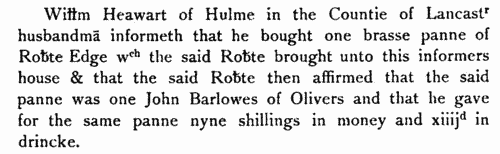
Oswald Mosley of Ancoats kept a notebook of the cases that came before him as a magistrate at the various Manchester sessions. The pages from 10 April 1616 to 10 March 1623 were transcribed for the Lancashire and Cheshire Record Society by Ernest Axon and published in 1901.BOARDMAN. Cost: £4.00. | Sample scan, click to enlarge
| Lancashire and Cheshire Marriage Licences
(1616-1624)
Licences for intended marriages in Chester archdeaconry, which covered Cheshire and Lancashire south of the Ribble (by far the most populous part of that county)BOARDMAN. Cost: £4.00. | Sample scan, click to enlarge

| Lancashire and Cheshire Marriage Licences
(1624-1632)
Licences for intended marriages in Chester archdeaconry, which covered Cheshire and Lancashire south of the Ribble (by far the most populous part of that county)BOARDMAN. Cost: £4.00. | Sample scan, click to enlarge

| Wills proved at York: Names of Testators
(1627-1637)
The diocese of York comprised most of Yorkshire, and Nottinghamshire: the York Exchequer court was the ordinary probate jurisdiction for the Yorkshire part of the diocese, but some wills from Nottinghamshire and other parts of the province of York were also proved there. Dr Francis Collins compiled this index to the transcribed wills of the Prerogative and Exchequer Courts in the York registry proved from 1627 to 1637. The date on the left is that of probate; the testator's full name is then given (surname first), parish or place of abode, and sometimes occupation, and date that the will was executed; and volume and folio number where it the transcript commences. The Act Books were used by Dr Collins to supply deficiencies in the information from the transcripts.BOARDMAN. Cost: £2.00. | Sample scan, click to enlarge

|
Research your ancestry, family history, genealogy and one-name study by direct access to original records and archives indexed by surname.
|