Adye Surname Ancestry ResultsOur indexes 1000-1999 include entries for the spelling 'adye'. In the period you have requested, we have the following 85 records (displaying 1 to 10): Single Surname Subscription | | | Buying all 85 results of this search individually would cost £408.00. But you can have free access to all 85 records for a year, to view, to save and print, for £100. Save £308.00. More... |
These sample scans are from the original record. You will get scans of the full pages or articles where the surname you searched for has been found. Your web browser may prevent the sample windows from opening; in this case please change your browser settings to allow pop-up windows from this site. Secretary of State's Papers
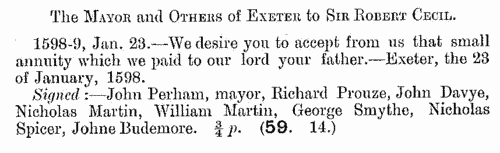
(1599)
The letters and papers of sir Robert Cecil, Secretary of State, deal with all manner of government business in England, Ireland and abroad.ADYE. Cost: £4.00.  | Sample scan, click to enlarge
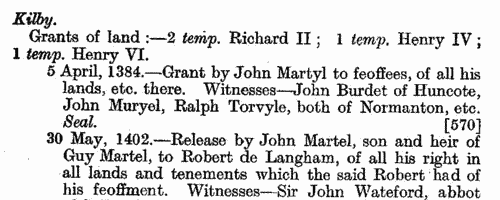
| Hastings family deeds
(1100-1600)
John Harley of the Historical Manuscripts Commission was invited by Reginald Rawdon Hastings to examine his family's extensive archives at the Manor House, Ashby de la Zouche, in Leicestershire. Harley produced a detailed calendar, of which is the first volume, published in 1928, Hastings himself having since died, and Harley having been killed at Gallipoli. This volume covers four categories of the records: the Ancient Deeds; Manorial and other Documents; Accounts and Inventories; and Miscellaneous Papers. Most, but not all, of the material is mediaeval. About half of the deeds relate to the family property in Leicestershire; then there are sections for Derbyshire, Nottinghamshire, Northamptonshire, Lincolnshire, Warwickshire, Staffordshire, Yorkshire, Northumberland, Norfolk, Cambridgeshire, Huntingdonshire, London, Wiltshire, Somersetshire, Devonshire, Buckinghamshire, Oxfordshire, &c. The manorial section includes a partitions of the estates of the Earls of Leicester and Wilton about 1204 and 1277; manor court rolls are mentioned, but not extracted. Choicer items from the family accounts and inventories are copied in extenso for 1596 and 1607, and thereafter summarised. Most of the later material is merely dipped into for curiosities.ADYE. Cost: £4.00. | Sample scan, click to enlarge
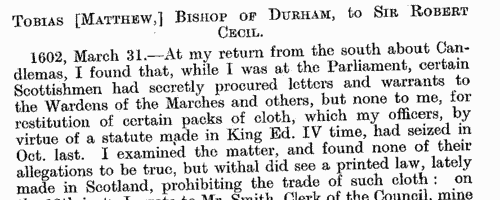
| Secretary of State's Papers
(1602)
The letters and papers of sir Robert Cecil, Secretary of State, deal with all manner of government business in England, Ireland and abroad.ADYE. Cost: £4.00. | Sample scan, click to enlarge
| Official Papers
(1611-1618)
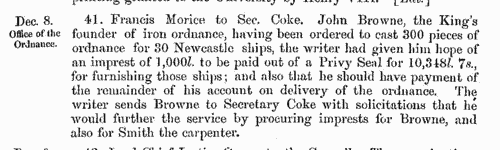
The State Papers Domestic cover all manner of business relating to Britain, Ireland and the colonies, conducted in the office of the Secretary of State as well as other miscellaneous records.
ADYE. Cost: £4.00. | Sample scan, click to enlarge

| Official Papers
(1625-1626)
The State Papers Domestic cover all manner of business relating to Britain, Ireland and the colonies, conducted in the office of the Secretary of State as well as other miscellaneous records.
ADYE. Cost: £4.00. | Sample scan, click to enlarge
| Merchants and traders in Aberdeen
(1399-1631)
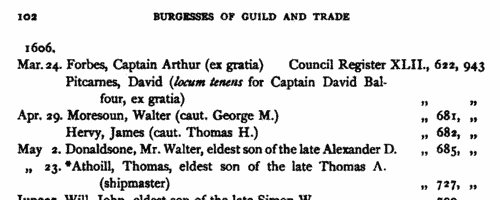
A. M. Munro searched the council registers of the royal burgh of Aberdeen, and compiled this list of burgesses admited to the borough. The entries prior to 1591 were contained in lists engrossed in the council registers at the close of the minutes for the year ending at Michaelmas, but after that date in addition to the annual lists, which are continued, there is almost always a separate minute of admission under the respective dates. The records before 1591 are not only sparser, often with no more than a name, but are also lacking for 1401-1405, 1413-1432, 1434-1435, 1518-1519, 1557 and 1562-1564 - other blanks were filled in from the guildry accounts where such existed. Guild burgesses were allowed unfettered trading rights in Aberdeen; simple burgesses could only deal in Scottish wares (so being barred from the lucrative English and Flemish imports and exports); trade burgesses were limited to their own particular trades; and the council was able ex gratia to create honourary burgesses, who were accorded the full privileges of burgesses of guild and trade, and among whom numbered members of almost every family of note in Aberdeenshire. Burgesses could thus be created by descent, by apprenticeship into a trade, or ex gratia, and in the later portions of this roll the precise circumstances are usually given, sometimes also with the name of a cautioner or surety. Burgesses, masters and cautioners are all indexed here.ADYE. Cost: £4.00. | Sample scan, click to enlarge
| Wiltshire freeholders
(1625-1645)
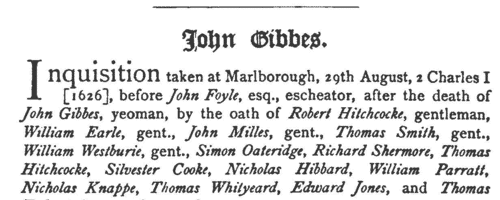
Inquisitions post mortem were held after the death of freeholders who held their estates in capite or in chief, i. e., directly from the crown. The inquisition, held by the royal escheator upon the oath of jurors from the county who were also normally freeholders, recorded what estates the deceased had held, by what tenure, what they were worth, the date of death, who was the next heir, and whether the heir was of age. The sample scan shows an unusually brief inquisition: these abstracts usually run to two or three pages of print. ADYE. Cost: £4.00. | Sample scan, click to enlarge
| PCC Probates and Administrations
(1649)
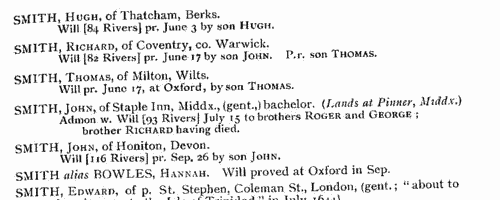
The Prerogative Court of Canterbury's main jurisdiction was central and southern England and Wales, as well as over sailors &c dying abroad: these brief abstracts, compiled under the title "Year Books of Probates", and printed in 1906, usually give address, date of probate and name of executor or administrator. They are based on the Probate Act Books, cross-checked with the original wills, from which additional details are, occasionally, added. The original spelling of surnames was retained, but christian and place names have been modernised where necessary.ADYE. Cost: £2.00. | Sample scan, click to enlarge
| Purchasers of Bishops' Lands: London and Middlesex
(1647-1651)
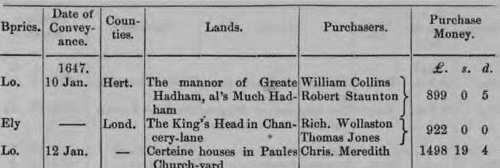
16 November 1646 Parliament ordained the sale of all the lands and estates of the bishops and archbishops for the service of the Commonwealth. This account, printed in 1834, is a transcript from a manuscript presented to the British Museum by William Bray (Add. 9049). It gives in tabular form the details of the conveyances of the lands to private individuals, showing the name of the bishopric; the date of the conveyance; county; description of the lands; purchaser; and purchase money. A total of over £624,158 was raised: after the restoration of the monarchy these estates were returned to the Church, with compensation.ADYE. Cost: £6.00. | Sample scan, click to enlarge
| Prerogative Court of Canterbury Wills: Gloucestershire: Strays
(1658)
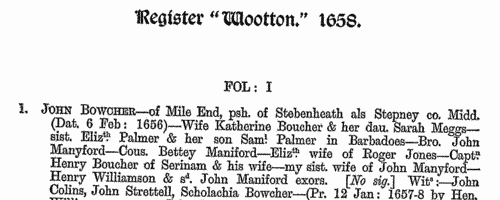
William Brigg compiled abstracts of all the wills in Register "Wootton" of the Prerogative Court of Canterbury. The abstracts of those proved in 1658 were published by him in 1894. The court's main jurisdiction was central and southern England and Wales, as well as over sailors &c dying abroad. We have re-indexed the whole volume, county by county, for both testators and strays (legatees, witnesses and other persons mentioned in the abstracts). ADYE. Cost: £4.00. | Sample scan, click to enlarge
|
Research your ancestry, family history, genealogy and one-name study by direct access to original records and archives indexed by surname.
|