Adair Surname Ancestry ResultsOur indexes 1000-1999 include entries for the spelling 'adair'. In the period you have requested, we have the following 340 records (displaying 1 to 10): Single Surname Subscription | | | Buying all 340 results of this search individually would cost £1,748.00. But you can have free access to all 340 records for a year, to view, to save and print, for £100. Save £1,648.00. More... |
These sample scans are from the original record. You will get scans of the full pages or articles where the surname you searched for has been found. Your web browser may prevent the sample windows from opening; in this case please change your browser settings to allow pop-up windows from this site. Scottish litigants, rebels and cautioners
(1545-1569)
The Privy Council of Scotland exercised a superior judicial authority in the kingdom, and consequently received and dealt with a constant stream of petitions, as well as dealing with the internal security of the state. This register of the council from June 1545 to July 1569, in the reigns of Mary queen of Scots and king James VI, was edited by John Hill Burton, Historiographer Royal for Scotland, and published under the direction of the Lord Clerk Register of Scotland in 1877. Some of the individuals mentioned are the complainants, those of whom they complained, and the sureties on both sides: at this period, some of the complainants are alleging serious attacks, often of a feuding nature. Many of the bonds entered into by the cautioners are promises to keep the peace towards such enemies. Failure to answer to the council when summoned was a serious contempt, leading to being denounced a rebel, with serious consequences. But 'horning' was also used in the pursuit of debts: there was no imprisonment for debt in Scotland, but a creditor could have an obstinate debtor ordered, in the sovereign's name, to pay what was due, failing which, the debtor could be put to the horn, denounced as a rebel, and imprisoned as a rebel. In his preface to this volume, Burton remarked that "There might perhaps be objections to the abundance of names of persons and places unknown to fame; but it was considered that in such a work the proper names of all persons and places occurring in the Register should be preserved, to be at the service of genealogical as well as historical investigators".
ADAIR. Cost: £4.00.  | Sample scan, click to enlarge
| Scottish litigants, rebels and cautioners
(1569-1578)
The Privy Council of Scotland exercised a superior judicial authority in the kingdom, and consequently received and dealt with a constant stream of petitions, as well as dealing with the internal security of the state. This register of the council from July 1569 to June 1578, in the reign of king James VI, was edited by John Hill Burton, Historiographer Royal for Scotland, and published under the direction of the Lord Clerk Register of Scotland in 1878. Some of the individuals mentioned are the complainants, those of whom they complained, and the sureties on both sides: at this period, some of the complainants are alleging serious attacks, often of a feuding nature. Many of the bonds entered into by the cautioners are promises to keep the peace towards such enemies. Failure to answer to the council when summoned was a serious contempt, leading to being denounced a rebel, with serious consequences. But 'horning' was also used in the pursuit of debts: there was no imprisonment for debt in Scotland, but a creditor could have an obstinate debtor ordered, in the sovereign's name, to pay what was due, failing which, the debtor could be put to the horn, denounced as a rebel, and imprisoned as a rebel.
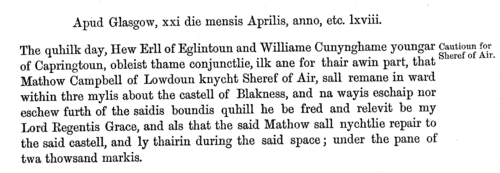
ADAIR. Cost: £4.00. | Sample scan, click to enlarge
| Scottish litigants, rebels and cautioners
(1585-1592)
The Privy Council of Scotland exercised a superior judicial authority in the kingdom, and consequently received and dealt with a constant stream of petitions, as well as dealing with the internal security of the state. This register of the council from 1 August 1585 to 31 July 1592, in the reign of king James VI, was edited by David Masson, and published under the direction of the Lord Clerk Register of Scotland in 1881. Some of the individuals mentioned are the complainants, those of whom they complained, and the sureties on both sides: at this period, some of the complainants are alleging serious attacks, often of a feuding nature. Many of the bonds entered into by the cautioners are promises to keep the peace towards such enemies. Failure to answer to the council when summoned was a serious contempt, leading to being denounced a rebel, with serious consequences. But 'horning' was also used in the pursuit of debts: there was no imprisonment for debt in Scotland, but a creditor could have an obstinate debtor ordered, in the sovereign's name, to pay what was due, failing which, the debtor could be put to the horn, denounced as a rebel, and imprisoned as a rebel. The main text (to page 774) is from the Acta Secreti Concilii, containing the minutes of the Privy Council, with intermixed Acta Proper (political edicts), Decreta (judicial decisions), Acta Cautionis (acts of caution) and Bands (registration of bonds). After that are printed some miscellaneous Privy Council documents from the same years: additional acts of caution (775-778); ordinances and acts anent the Borders and the North (779-814); and miscellaneous privy council papers (815-834). The sources most productive of names, the Acta Cautionis and Registration of Bands, are also the most repetitive in form, and are not transcribed verbatim and literatim: nevertheless, one of the editor's rules was for 'All proper names and names of places occurring in the originals to be preserved in the abstracts without exception, and in the exact original spelling.'
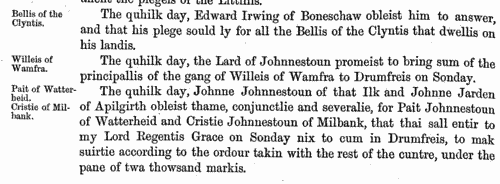
ADAIR. Cost: £4.00. | Sample scan, click to enlarge
| Scottish litigants, rebels and cautioners
(1592-1599)
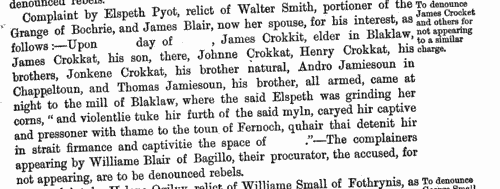
The Privy Council of Scotland exercised a superior judicial authority in the kingdom, and consequently received and dealt with a constant stream of petitions, as well as dealing with the internal security of the state. This register of the council from August 1592 to May 1599, in the reign of king James VI, was edited by David Masson and published under the direction of the Deputy Clerk Register of Scotland in 1882. The publication brings together the contents of the principal register (Acta Secreti Concilii) with acts and bands (bonds) of caution (surety) from the registers called Acta Cautionis (pp 561-730); Acts and Ordinances relating to the Borders and the North (731-748); and Miscellaneous Privy Council Papers (749-769). Many of the individuals mentioned are the complainants, those of whom they complained, and the sureties on both sides: at this period, many of the complainants are alleging serious attacks, often of a feuding nature. Many of the bonds entered into by the cautioners are promises to keep the peace towards such enemies. Failure to answer to the council when summoned was a serious contempt, leading to being denounced a rebel, with serious consequences.
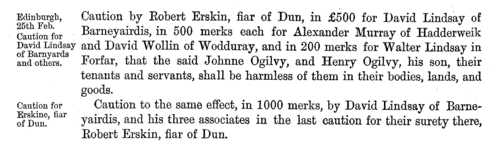
ADAIR. Cost: £4.00. | Sample scan, click to enlarge
| Irish Patent and Close Rolls
(1625-1633)
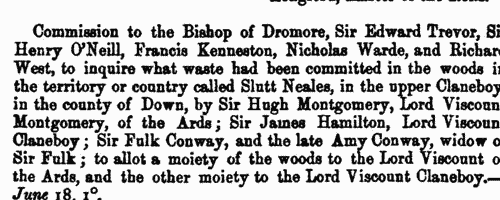
Under the direction of the Master of the Rolls of Ireland, James Morrin, Clerk of Enrolments in Chancery, prepared a calendar of the Patent and Close Rolls of Ireland of the 1st to 8th years of the reign of king Charles I (27 March 1625 to 26 March 1633). These rolls record royal orders and commissions, general and particular, the individuals mentioned being mainly officers, officials and petitioners.ADAIR. Cost: £4.00. | Sample scan, click to enlarge
| Irish petitions, memoranda and correspondence
(1606-1663)
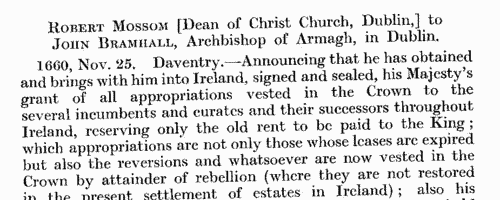
John Harley of the Historical Manuscripts Commission was invited by Reginald Rawdon Hastings to examine his family's extensive archives at the Manor House, Ashby de la Zouche, in Leicestershire. Harley produced a detailed calendar, in three volumes; Hastings himself having since died, and Harley having been killed at Gallipoli, the work was completed by his colleague, Francis Bickley, who also produced a fourth volume, published in 1947, by which time the manuscripts themselves had gone to the Henry E. Huntington Library at San Marino in California. This volume covers nine categories of the records, of which much, but not all, relates to Ireland: Correspondence of sir John Davies (Solicitor-General for Ireland 1603-1606 and Attorney-General for Ireland 1606-1619) (pages 1-17); Warrants, Petitions, &c., relating to Ireland, 1604-1618 and 1634 (18-54); Correspondence of John Bramhall (Bishop of Derry 1634-1660 and Archbishop of Armagh 1660-1663) (55-136); Petitions, Orders and Miscellaneius Documents mostly relating to the Episcopate of John Bramhall (137-152); Other Miscellaneous Irish Papers (153-185), including a particularly valuable Survey of the Undertakers and Servitors planted in Ulster between 2 February and 25 April 1613 (159-182); Royal Letters and Letters from the Lords of the Council, &c., mostly to the Earls of Huntingdon as Lords Lieutenant of Leicestershire and Rutland, and other Documents relating chiefly to County Affairs (186-221); Notes on Speeches and Proceedings in the House of Lords 1610-1621 and 1670-1695 (222-324); Later Miscellaneous and Additional Papers (325-358); and Letters and Papers of the Graham Family, chiefly relating to the disposal of the estates and titles of the Earls of Airth and Menteith and proposals for the marriage of Helen, daughter of sir James Graham.ADAIR. Cost: £4.00. | Sample scan, click to enlarge
| Letters and papers of James first duke of Ormond, Lord Deputy of Ireland
(1660-1675)
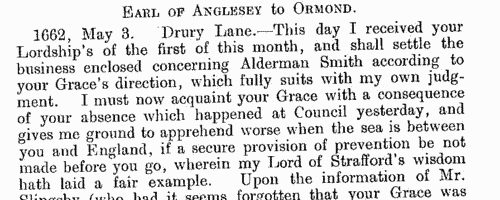
This correspondence deals with a large variety of personal and public affairs in Ireland and England.ADAIR. Cost: £4.00. | Sample scan, click to enlarge
| Official Papers
(1677-1678)
The State Papers Domestic cover all manner of business relating to Britain, Ireland and the colonies, conducted in the office of the Secretary of State as well as other miscellaneous records. Includes lists of passes to travel abroad.
ADAIR. Cost: £4.00. | Sample scan, click to enlarge
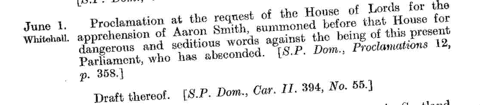
| Letters and papers of James first duke of Ormond, Lord Deputy of Ireland
(1679-1681)
This correspondence deals with a large variety of personal and public affairs in Ireland and England. ADAIR. Cost: £4.00. | Sample scan, click to enlarge
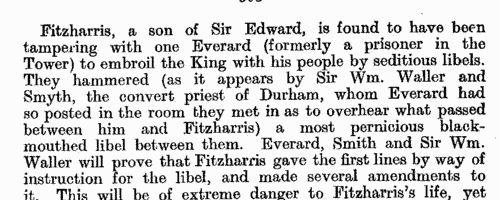
| Treasury Books
(1689-1692)
Records of the Treasury administration in Britain, America and the colonies.
ADAIR. Cost: £4.00. | Sample scan, click to enlarge
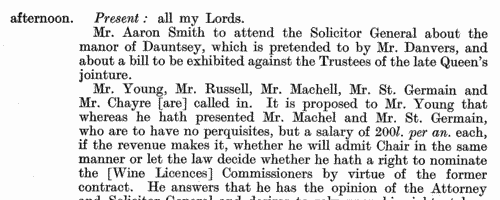
|
Research your ancestry, family history, genealogy and one-name study by direct access to original records and archives indexed by surname.
|