Aaron Surname Ancestry ResultsOur indexes 1000-1999 include entries for the spelling 'aaron'. In the period you have requested, we have the following 119 records (displaying 1 to 10): Single Surname Subscription | | | Buying all 119 results of this search individually would cost £658.00. But you can have free access to all 119 records for a year, to view, to save and print, for £100. Save £558.00. More... |
These sample scans are from the original record. You will get scans of the full pages or articles where the surname you searched for has been found. Your web browser may prevent the sample windows from opening; in this case please change your browser settings to allow pop-up windows from this site. Curia Regis Rolls
(1196-1201)
The Curia Regis, king's court, of mediaeval England took cases from throughout the country, and its records are among the most important surviving from this early period.AARON. Cost: £4.00.  | Sample scan, click to enlarge
| Pipe Roll
(1241-1242)
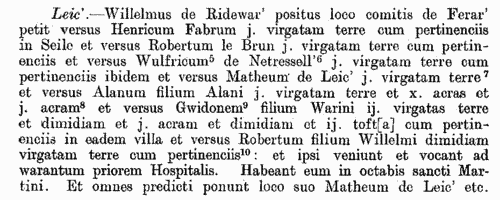
The Great Rolls of the Pipe are the central record of the crown compiling returns of income and expenditure from the sheriffs and farmers of the various English counties or shires. This is the oldest series of public records, and the earliest surviving instances of many surnames are found in the Pipe Rolls. This is the roll for the 26th year of the reign of king Henry III, that is, accounting for the year from Michaelmas 1241 to Michaelmas 1242. Most (but not all) of the entries in which names appear relate to payments for grants of land and fines or pardons arising from the proceedings of the justices. The text was edited by Henry Lewin Cannon for Yale Historical Publications and printed in 1918. The name of the county is given at the head of each page, and variant spellings, omissions and additions found in the duplicate Chancellor's Roll [C. R.] are given in the footnotes.AARON. Cost: £4.00. | Sample scan, click to enlarge
| Liberate Rolls
(1245-1251)
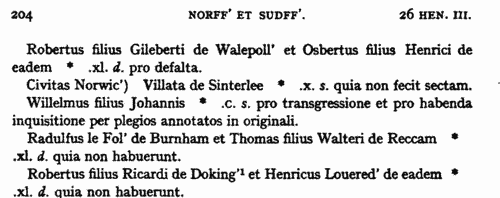
These chancery liberate rolls of the 30th to 35th years of the reign of Henry III of England record the details of payments and allowances as part of the administration of government. Most entries start with the Latin words 'liberate', meaning 'deliver', or 'allocate', meaning allow. There are also 'contrabreves', warrants mainly to sheriffs of shires, assigning them tasks and allowing expenses. Most of the entries relate to England and Wales, but there are occasional references to Ireland and the English possessions in France.AARON. Cost: £4.00. | Sample scan, click to enlarge

| Rockingham Forest Pleas
(1255)
Much of eastern Northamptonshire lay in the jurisdiction of the Forest of Rockingham. Forest pleas heard on the morrow of Midsummer in the 39th year of the reign of king Henry III, 25 June 1255, recorded in Public Record Office Forest Proceedings, Treasury of Receipt, No. 68, were selected, transcribed (the Latin extended) and translated by G. J. Turner and published by the Selden Society in 1901. The text and translation are printed on facing pages. AARON. Cost: £4.00. | Sample scan, click to enlarge
| Patent Rolls: entries for Surrey
(1277-1278)
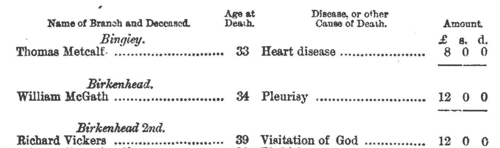
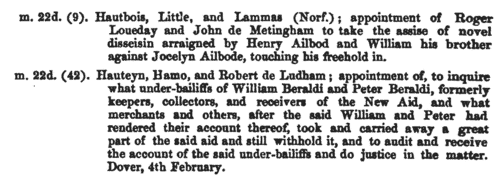
Calendars of the patent rolls of the reign of king Edward I are printed in the Calendars of State Papers: but these cover only a fraction of the material on the rolls. From 1881 to 1889 the reports of the Deputy Keeper of the Public Record Office also include calendars of other material from the rolls - about five times as many entries as in the State Papers - predominantly mandates to the royal justices to hold sessions of oyer and terminer to resolve cases arising locally; but also other general business. The calendar for the 6th year of king Edward I [20 November 1277 to 19 November 1278], hitherto unindexed, is covered here.AARON. Cost: £6.00. | Sample scan, click to enlarge
| Patent Rolls: entries for Surrey
(1278-1279)
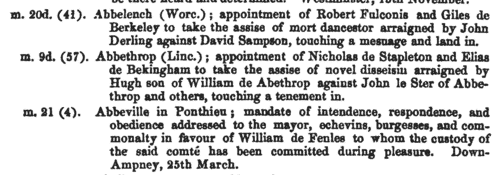
Calendars of the patent rolls of the reign of king Edward I are printed in the Calendars of State Papers: but these cover only a fraction of the material on the rolls. From 1881 to 1889 the reports of the Deputy Keeper of the Public Record Office also include calendars of other material from the rolls - about five times as many entries as in the State Papers - predominantly mandates to the royal justices to hold sessions of oyer and terminer to resolve cases arising locally; but also other general business. The calendar for the 7th year of king Edward I [20 November 1278 to 19 November 1279], hitherto unindexed, is covered here.AARON. Cost: £6.00. | Sample scan, click to enlarge
| Clerks and Clergy in Herefordshire, Shropshire and Gloucestershire
(1317-1327)
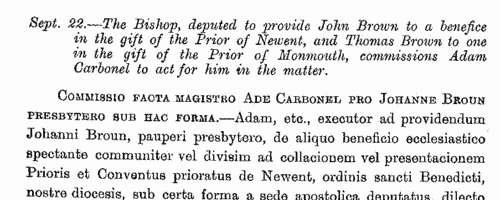
The register of bishop Adam de Orleton of Hereford, containing general diocesan business. Hereford diocese covered almost all Herefordshire, southern rural Shropshire, a westward arm of Worcestershire, and a northwestern slice of Gloucestershire.AARON. Cost: £6.00. | Sample scan, click to enlarge
| Clerks and Clergy in Herefordshire, Shropshire and Gloucestershire
(1344-1360)
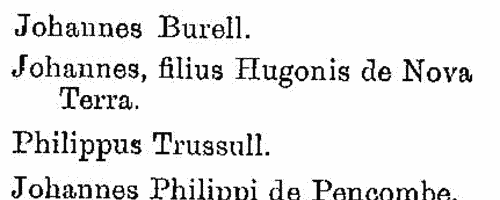
The register of bishop John de Trillek of Hereford, containing general diocesan business, but also including ordination lists for monks and clergy. Only a small proportion of the clerks went on to acquire benefices and remained celibate. Hereford diocese covered almost all Herefordshire, southern rural Shropshire, a westward arm of Worcestershire, and a northwestern slice of Gloucestershire.AARON. Cost: £6.00. | Sample scan, click to enlarge
| Allegations for marriages in southern England
(1679-1687)
The province or archbishopric of Canterbury covered all England and Wales except for the northern counties in the four dioceses of the archbishopric of York (York, Durham, Chester and Carlisle). Marriage licences were generally issued by the local dioceses, but above them was the jurisdiction of the archbishop, exercised through his vicar-general. Where the prospective bride and groom were from different dioceses it would be expected that they obtain a licence from the archbishop; in practice, the archbishop residing at Lambeth, and the actual offices of the province being in London, which was itself split into myriad ecclesiastical jurisdictions, and spilled into adjoining dioceses, this facility was particularly resorted to by couples from London and the home counties, although there are quite a few entries referring to parties from further afield. The abstracts of the allegations given here usually state name, address (street in London, or parish), age, and condition of bride and groom; and sometimes the name, address and occupation of the friend or relative filing the occupation. Where parental consent was necessary, a mother's or father's name may be given. The ages shown should be treated with caution; ages above 21 tended to be reduced, doubtless for cosmetic reasons; ages under 21 tended to be increased, particularly to avoid requiring parental consent; a simple statement 'aged 21' may merely mean 'of full age' and indicate any age from 21 upwards. These are merely allegations to obtain licences; although nearly all will have resulted in the issuing of the licence, many licences did not then result in marriage. AARON. Cost: £4.00. | Sample scan, click to enlarge

| Licences for marriages in southern England
(1632-1714)
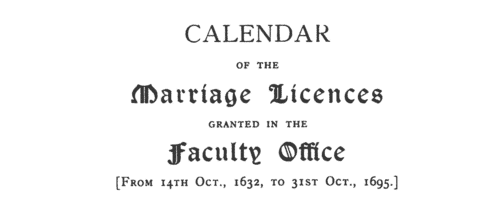
The province or archbishopric of Canterbury covered all England and Wales except for the northern counties in the four dioceses of the archbishopric of York (York, Durham, Chester and Carlisle). Marriage licences were generally issued by the local dioceses, but above them was the jurisdiction of the archbishop. Where the prospective bride and groom were from different dioceses it would be expected that they obtain a licence from the archbishop; in practice, the archbishop residing at Lambeth, and the actual offices of the province being in London, which was itself split into myriad ecclesiastical jurisdictions, and spilled into adjoining dioceses, this facility was particularly resorted to by couples from London and the home counties, although there are quite a few entries referring to parties from further afield. Three calendars of licences issued by the Faculty Office of the archbishop were edited by George A Cokayne (Clarenceux King of Arms) and Edward Alexander Fry and printed as part of the Index Library by the British Record Society Ltd in 1905. The first calendar is from 14 October 1632 to 31 October 1695 (pp. 1 to 132); the second calendar (awkwardly called Calendar No. 1) runs from November 1695 to December 1706 (132-225); the third (Calendar No. 2) from January 1707 to December 1721, but was transcribed only to the death of queen Anne, 1 August 1714. The calendars give only the dates and the full names of both parties. Where the corresponding marriage allegations had been printed in abstract by colonel Joseph Lemuel Chester in volume xxiv of the Harleian Society (1886), an asterisk is put by the entry in this publication. The licences indicated an intention to marry, but not all licences resulted in a wedding. AARON. Cost: £4.00. | Sample scan, click to enlarge
|
Research your ancestry, family history, genealogy and one-name study by direct access to original records and archives indexed by surname.
|