Crabtree Surname Ancestry ResultsOur indexes 1000-1999 include entries for the spelling 'crabtree'. In the period you have requested, we have the following 488 records (displaying 1 to 10): Single Surname Subscription | | | Buying all 488 results of this search individually would cost £2,766.00. But you can have free access to all 488 records for a year, to view, to save and print, for £100. Save £2,666.00. More... |
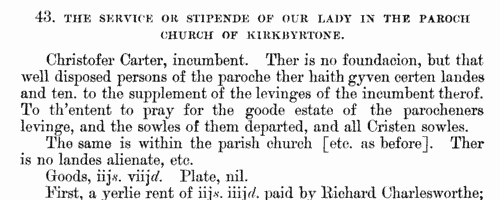
These sample scans are from the original record. You will get scans of the full pages or articles where the surname you searched for has been found. Your web browser may prevent the sample windows from opening; in this case please change your browser settings to allow pop-up windows from this site. Tenants, founders and incumbents of Yorkshire chantries
(1546-1548)
Chantries were established to perform services for the souls of their founders and other faithful dead, including annual obits and anniversaries at which alms were usually distributed. The chantries could be at an existing altar in a parish church, a new altar in a side chapel of an existing church, in a new chapel in the churchyard or some miles from an existing church: few were founded before 1300, and most date from 1450 to 1500. Hospitals were places provided by similar foundations to receive the poor and weak; there were also religious guilds, brotherhoods and fraternities, and colleges (like large chantries at which three or more secular priests lived in common). An Act of Parliament of 1545 gave king Henry VIII the power to dissolve such chantries, chapels, &c., the proceeds to be devoted to the expenses of the wars in France and Scotland. Commissioners were appointed 14 February 1546 to survey the chantries and seize their property, and from 1546 to 1548 the commissioners produced these certificates giving brief details of the establishment and nature of each foundation, with an inventory of valuables and rental of lands. The individuals named in the certificates are thus the founder, the present incumbent, and the tenants whose rents provided the chantry's income. All the surviving certificates were edited by William Page for the Surtees Society, and published from 1892.CRABTREE. Cost: £6.00.  | Sample scan, click to enlarge
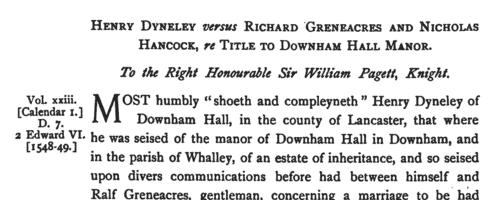
| Inhabitants of Lancashire
(1547-1558)
Pleadings and depositions in the Duchy Court of Lancaster from the 1st year of Edward VI to the 5th and 6th of Philip and Mary were edited by lieutenant-colonel Henry Fishwick for the Lancashire and Cheshire Record Society and published in 1899. The records include some long and detailed depositions about the precise facts of the cases: whereas plaintiffs and defendants were by and large from the landed gentry, deponents were often of much humbler stations in life, people who otherwise hardly appear in surviving records.CRABTREE. Cost: £4.00. | Sample scan, click to enlarge
| London Marriage Allegations
(1521-1610)
London, Essex and part of Hertfordshire lay within the diocese of London. In the later 17th century the individual archdeaconry courts issued marriage licences, but for this period the only surviving material is from the overarching London Consistory court. The main series of marriage allegations from the consistory court starts 7 December 1597, and these were extracted by Colonel Joseph Lemuel Chester; Colonel Chester then discovered earlier material, back to 5 January 1521, in Vicar-General's Books of the Principal Probate Registry. The notices in these books were much briefer, but as well as extending back so much earlier, they included additional material for 1597 onwards. All this he collated with the consistory court extracts, and the text was edited by George J. Armytage and published by the Harleian Society in 1887. A typical later entry will give date; name, address and occupation of groom; name, address and condition of his intended bride, and/or, where she is a spinster, her father's name, address and occupation. Lastly we have the name of the church where the wedding was going to take place; or the words Gen. Lic. signifying a general or open licence.CRABTREE. Cost: £4.00. | Sample scan, click to enlarge

| Lancashire and Cheshire Marriage Licences
(1606-1616)
Licences for intended marriages in Chester archdeaconry, which covered Cheshire and Lancashire south of the Ribble (by far the most populous part of that county)CRABTREE. Cost: £4.00. | Sample scan, click to enlarge

| Official Papers
(1623)
The State Papers Domestic cover all manner of business relating to Britain, Ireland and the colonies, conducted in the office of the Secretary of State as well as other miscellaneous records. Includes some material from previous years, as early as 1603.
CRABTREE. Cost: £4.00. | Sample scan, click to enlarge

| Yorkshire Marriage Licences
(1628)
William Paver, a 19th-century Yorkshire genealogist, made brief abstracts of early marriage licences (now lost) in York RegistryCRABTREE. Cost: £4.00. | Sample scan, click to enlarge

| Wills proved at York: Names of Testators
(1627-1637)
The diocese of York comprised most of Yorkshire, and Nottinghamshire: the York Exchequer court was the ordinary probate jurisdiction for the Yorkshire part of the diocese, but some wills from Nottinghamshire and other parts of the province of York were also proved there. Dr Francis Collins compiled this index to the transcribed wills of the Prerogative and Exchequer Courts in the York registry proved from 1627 to 1637. The date on the left is that of probate; the testator's full name is then given (surname first), parish or place of abode, and sometimes occupation, and date that the will was executed; and volume and folio number where it the transcript commences. The Act Books were used by Dr Collins to supply deficiencies in the information from the transcripts.CRABTREE. Cost: £2.00. | Sample scan, click to enlarge

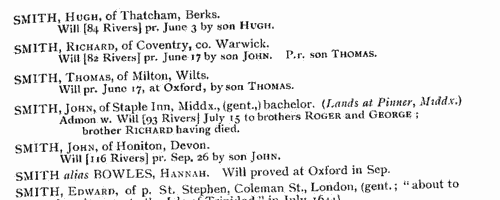
| PCC Probates and Administrations
(1645)
The Prerogative Court of Canterbury's main jurisdiction was central and southern England and Wales, as well as over sailors &c dying abroad: these brief abstracts, compiled under the title "Year Books of Probates", and printed in 1906, usually give address, date of probate and name of executor or administrator. They are based on the Probate Act Books, cross-checked with the original wills, from which additional details are, occasionally, added. The original spelling of surnames was retained, but christian and place names have been modernised where necessary.CRABTREE. Cost: £2.00. | Sample scan, click to enlarge
| London Marriage Allegations
(1611-1660)
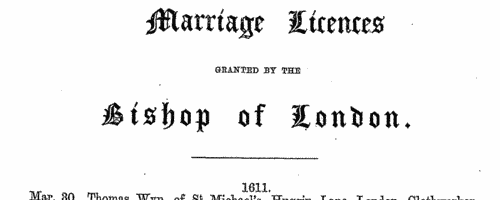
London, Essex and part of Hertfordshire lay within the diocese of London. In the later 17th century the individual archdeaconry courts issued marriage licences, but for this period the only surviving material is from the overarching London Consistory court. The main series of marriage allegations from the consistory court was extracted by Colonel Joseph Lemuel Chester, and the text was edited by George J. Armytage and published by the Harleian Society in 1887. A typical later entry will give date; name, address and occupation of groom; name, address and condition of his intended bride, and/or, where she is a spinster, her father's name, address and occupation. Lastly we have the name of the church where the wedding was going to take place. For the later years Colonel Chester merely picked out items that he thought were of interest, and his selections continue as late as 1828, but the bulk of the licences abstracted here are from the 17th century.CRABTREE. Cost: £4.00. | Sample scan, click to enlarge
| York Will Calendar
(1660-1665)
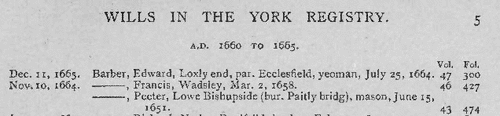
The diocese of York comprised most of Yorkshire, and Nottinghamshire: the York Exchequer court was the ordinary probate jurisdiction for the Yorkshire part of the diocese, but some wills from Nottinghamshire and other parts of the province of York were also proved there. Dr Francis Collins compiled this index to the wills in the York registry proved from 1660 to 1665. The date of the probate precedes the name of the testator: during the period covered by the volume the dates of probate are very rarely given in the registers - they were therefore supplied from the Act Books. However, the Act Book for Ainsty, City and Craven deaneries is missing for this period, and in those cases no date could be given. In a very few instances (marked with an asterisk) in these deaneries in which the date has been supplied it has been taken from the registers. Additional matter from the Act Books is given within square brackets. Testators' names are given in full, surname first; then parish or place of abode, and in some cases occupation; then date of the will itself; and volume and folio number in the probate register. Where a place of burial, or intended burial, was indicated, that is also added, with the word 'bur.', within round brackets. All wills between 1652 and 1660 were proved in London; in practice, many Yorkshire wills had remained unproved at the date that the York Exchequer probate court was restored, and so there is in this list a large number of wills dating back through the 1650s.CRABTREE. Cost: £2.00. | Sample scan, click to enlarge
|
Research your ancestry, family history, genealogy and one-name study by direct access to original records and archives indexed by surname.
|