Our indexes 1000-1999 include entries for the spelling 'coale'. In the period you have requested, we have the following 47 records (displaying 1 to 10): Open Access | | | Buying all 47 results of this search individually would cost £240.00. But you can have free access to all 47 records for a year, to view, to save and print, for £100. Save £140.00. More... |
|
These sample scans are from the original record. You will get scans of the full pages or articles where the surname you searched for has been found. Your web browser may prevent the sample windows from opening; in this case please change your browser settings to allow pop-up windows from this site. Tradesmen of Lynn in Norfolk
(1292-1836) Lists of admissions of freemen of Lynn from the earliest surviving records to 1836 were published by the Norfolk and Norwich Archaeological Society in 1913. These lists were extracted from the tallage rolls of 1291 to 1306; the Red Register of Lynn from 1342 to 1395; from the assembly rolls for the reigns of Henry IV and V [1399 to 1422]; from the hall books from 1423; and from a list of freemen starting in 1443 in the Book of Oaths (but itself abstracted from entries in the hall books). Freedom of the borough, necessary to practise a trade there, could be obtained by birth (in which case the father's name and occupation are usually given); by apprenticeship to a freeman (the master's name and occupation being given); by gratuity; or by purchase. Both the freemen and the masters listed are indexed here. The main abbreviations used are: B., freedom taken up by right of birth; A., freedom taken up by right of apprenticeship; G., freedom granted by order of assembly (gratuity); and P., freedom acquired by purchase.COALE. Cost: £4.00.  |
Sample scan, click to enlarge | Freemen of Canterbury by Apprenticeship
(1392-1800) No man or woman could trade in the city of Canterbury without having obtained 'freedom' of the city, unless they paid an annual fee to do so. Admissions of freemen were recorded on the Chamberlains' Accounts of the city, which were prepared annually from Lady Day (25 March) to Lady Day until 1752, and thereafter each set runs from 1 January to 31 December. The accounts for 1392 are incomplete, but thereafter until 1800 there is a complete series except for the years 1455 to 1457 and the year 1552-3. Joseph Meadows Cowper, Honorary Librarian to the Corporation, produced this extract of the names from 1392 to 1800, and the volume was privately printed in 1903. There are five groups of freemen: those who obtained freedom after serving out an apprenticeship to a freeman; the children of freemen; those who married a freeman's daughter; those who claimed freedom by 'redemption', i. e. by purchase; and those who were honoured by a gift of the freedom from the Mayor and Court of Aldermen. Cowper published his lists divided into the five categories: the sample scan is from the list of those who obtained freedom by marriage. This is the index to those who gained their freedom by apprenticeship.COALE. Cost: £4.00.  |
Sample scan, click to enlarge | Wives and Masters of Freemen of Canterbury
(1392-1800) No man or woman could trade in the city of Canterbury without having obtained 'freedom' of the city, unless they paid an annual fee to do so. Admissions of freemen were recorded on the Chamberlains' Accounts of the city, which were prepared annually from Lady Day (25 March) to Lady Day until 1752, and thereafter each set runs from 1 January to 31 December. The accounts for 1392 are incomplete, but thereafter until 1800 there is a complete series except for the years 1455 to 1457 and the year 1552-3. Joseph Meadows Cowper, Honorary Librarian to the Corporation, produced this extract of the names from 1392 to 1800, and the volume was privately printed in 1903. There are five groups of freemen: those who obtained freedom after serving out an apprenticeship to a freeman; the children of freemen; those who married a freeman's daughter; those who claimed freedom by 'redemption', i. e. by purchase; and those who were honoured by a gift of the freedom from the Mayor and Court of Aldermen. Cowper published his lists divided into the five categories: the sample scan is from the list of those who obtained freedom by marriage. This is the index to all the stray names in the records: the wives and father-in-laws by whom freedom was acquired; the masters of apprentices; and other persons mentioned by the way in the record.COALE. Cost: £4.00.  |
Sample scan, click to enlarge | Boys at Eton
(1441-1698) King Henry VI founded a college at Eton in Buckinghamshire in 1440, 'to the praise, glory and honour of the Crucified, the exaltation of the most glorious Virgin His mother, and the establishing of holy Church His bride'. From this foundation has evolved the modern public school. Sir Wasey Sterry compiled a register for the college from 1441 to 1698, from a variety of surviving records, and including groundwork from his 'A List of Eton Commensals' of 1904, and R. A. Austen-Leigh's 'A List of Eton Collegers' of 1905. This resulting 'Eton College Register' was published in 1943. Because of the variety of underlying materials, the entries vary greatly in depth: some names survive only as a surname of not too certain date. In the fullest entries, the surname (often with a variant spelling) is given first, in bold, followed by the years of entry and leaving. The christian name is given next; then birthplace, and name of father. The initials K. S. (King's Scholar) indicate a scholar on the foundation. There will then follow a summary of the man's career, death, burial and probate; and the sources for the information, in italics, at the end of the entry.COALE. Cost: £4.00.  |
Sample scan, click to enlarge | Merchants and traders in Newcastle-upon-Tyne
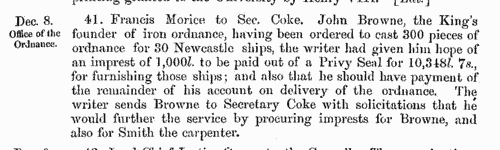
(1515-1898) The society of Merchant Adventurers of Newcastle-upon-Tyne consisted of those who had obtained freedom of the city (allowing them to trade there) by birth as a son of, or apprenticeship, to a freeman: and within that, freedom of one of the three 'trades', i. e. boothman, draper or mercer. F. W. Dendy prepared extracts from the merchant adventurers' records, the second volume, published by the Surtees Society in 1899 containing extracts from the minute books relating to the history of the merchants' court, an account of the long-standing dispute between the Newcastle company and the London company, some extracts relating to the relations between the Newcastle company and the Eastland Company (who had a monopoly of the trade with Russia and the Baltic), copies of the oaths used by the Newcastle company, the London company and the Eastland Company, and (pages 185 to 381) a list of the apprentices enrolled in, and of the freemen admitted to, the Newcastle company. This list is arranged in a table of seven columns: Name of Apprentice; Name of Father of Apprentice and Observations (particularly, instances where an apprentice is passed over to a new master during his apprenticeship); Master; Boothman (B.), Draper (D.) or Mercer (M.); Date of Indentures: Enrolment: Admission. All the dates are normalised to New Style, i. e. to the modern calendar. Finally, there is a list of sons and apprentices of members who, having thus acquired the right of freedom of the city, took up the freedom, but did not assume the freedom of any of the three trades. The index covers all the contents of the volume, not just the apprentice and freemen lists.COALE. Cost: £4.00.  |
Sample scan, click to enlarge | Inhabitants of Reading in Berkshire
(1550-1667) The borough of Reading in Berkshire comprised three ancient parishes - St Giles, St Lawrence and St Mary. The churchwardens' accounts of Reading St Mary from 1550 to 1667 were transcribed by Francis N. A. Garry and A. G. Garry and published in 1893. The accounts, usually signed off by the two churchwardens and two surveyors of the highways for the year, listed the income and expenditure of the church. Income included annual payments for seats in the pews; rents from church property; fees for the use of the pall and for tolling the knell (knill) at funerals, and for opening graves; and sums received for 'gatherings', i. e. money gathered from communicants at Easter, Hocktide, Mayday, Hallowmas, Christmas and Whit. Expenditure was largely on maintaining the church fabric, and paying the minor officials - most of the names found on this side of the account are of local workmen busy with repairs.COALE. Cost: £4.00.  |
Sample scan, click to enlarge | Nottinghamshire Marriage Licences
(1577-1700) Nottingham Archdeaconry, which was almost coextensive with the county of Nottingham, lay in the diocese and province of York, but it had substantially independent jurisdiction for both probate and the issuing of marriage licences. These are abstracts of the archdeaconry marriage licences: they usually state the groom's address, occupation, age, and condition; the bride's address, age and condition; and the names of the churches or parishes at which it was intended the marriage would be celebrated. Not all licences led to marriages. Where the age given is 21, it should be construed as '21 or over'. There was no obligation for the marriage to take place at the parish suggested, but the licence would only be valid within the county. These abstracts have been annotated with extra information found on the marriage bonds. 26 Nottinghamshire parishes (Beckingham, Darlton, Dunham, Eaton, North Leverton, Ragnall, Rampton, South Wheatley, Cropwell Bishop, Bleasby, Blidworth, Calverton, Caunton, Edingley, Farnsfield, Halloughton, Holme, Kirklington, Morton, North Muskham, Norwell, Oxton, South Muskham, Southwell, Upton and Woodborough) lay within the small peculiar jurisdiction of Southwell, which issued its own licences: abstracts of these for the period 1588 to 1754 are also included here.COALE. Cost: £4.00.  |
Sample scan, click to enlarge | Cecil Manuscripts
(1590-1594) Letters and papers of William Cecil lord Burghley, Lord Treasurer of England.COALE. Cost: £4.00.  |

Sample scan, click to enlarge | Middlesex Sessions
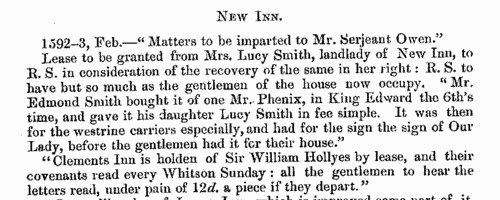
(1603-1625) Incidents from the Middlesex Sessions Books. These are abstracts of sessional orders, minutes of criminal cases, memoranda and other entries of record taken from the three volumes of Gaol Delivery Register, four volumes of Sessions of Peace Register and two volumes of Process Books of Indictments for the county of Middlesex from the reign of king James I. The references at the end of each item indicate the volume in question, the abbreviations being G. D. for Gaol Delivery, S. P. for Sessions of Peace, and S. O. T. for Session of Oyer and Terminer; occasionally preceded by S. for Special or G. for general, or followed by R. for Roll or Reg. for Register. It should be noted that, in the case of 'true bills' or indictments, the abstract starts with the date on which the offence took place, the date of the conviction &c. being at the end of the entry.COALE. Cost: £4.00.  |
Sample scan, click to enlarge | London Marriage Allegations
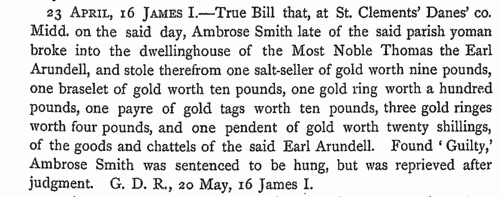
(1611-1660) London, Essex and part of Hertfordshire lay within the diocese of London. In the later 17th century the individual archdeaconry courts issued marriage licences, but for this period the only surviving material is from the overarching London Consistory court. The main series of marriage allegations from the consistory court was extracted by Colonel Joseph Lemuel Chester, and the text was edited by George J. Armytage and published by the Harleian Society in 1887. A typical later entry will give date; name, address and occupation of groom; name, address and condition of his intended bride, and/or, where she is a spinster, her father's name, address and occupation. Lastly we have the name of the church where the wedding was going to take place. For the later years Colonel Chester merely picked out items that he thought were of interest, and his selections continue as late as 1828, but the bulk of the licences abstracted here are from the 17th century.COALE. Cost: £4.00.  |
Sample scan, click to enlarge |
Research your ancestry, family history, genealogy and one-name study by direct access to original records and archives indexed by surname.

|
|