Boakes Surname Ancestry ResultsOur indexes 1000-1999 include entries for the spelling 'boakes'. In the period you have requested, we have the following 31 records (displaying 1 to 10): Single Surname Subscription | | | Buying all 31 results of this search individually would cost £172.00. But you can have free access to all 31 records for a year, to view, to save and print, for £100. Save £72.00. More... |
These sample scans are from the original record. You will get scans of the full pages or articles where the surname you searched for has been found. Your web browser may prevent the sample windows from opening; in this case please change your browser settings to allow pop-up windows from this site. Intended brides and grooms in East Sussex
(1670-1739)
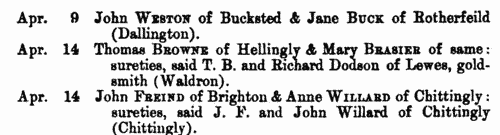
Sussex was in the Diocese of Chichester, divided into two archdeaconries - Chichester for west Sussex, Lewes for the east. Both archdeaconries exercised active probate jurisdictions, and issued marriage licences. Those issued by Lewes Archdeaconry court in this period were recorded in a series of registers (E3, E4, E5 and E6), which were edited by Edwin H. W. Dunkin and published by the Sussex Record Society in 1907. Each entry gives the date of the licence, the full names of bride and groom, with parish for each, and often stating whether the bride was a widow or maiden. To obtain a licence it was necessary for the parties to obtain a bond, with two sureties. One of these was often the prospective husband; the other might be a relative or other respectable person. From the bonds the names of the sureties were also copied into the register, together with the name of the church at which the wedding was intended to take place. These details are usually given until 1701; thereafter sureties and intended church are usually omitted. One deanery in Lewes archdeaconry, that of South Malling, was an exempt jurisdiction (or peculiar) of the Archbishop of Canterbury, which had separate probate and issued its own marriage licences, also recorded in a series of registers. This volume also includes the contents of registers C1 to C6 of the Deanery of South Malling, for marriage licences from 1620 to 1732. The details recorded are as with the main series, similarly lacking names of sureties and intended church after 1721. South Malling deanery comprised the parishes of Edburton, Lindfield, Buxted, Framfield, Isfield, Uckfield, Mayfield, Wadhurst, Glynde, Ringmer, St Thomas at Cliffe, South Malling and Stanmer. BOAKES. Cost: £4.00.  | Sample scan, click to enlarge
|  Masters and Apprentices
(1741) Masters and Apprentices
(1741)
Apprenticeship indentures and clerks' articles were subject to a 6d or 12d per pound stamp duty: the registers of the payments usually give the master's trade, address, and occupation, and the apprentice's father's name and address, as well as details of the date and length of the apprenticeship. 1 January to 31 December 1741BOAKES. Cost: £8.00. | Sample scan, click to enlarge

| Masters and Apprentices
(1747)
Apprenticeship indentures and clerks' articles were subject to a 6d or 12d per pound stamp duty: the registers of the payments usually give the master's trade, address, and occupation, and the apprentice's father's name and address, as well as details of the date and length of the apprenticeship.BOAKES. Cost: £8.00. | Sample scan, click to enlarge

| Electors in Goudhurst
(1835)
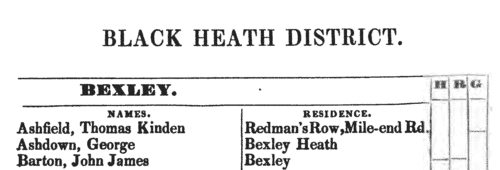
A poll to elect knights of the shire to represent the Western Division of the county of Kent in parliament was held in 1835, the candidates being Thomas Law Hodges (H), Thomas Rider (R) and sir William R. P. Geary (G). The poll started on January 19th; Rider withdrawing his name on that first day, the poll was closed prematurely, many electors not yet having voted. This poll book lists all the electors, whether they voted or not; the county franchise included not only male freeholders of 40s a year, but also £10 copyholders and long-leaseholders, and £50 short-leaseholders and tenants. For each elector the full name is given (surname first) and residence (often not the place for which qualified to vote). Votes are indicated by dashes in the right-hand columns. BOAKES. Cost: £4.00. | Sample scan, click to enlarge
| Electors in Sevenoaks
(1835)
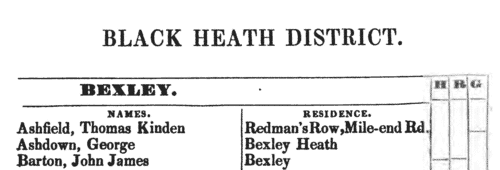
A poll to elect knights of the shire to represent the Western Division of the county of Kent in parliament was held in 1835, the candidates being Thomas Law Hodges (H), Thomas Rider (R) and sir William R. P. Geary (G). The poll started on January 19th; Rider withdrawing his name on that first day, the poll was closed prematurely, many electors not yet having voted. This poll book lists all the electors, whether they voted or not; the county franchise included not only male freeholders of 40s a year, but also £10 copyholders and long-leaseholders, and £50 short-leaseholders and tenants. For each elector the full name is given (surname first) and residence (often not the place for which qualified to vote). Votes are indicated by dashes in the right-hand columns. BOAKES. Cost: £4.00. | Sample scan, click to enlarge
| British merchant seamen
(1835-1840)
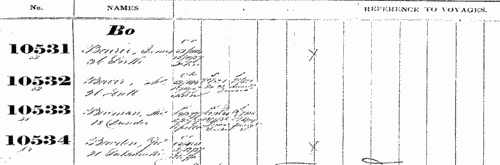
At this period, the foreign trade of ships plying to and from the British isles involved about 150,000 men on 15,000 ships; and the coasting trade about a quarter as many more. A large proportion of the seamen on these ships were British subjects, and so liable to be pressed for service in the Royal Navy; but there was no general register by which to identify them, so in 1835 parliament passed a Merchant Seamen's Registration Bill. Under this act a large register of British seamen was compiled, based on ships' crew lists gathered in British and Irish ports, and passed up to the registry in London. A parliamentary committee decided that the system devised did not answer the original problem, and the original register was abandoned after less than two years: the system was then restarted in this form, with a systematic attempt to attribute the seamen's (ticket) numbers, and to record successive voyages. The register records the number assigned to each man; his name; age; birthplace; quality (S = seaman, &c.); and the name and official number of his ship, with the date of the crew list (usually at the end of a voyage). Most of the men recorded were born in the British Isles, but not all. The system was still very cumbersome, because the names were amassed merely under the first two letters of surname; an attempt was made to separate out namesakes by giving the first instance of a name (a), the second (b), and so on. During 1840 this series of ledgers was abandoned, and a new set started with names grouped together by surname. BT 112/7BOAKES. Cost: £8.00. | Sample scan, click to enlarge
| Persons of standing recommending London police recruits
(1830-1842)
The Metropolitan Police Register of Joiners (MEPO 333/4) lists policemen joining the force through to 31 December 1842 (to warrant number 19892). The register is alphabetical, in so far as the recruits are listed chronologically grouped under first letter of surname. It is evidently a continuation of a similar earlier register, not closed until its alphabetical sections were filled: consequently, there are no entries in this register for the initial letters N, O, Q, U, V, X, Y or Z; and the sections of this register start at different dates - A 18 April 1840 (warrant number 16894); B 11 December 1830 (5570); C 7 September 1830 (4988); D 27 May 1833 (8445); E 15 December 1838 (14476); F 30 March 1832 (7372); G 1 December 1835 (11,184); H 25 April 1832 (7457); I and J 13 February 1837 (12449); K 2 January 1838 (13457); L 3 October 1834 (9905); M 15 November 1832 (7999); P 4 October 1831 (6869); R 4 September 1837 (13021); S 30 March 1835 (10366); T 6 April 1840 (16829); W 30 December 1833 (9096). The register gives Date of Appointment, Name, Number of Warrant, Cause of Removal from Force (resigned, dismissed, promoted or died), and Date of Removal. Those recruits not formerly in the police, the army, or some government department, were required to provide (normally) at least two letters of recommendation from persons of standing, and details of these are entered on the facing pages: the names in these are indexed here (the police recruits are indexed separately and not included here). Recruits transferred from other forces or rejoining the force did not normally need recommendations - in the latter case, former warrant numbers are given - but some recommendations are from police inspectors, even other constables. Recruits coming from the army sometimes have general military certificates of good conduct, but most often have a letter from their former commanding officer; recruits recommended by government departments (most often the Home Office) similarly have letters from the head of department. But the great majority of the names and addresses in these pages are of respectable citizens having some sort of personal acquaintance with the recruit. Where more than two recommendations were provided, the clerk would only record one or two, with the words 'and others'. Tradesmen are sometimes identified as such by their occupations; there are some gentry. Although the great bulk of these names are from London and the home counties, a scattering are from further afield throughout Britain and Ireland. BOAKES. Cost: £8.00. | Sample scan, click to enlarge

| Traders and professionals in London
(1851)
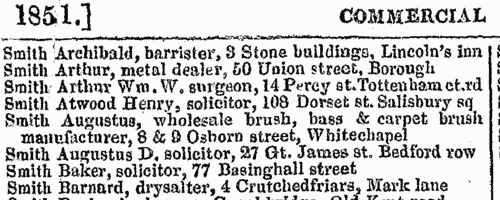
The Post Office London Directory for 1851 includes this 'Commercial and Professional Directory', recording about 80,000 individuals. BOAKES. Cost: £4.00. | Sample scan, click to enlarge
| Members of the London & County Joint Stock Banking Company
(1853)
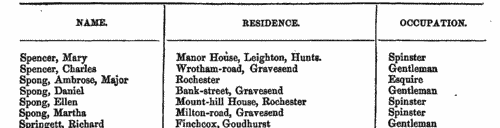
Inland Revenue copy of the return under 7 & 8 Vic. cap. 32 listing persons of whom the company or partnership consists: giving name, residence and occupation. 23 February 1853BOAKES. Cost: £4.00. | Sample scan, click to enlarge
| Sailors and marines on H. M. S. Cyclops in the Crimean War
(1854-1856)
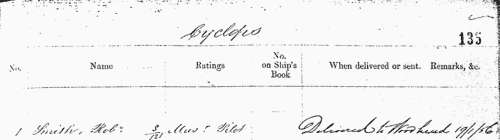
Sebastopol in the Crimea was the great Russian naval arsenal on the Black Sea. A combined assault by British, French and Turkish troops resulted in the reduction of Sebastopol and led to the Treaty of Paris of 27 April 1856, guaranteeing the independence of the Ottoman Empire. By Admiralty Order the Crimea Medal was awarded to sailors and marines present during the campaign, between 17 September 1854 (the first landing at Eupatoria) and 9 September 1855 (when the allies secured Sebastopol). The sailors' medals were mostly delivered to them on board ship in the course of 1856; the marines' medals were sent to their respective headquarters for distribution. The remarks as to distribution in this medal roll therefore give more specific information as to the whereabouts of the sailor recipients in 1856 than about the marines. Her Majesty's Ship Cyclops, a 6-gun steam ship, took part in the assault. Four clasps to this medal were awarded to the men present in the actions at Sebastopol itself, Inkerman, Balaklave (Balaclava) and (the sea of) Azoff, but the recipients of these clasps are recorded on separate rolls, not part of this index, but indexed on this site.BOAKES. Cost: £8.00. | Sample scan, click to enlarge
|
Research your ancestry, family history, genealogy and one-name study by direct access to original records and archives indexed by surname.
|