Boake Surname Ancestry ResultsOur indexes 1000-1999 include entries for the spelling 'boake'. In the period you have requested, we have the following 32 records (displaying 1 to 10): Single Surname Subscription | | | Buying all 32 results of this search individually would cost £172.00. But you can have free access to all 32 records for a year, to view, to save and print, for £100. Save £72.00. More... |
These sample scans are from the original record. You will get scans of the full pages or articles where the surname you searched for has been found. Your web browser may prevent the sample windows from opening; in this case please change your browser settings to allow pop-up windows from this site. Intended Brides in Yorkshire
(1627)
William Paver, a 19th-century Yorkshire genealogist, made brief abstracts of early marriage licences (now lost) in York Registry. His manuscript, which became Additional Manuscripts 29667 in the British Museum, was transcribed by J. W. Clay, F. S. A., and printed in various issues of the Yorkshire Archaeological Journal: this is from the volume for 1903. Paver did not note the dates of the licences, merely listing them by year: his abstracts give the names and addresses of both parties, and the name of the parish church in which it was intended that the wedding would take place.BOAKE. Cost: £4.00.  | Sample scan, click to enlarge

| Inhabitants of Dublin
(1805)
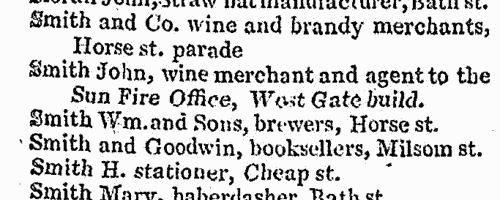
Holden's Triennial Directory of 1805 to 1807 included a provincial section, listing professional people and traders in England, Wales, Scotland and Ireland. (The sample scan here is from the listing for Bath)BOAKE. Cost: £6.00. | Sample scan, click to enlarge
| Owners of Merchantmen
(1822)
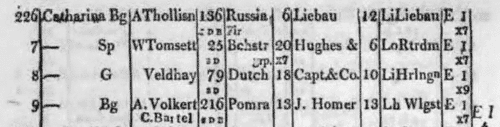
The Society for the Registry of Shipping was instituted in 1760, and published an annual register and supplement. The annual register consisted of an alphabetical list of ships surveyed for insurance in Britain and Ireland, together with an alphabetical supplement. The society maintained a Registry Office at which alterations and additions were notified, and members delivering their registers when called for had them updated and returned on the following or the ensuing day. Each ship was given a number within each letter of the alphabet: ships' names were not unique, so within each name a ship was identified by the name of the captain or master at the time of the last survey. Then abbreviations indicate the type of vessel (Bg, brig; Bk, barque; Cr, cutter; Dr, dogger; G, galliott; H, hoy; K, ketch; S, ship; Sk, smack; Sp, sloop; Sr, schooner; St, schoot; Sw, snow), and whether sheathed (s) and/or doubled (d) with copper (C) and iron bolts (I B) or over boards (W & C), patent felt (P F), copper fastened (c f), copper bolted (c b), or copper repaired (C rp) sometimes with a date, such as (18)18. The third column, reserved for masters' names, is not particularly wide; with short surnames, an initial will be given; but longer surnames omit the initials, and even longer surnames are abbreviated. It will be borne in mind that these are the names of the masters not (necessarily) in 1822, but at the time of the last survey. Often new masters had been appointed by the time of re-survey, and their names are added in slightly smaller type under the original master's names in the third column. In the fourth column is the tonnage: where there is a blank under the number this indicates that the ship had two decks; more often the letters S D (B) for single deck (with beams); D W for deep waist; S D W single deck with deep waist; B D W single deck with beams and deep waist. Underneath the entry may run references to recent repairs: Cl. clincher built; Drp. damages repaired; grp. good repair; len. lengthened; lrp. large repair; N. (new) B. bottom, D. deck, Kl. keel, Sds. sides or UW. upper-works; rb. rebuilt; rsd. raised; Srprs. some repairs; or trp. thorough repair. In italics, the timber of the ship is described - B. B., black birch; C., cedar; H., hazel; Hk., hackmetack; J., juniper; L. O., live oak; M., mahogany; P., pine; P. P., pitch pine; S., spruce; W. H., witch hazel; W. O., white oak. The fifth column gives the place that the ship was built. For foreign ships this may be as vague as 'Dutch' or 'French'; but nothing in this record specifically indicates the nationality of ship, master or owners, except that an A. under the owner's name indicates that the vessel was American property. The sixth column gives the year of the ship's age; a few were still sailing after 30 or 40 years. The seventh column gives the owner's name, abbreviated in the same way as the master's name. Where the master was the owner, the word Capt. will appear. With vessels owned abroad, the name in this column is sometimes that of the port of origin, not the surname of the owner. Where there has been a change of owner by the time of re-survey, the new name is put underneath in smaller type. The printer sought to avoid confusion by aligning names of ports to the left and surnames to the right, but that leaves longer names doubtful. The eighth column gives the feet of the draught of water when loaded. The ninth column shows the destined voyage for which the survey took place, with the port of survey abbreviated (Be., Belfast; Br., Bristol; Co., Cork; Cs, Cowes; Da., Dartmouth; Du., Dublin; Eh, Exmouth; Ex., Exeter; Fa., Falmouth; Gr., Greenock; Hl, Hull; Hn, Harrington; La., Lancaster; Lh, Leith; Li., Liverpool; Lo., London; Ly., Lynn; Mt., Maryport; Po., Poole; Ph, Portsmouth; Pl., Plymouth; Sc., Star-Cross; Tn., Teignmouth; Tp., Topsham; Wa., Waterford; Wn, Whitehaven; Wo., Workington; Ya., Yarmouth), and the letter C where the vessel was a constant trader between the two ports. The tenth column gives the classification of the vessel (A, first; E, second) and its stores (1, first; 2, second) and the year of survey, e. g. 09 for 1809, or, if surveyed during 1821, the month, e. g. 3 for March. Where the vessel has been re-surveyed, the classification letter and number will be repeated or revised in the final column. The sample scan is from the main list. This is the index to owners in the main list and the supplement.BOAKE. Cost: £6.00. | Sample scan, click to enlarge
| Irish Insolvents
(1829)
Insolvency notices for Ireland: insolvency often caused people to restart their lives elsewhere, so these are an important source for lost links, especially for emigrantsBOAKE. Cost: £6.00. | Sample scan, click to enlarge

| Merchants and Traders in Dublin (1830)
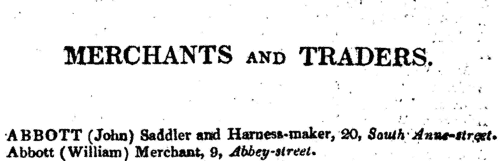
Wilson's Dublin Directory for the year 1830 lists merchants and traders alphabetically by surname, with christian name or initials, trade, and (in italics) address.
BOAKE. Cost: £8.00. | Sample scan, click to enlarge
| Deaths, Marriages, News and Promotions
(1838)
Death notices and obituaries, marriage and birth notices, civil and military promotions, clerical preferments and domestic occurrences, as reported in the Gentleman's Magazine. Mostly from England and Wales, but items from Ireland, Scotland and abroad.
BOAKE. Cost: £4.00. | Sample scan, click to enlarge

|  London Policemen
(1830-1842) London Policemen
(1830-1842)
The Metropolitan Police Register of Joiners (MEPO 333/4) lists policemen joining the force through to 31 December 1842 (to warrant number 19892). The register is alphabetical, in so far as the recruits are listed chronologically grouped under first letter of surname. It is evidently a continuation of a similar earlier register, not closed until its alphabetical sections were filled: consequently, there are no entries in this register for the initial letters N, O, Q, U, V, X, Y or Z; and the sections of this register start at different dates - A 18 April 1840 (warrant number 16894); B 11 December 1830 (5570); C 7 September 1830 (4988); D 27 May 1833 (8445); E 15 December 1838 (14476); F 30 March 1832 (7372); G 1 December 1835 (11,184); H 25 April 1832 (7457); I and J 13 February 1837 (12449); K 2 January 1838 (13457); L 3 October 1834 (9905); M 15 November 1832 (7999); P 4 October 1831 (6869); R 4 September 1837 (13021); S 30 March 1835 (10366); T 6 April 1840 (16829); W 30 December 1833 (9096). The register gives Date of Appointment, Name, Number of Warrant, Cause of Removal from Force (resigned, dismissed, promoted or died), and Date of Removal. Although the register was closed for new entrants at the end of 1842, the details of removals were always recorded, some being twenty or more years later. Those recruits not formerly in the police, the army, or some government department, were required to provide (normally) at least two letters of recommendation from persons of standing, and details of these are entered on the facing pages: the names in these are indexed separately - this index refers only to the police constables. Where a recruit was only recently arrived in the metropolis, the names and addresses of the recommenders can be invaluable for tracing where he came from.BOAKE. Cost: £8.00. | Sample scan, click to enlarge

| Ceylon Bridegrooms
(1843)
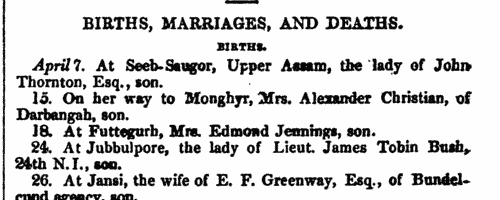
The Indian Mail, 'A Monthly Register for British & Foreign India, China, & Australasia' commenced publication 9 May 1843 as a continuation of the digest of Eastern intelligence that thitherto had formed a part of the Asiatic Journal. The Register section contained notices of births, marriages and deaths from the presidencies of Calcutta (extending across northern India, and into Burma), Madras, and Bombay (including Aden), as well as Australasia, Ceylon, China, Cape of Good Hope, Mauritius, and Singapore.
BOAKE. Cost: £6.00. | Sample scan, click to enlarge
| Deaths, Marriages, News and Promotions
(1843)
Death notices and obituaries, marriage and birth notices, civil and military promotions, clerical preferments and domestic occurrences, as reported in the Gentleman's Magazine. Mostly from England and Wales, but items from Ireland, Scotland and abroad.
BOAKE. Cost: £4.00. | Sample scan, click to enlarge

| Residents of Carlow (1846)
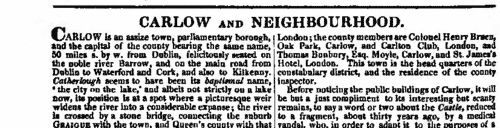
Professionals and tradespeople listed in Carlow and neighbourhood in Slater's Directory of Ireland
BOAKE. Cost: £8.00. | Sample scan, click to enlarge
|
Research your ancestry, family history, genealogy and one-name study by direct access to original records and archives indexed by surname.
|