Blythe Surname Ancestry ResultsOur indexes 1000-1999 include entries for the spelling 'blythe'. In the period you have requested, we have the following 380 records (displaying 1 to 10): Single Surname Subscription | | | Buying all 380 results of this search individually would cost £2,102.00. But you can have free access to all 380 records for a year, to view, to save and print, for £100. Save £2,002.00. More... |
These sample scans are from the original record. You will get scans of the full pages or articles where the surname you searched for has been found. Your web browser may prevent the sample windows from opening; in this case please change your browser settings to allow pop-up windows from this site. Clerks and Clergy in Yorkshire, Nottinghamshire, and parts of Lancashire, Westmorland, and Northumberland
(1215-1255)
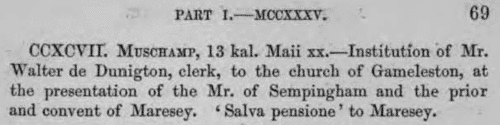
The register of archbishop Walter Gray of York, containing general diocesan business, mostly relating to clergy. The diocese of York at this period covered all of Yorkshire and Nottinghamshire, as well as Lancashire north of the Ribble, southern Westmorland, and Hexhamshire in Northumberland. The register survives as two rolls (called the Major and the Minor), in all amounting to nearly 71 feet of parchment. It is thought that a third roll or more has been lost, because the acts of the archbishop for the last ten years of his episcopate are missing, as are all the ordination and ecclesiastical discipline records for his reign. The then unpublished parts of the register were edited for the Surtees Society by James Raine and printed in 1870, with some additional material included in appendices.BLYTHE. Cost: £4.00.  | Sample scan, click to enlarge
| Clerks and Clergy in Yorkshire, Nottinghamshire, and parts of Lancashire
(1266-1279)
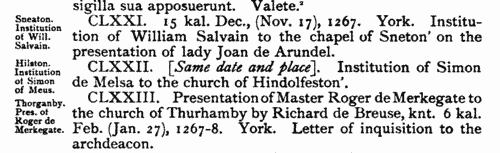
The register of archbishop Walter Giffard of York, containing general diocesan business, mostly relating to clergy, was edited by William Brown for the Surtees Society and published in 1904. The ancient diocese of York covered all of Yorkshire and Nottinghamshire, as well as Lancashire north of the Ribble, southern Westmorland, and Hexhamshire in Northumberland. But there are few entries relating to the archdeaconry of Richmond, and few about the peculiar jurisdictions of Southwell, Ripon, Beverley and Hexham. The dioceses of Carlisle and Durham, both in the province of York, are hardly mentioned. Archbishop Giffard spent much of his pontificate away from his diocese, and the register has gaps: but at least it survives, unlike those for his immediate predecessors, Sewall de Boville (1256-1258) and Godfrey de Ludham (1258-1264). Moreover, there are ordination lists (pages 187 to 198) of acolytes, subdeacons, deacons and priests ordained in 1267 to 1274. These usually give full name, and indicate whether the man was 'religious' (a monk or friar), and whether his 'title' (sponsorship) arose from his own patrimony, but 'title' is not usually otherwise specified. BLYTHE. Cost: £4.00. | Sample scan, click to enlarge
| Inhabitants of London
(1275-1298)
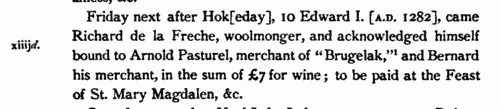
Liber Horn or the Lesser Black Book, now known as Letter Book A of the City of London contains enrolments of recognizances between inhabitants, particularly citizens, for sums of money lent or due; grants of pieces of land or property; and various records relating to the city administration. The letter books are so called because they were lettered from A to Z and from AA to ZZ, not because they were books of letters. Letter Book A was edited by Reginald R. Sharpe for the corporation and printed in 1899.
BLYTHE. Cost: £4.00. | Sample scan, click to enlarge
| Inhabitants of London
(1275-1312)
Letter Book B of the City of London contains enrolments of recognizances between inhabitants, particularly citizens, for sums of money lent or due; grants of pieces of land or property; and various records relating to the city administration.
BLYTHE. Cost: £4.00. | Sample scan, click to enlarge
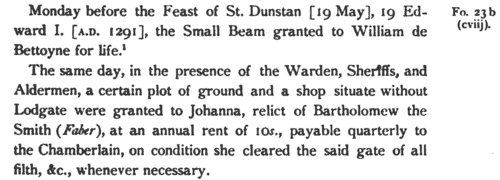
| Close Rolls
(1313-1318)
The close rolls of the 7th, 8th, 9th, 10th and 11th years of the reign of king Edward II record the main artery of government administration in England, the orders sent out day by day to individual officers, especially sheriffs of shires: they are an exceptionally rich source for so early a period. In amongst this official material, the rolls were also used as a way of recording many acknowledgments of private debts and contracts between individuals. Most of the contents relate to England, but there are also entries concerning Wales, Scotland, Ireland and the English possessions in France.BLYTHE. Cost: £4.00. | Sample scan, click to enlarge
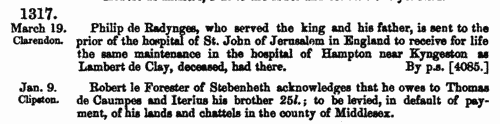
| Grantees of offices, commissions and pardons
(1317-1321)
The Patent Rolls are the Chancery enrolments of royal letters patent. Those for the 11th to the 14th years of the reign of king Edward II (8 July 1317 to 7 July 1321) were edited for the Public Record Office by G. F. Handcock, and published in 1903. The main contents are royal commissions and grants; ratifications of ecclesiastical estates; writs of aid to royal servants and purveyors; and pardons. Most extensive are the commissions of oyer and terminer to justices to investigate complaints about specific crimes and wrongs in particular counties.BLYTHE. Cost: £2.00. | Sample scan, click to enlarge
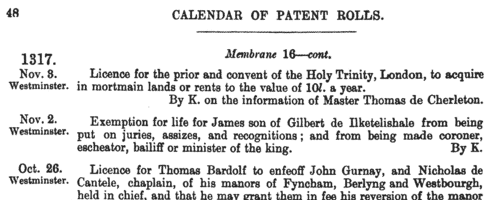
| Inhabitants of Warwickshire
(1332)
This lay subsidy roll for Warwickshire records the tax of a tenth and a fifteenth on the laity of the county at Michaelmas 1332. The record is arranged by boroughs, ancient demesnes, and hundreds, and within hundreds by township. The roll was translated and edited by William Fowler Carter and published by the Dugdale Society in 1926, with an appendix printing the lay subsidy rolls for Stratford-upon-Avon of 1309, 1313 and 1332, and a brief extract from an assize roll of 1323 inquiring about irregularities in the levying of the tax.BLYTHE. Cost: £4.00. | Sample scan, click to enlarge
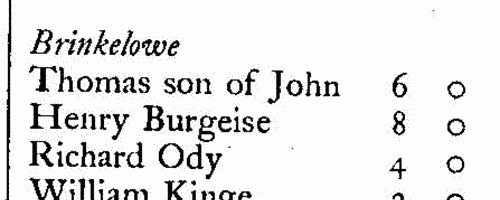
| Close Rolls
(1343-1346)
The close rolls of the 17th, 18th and 19th years of the reign of king Edward III record the main artery of government administration in England, the orders sent out day by day to individual officers, especially sheriffs of shires: they are an exceptionally rich source for so early a period. There is also some material relating to Wales, Scotland, Ireland and the English possessions in France.BLYTHE. Cost: £4.00. | Sample scan, click to enlarge

| Inhabitants of London
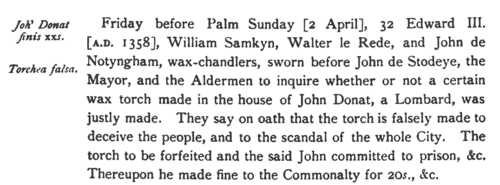
(1352-1374)
Letter Book G of the City of London contains enrolments of recognizances between inhabitants, particularly citizens, for sums of money lent or due; grants of pieces of land or property; and various records relating to the city administration.
BLYTHE. Cost: £4.00. | Sample scan, click to enlarge
| Inhabitants of Yorkshire: Strafforth wapentake
(1379)
The poll tax returns for this wapentake, the area around Rotherham and Sheffield.BLYTHE. Cost: £6.00. | Sample scan, click to enlarge

|
Research your ancestry, family history, genealogy and one-name study by direct access to original records and archives indexed by surname.
|