Axe Surname Ancestry ResultsOur indexes 1000-1999 include entries for the spelling 'axe'. In the period you have requested, we have the following 74 records (displaying 1 to 10): Single Surname Subscription | | | Buying all 74 results of this search individually would cost £412.00. But you can have free access to all 74 records for a year, to view, to save and print, for £100. Save £312.00. More... |
These sample scans are from the original record. You will get scans of the full pages or articles where the surname you searched for has been found. Your web browser may prevent the sample windows from opening; in this case please change your browser settings to allow pop-up windows from this site. Dublin Merchants
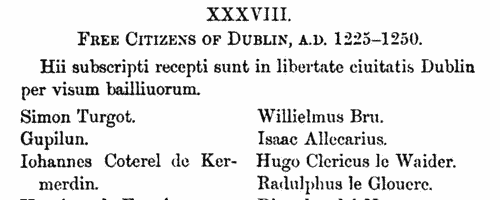
(1180-1200)
In 1870 documents of the Anglo-Normans in Ireland from 1172 to 1320, edited by J. T. Gilbert, Secretary of the Public Record Office of Ireland, were printed in the Rerum Britannicarum Medii Aevi Scriptores series. These include transcripts of the Dublin guild merchant rolls surviving from that period, which we have now indexed. This, the earliest of these rolls, is damaged, but can be dated to about 1180 to 1200. Those named, although enjoying the privilege of trading in Dublin, were not necessarily resident there, and in several cases a name will be followed by an English address, such as 'de Wigornia' (from Worcester).AXE. Cost: £6.00.  | Sample scan, click to enlarge
| Patent Rolls: entries for Gloucestershire
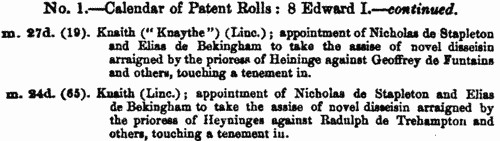
(1279-1280)
Calendars of the patent rolls of the reign of king Edward I are printed in the Calendars of State Papers: but these cover only a fraction of the material on the rolls. From 1881 to 1889 the reports of the Deputy Keeper of the Public Record Office also include calendars of other material from the rolls - about five times as many entries as in the State Papers - predominantly mandates to the royal justices to hold sessions of oyer and terminer to resolve cases arising locally; but also other general business. The calendar for the 8th year of king Edward I [20 November 1279 to 19 November 1280], hitherto unindexed, is covered here.AXE. Cost: £6.00. | Sample scan, click to enlarge
| Chancery Warrants
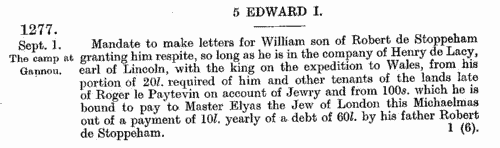
(1244-1326)
Warrants were issued by the kings of England to the royal chancery: most of these warrants led to further proceedings which are recorded on the Charter Rolls, Patent Rolls, Fine Rolls, Close Rolls or the Inquisitions: but archivists have identified a large number of warrants for which there are no such equivalent records, and those for the reigns of Edward I and Edward II are gathered here. Most of the entries relate to England and Wales, but with occasional items referring to Ireland and the English possessions in France.AXE. Cost: £4.00. | Sample scan, click to enlarge
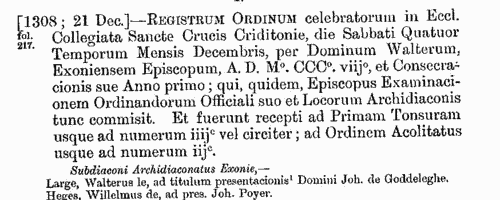
| Clerks and Clergy in Cornwall and Devon
(1307-1326)
The register of bishop Walter de Stapeldon of Exeter, containing general diocesan business, but in particular including ordination lists for monks and clergy. Only a small proportion of the clerks went on to acquire benefices and remained celibate. LatinAXE. Cost: £6.00. | Sample scan, click to enlarge
| Close Rolls
(1343-1346)
The close rolls of the 17th, 18th and 19th years of the reign of king Edward III record the main artery of government administration in England, the orders sent out day by day to individual officers, especially sheriffs of shires: they are an exceptionally rich source for so early a period. There is also some material relating to Wales, Scotland, Ireland and the English possessions in France.AXE. Cost: £4.00. | Sample scan, click to enlarge

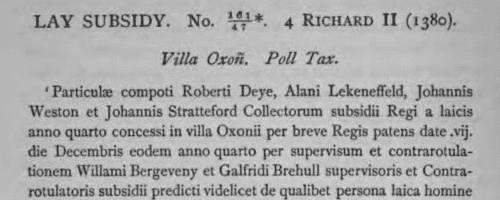
| Inhabitants of the city of Oxford
(1380)
The poll tax granted in 1379 was assessed and raised in the following two years. Every lay person, man or woman, aged over 15 was to be taxed. The returns for the city of Oxford, edited by J. E. Thorold Rogers, were printed for the Oxford Historical Society in 1891.AXE. Cost: £4.00. | Sample scan, click to enlarge
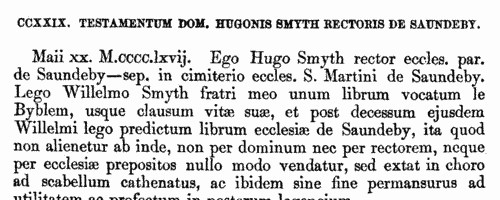
| Yorkshire Testators and Legatees
(1426-1466)
Wills and testaments from the diocese of York (Yorkshire, Nottinghamshire, Hexhamshire, Lancashire north of the Ribble, and southwest Westmorland) registered at York. Richmond and Southwell archdeaconries had their own lower probate jurisdictions, so the wills registered at York are predominantly from the East and West Ridings and the eastern part of the North Riding of Yorkshire. In theory, wills dealt with real property and testaments with personal property, but the distinction hardly applies in practice: most of these wills are in Latin, but some are in English. Being before the Reformation, they commonly start with benefactions to churches, chantries, chapels, &c., and with provisions for the burning of candles ('lights') and saying of masses.AXE. Cost: £4.00. | Sample scan, click to enlarge
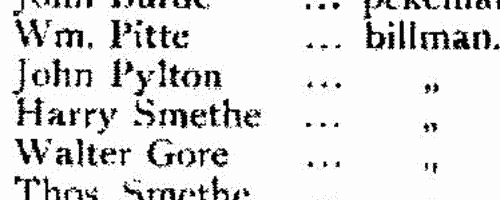
| Militia in Tintinhull hundred, Somerset
(1569)
A muster of the ablemen, gunners, light horsemen, pikemen, archers and billmen available from this hundred, compiled by sir Hugh Paulet, sir Maurice Barkeley, sir Ralph Hopton and John Horner in answer to a royal commission of the 11th year of queen Elizabeth. The returns are arranged by tithing. The hundred consisted of the parishes of (the borough of) Ilchester (or Ivelchester), Kingstone, Montacute, Northover, Stoke sub Hampdon, Thorne Coffin and Tintinhull. (The sample shown is from the return for the borough of Axbridge)AXE. Cost: £6.00. | Sample scan, click to enlarge
| Householders of Woodbury, Devon
(1591)
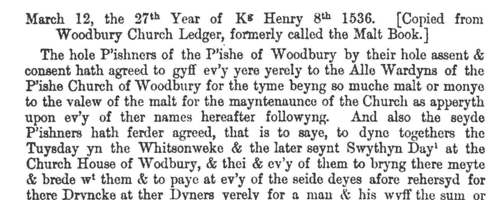
The Woodbury Church Ledger or Malt Book contained assessments of householders in the parish, arranged district by district, for the levy of the malt rate. This is the return for 28 June 1591.AXE. Cost: £6.00. | Sample scan, click to enlarge
| PCC Probates and Administrations
(1647)
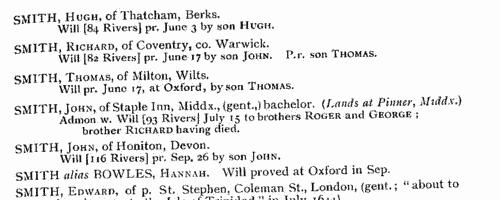
The Prerogative Court of Canterbury's main jurisdiction was central and southern England and Wales, as well as over sailors &c dying abroad: these brief abstracts, compiled under the title "Year Books of Probates", and printed in 1906, usually give address, date of probate and name of executor or administrator. They are based on the Probate Act Books, cross-checked with the original wills, from which additional details are, occasionally, added. The original spelling of surnames was retained, but christian and place names have been modernised where necessary.AXE. Cost: £2.00. | Sample scan, click to enlarge
|
Research your ancestry, family history, genealogy and one-name study by direct access to original records and archives indexed by surname.
|