Angold Surname Ancestry ResultsOur indexes 1000-1999 include entries for the spelling 'angold'. In the period you have requested, we have the following 27 records (displaying 1 to 10): Single Surname Subscription | | | Buying all 27 results of this search individually would cost £130.00. But you can have free access to all 27 records for a year, to view, to save and print, for £100. Save £30.00. More... |
These sample scans are from the original record. You will get scans of the full pages or articles where the surname you searched for has been found. Your web browser may prevent the sample windows from opening; in this case please change your browser settings to allow pop-up windows from this site. Suffolk Poll Tax Returns: Fornham All Saints
(1381)
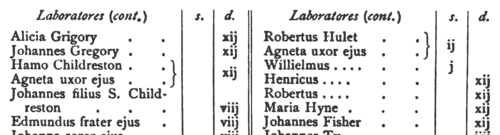
Edgar Powell transcribed and edited the poll tax returns for Thingo and Lackford hundreds (Public Record Office Lay Subsidy Suffolk 180/34, 38, 43, 49 and 52) for his study of the peasants' rising of 1381. Full lists of adults are given, township by township, under the heads armiger (esquire, rated at 6s), agricole (farmers, 3s a head), artifices (craftsmen, at 2s, often with their trade specified), laboratores (labourers, 12d), and servientes (servants, 4d to 12d a head, sometimes with their master's name given). There are returns for Barrow, Brockley-cum-Rede, Chevington, Flempton, Fornham All Saints, Hargrave, Hawsted, Hengrave, Horningsheath Magna, Horningsheath Parva, Ickworth, Lackford, Mildenhall, Nowton, Risby, Saxham Magna, Saxham Parva, Westley, and Whepsted.ANGOLD. Cost: £4.00.  | Sample scan, click to enlarge
| Suffolk Poll Tax Returns: Hengrave
(1381)
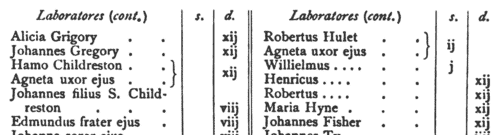
Edgar Powell transcribed and edited the poll tax returns for Thingo and Lackford hundreds (Public Record Office Lay Subsidy Suffolk 180/34, 38, 43, 49 and 52) for his study of the peasants' rising of 1381. Full lists of adults are given, township by township, under the heads armiger (esquire, rated at 6s), agricole (farmers, 3s a head), artifices (craftsmen, at 2s, often with their trade specified), laboratores (labourers, 12d), and servientes (servants, 4d to 12d a head, sometimes with their master's name given). ANGOLD. Cost: £4.00. | Sample scan, click to enlarge
| Inhabitants of Suffolk
(1568)
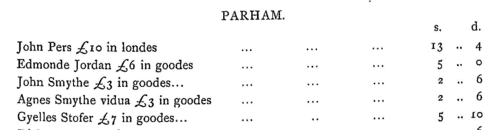
By Act of Parliament of December 1566 a subsidy of 8d in the £ on moveable goods and 4s in the £ on the annual value of land was raised from the lay (as opposed to clergy) population. These are the returns for Suffolk, printed in 1909 in the Suffolk Green Book series.ANGOLD. Cost: £4.00. | Sample scan, click to enlarge
|  Apprentices and trainee clerks
(1762) Apprentices and trainee clerks
(1762)
Apprenticeship indentures and clerks' articles were subject to a 6d or 12d per pound stamp duty (late payment of the 6d rate attracted double duty (D D) of 12d): the registers of the payments usually give the master's trade, address, and occupation, and the apprentice's name, as well as details of the date and length of the apprenticeship. 1 January to 31 December 1762.ANGOLD. Cost: £8.00. | Sample scan, click to enlarge

| Inhabitants of Diss in Norfolk
(1790-1797)
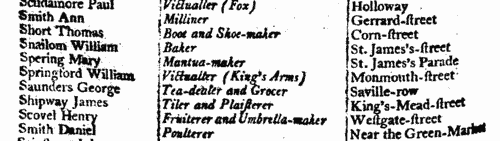
The provincial sections of the Universal British Directory include lists of gentry and traders from each town and the surrounding countryside, with names of local surgeons, lawyers, postmasters, carriers, &c. (the sample scan here is from the section for Bath). The directory started publication in 1791, but was not completed for some years, and the provincial lists, sent in by local agents, can date back as early as 1790 and as late as 1797.
ANGOLD. Cost: £6.00. | Sample scan, click to enlarge
| Masters of apprentices and clerks
(1801)
Apprenticeship indentures and clerks' articles were subject to a 6d or 12d per pound stamp duty: the registers of the payments usually give the master's trade, address, and occupation, and the apprentice's name, as well as details of the date and length of the apprenticeship. 2 January to 31 December 1801. IR 1/38ANGOLD. Cost: £8.00. | Sample scan, click to enlarge

| Traders and professionals in London
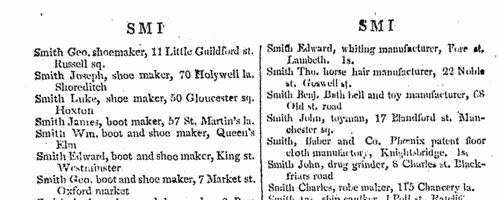
(1805)
Holden's Triennial Directory for 1805 to 1807 includes this 'London Alphabet of Businesses, Professions, &c.': coverage is good; about 30,000 individuals are recorded.ANGOLD. Cost: £4.00. | Sample scan, click to enlarge
| Voters in the Eastern Division of Norfolk, for the parish of Diss
(1832)
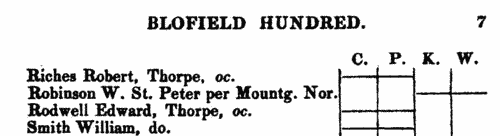
Under the Reform Act of 1832, the County of Norfolk was allotted four Members of Parliament, being two Knights of the Shire for the Eastern Division and two for the Western. The Eastern Division included the hundreds of Blofield, Clavering, Depwade, Diss, Earsham, North Erpingham, South Erpingham, Eynsford, East Flegg, West Flegg, Forehoe, Happing, Henstead, Humbleyard, Loddon, Taverham, Tunstead and Walsham. The franchise was available to freeholders worth 40s a year or over; copyholders and long leaseholders of £10 or more; short leaseholders and tenants of £50 or more: but limited to adult males. Voting took place on 20 and 21 December 1832. This poll book lists the voters for each parish, with the votes cast. Voting was not compulsory, and non-voters are not listed. Each voter had two votes: the votes are indicated in the columns C. (Lord Henry Cholmondeley, 2852); P. (Nathaniel William Peach, 2960); K. (Hon. George Keppel, 3261); and W. (William Howe Windham, 3304). The voters were not necessarily resident in the parish, but derived their franchise from the land there; so some of the names have addresses outside the parish. After the name there may appear the abbreviations cop. for copyholder; oc. for occupier; or le. for leaseholder: the rest are freeholders or annuitants.ANGOLD. Cost: £6.00. | Sample scan, click to enlarge
| Bankrupts
(1835)
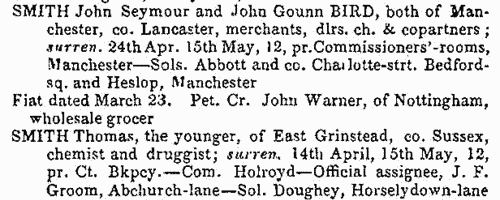
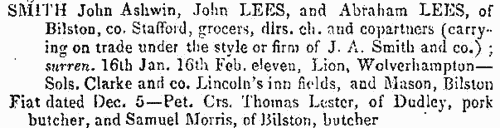
Bankruptcy notices for England and Wales: bankruptcy often caused people to restart their lives elsewhere, so these are an important source for lost links
ANGOLD. Cost: £6.00. | Sample scan, click to enlarge
| Bankrupts
(1836)
Bankruptcy notices for England and Wales: bankruptcy often caused people to restart their lives elsewhere, so these are an important source for lost links
ANGOLD. Cost: £6.00. | Sample scan, click to enlarge
|
Research your ancestry, family history, genealogy and one-name study by direct access to original records and archives indexed by surname.
|