Alan Surname Ancestry ResultsOur indexes 1000-1999 include entries for the spelling 'alan'. In the period you have requested, we have the following 35 records (displaying 1 to 10): Single Surname Subscription | | | Buying all 35 results of this search individually would cost £168.00. But you can have free access to all 35 records for a year, to view, to save and print, for £100. Save £68.00. More... |
These sample scans are from the original record. You will get scans of the full pages or articles where the surname you searched for has been found. Your web browser may prevent the sample windows from opening; in this case please change your browser settings to allow pop-up windows from this site. Worcestershire Inhabitants
(1280)
The Worcestershire Lay Subsidy roll of about 1280 lists lay inhabitants of each township of the shire and of each ward of the city of Worcester, with the amount of tax payable by each. Latin.ALAN. Cost: £4.00.  | Sample scan, click to enlarge
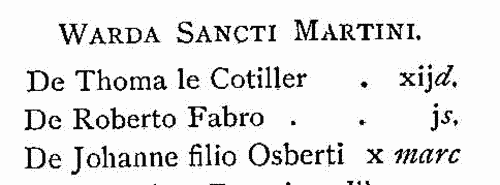
| Norfolk Feet of Fines
(1196-1307)
Pedes Finium - law suits, or pretended suits, putting on record the ownership of land in Norfolk. These abstracts were prepared by Walter Rye.ALAN. Cost: £4.00. | Sample scan, click to enlarge

| Inhabitants of London
(1275-1312)
Letter Book B of the City of London contains enrolments of recognizances between inhabitants, particularly citizens, for sums of money lent or due; grants of pieces of land or property; and various records relating to the city administration.
ALAN. Cost: £4.00. | Sample scan, click to enlarge
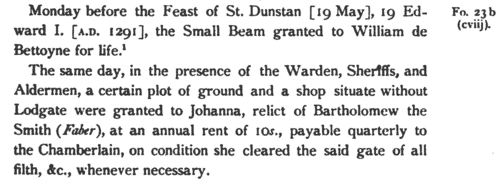
| Close Rolls
(1343-1346)
The close rolls of the 17th, 18th and 19th years of the reign of king Edward III record the main artery of government administration in England, the orders sent out day by day to individual officers, especially sheriffs of shires: they are an exceptionally rich source for so early a period. There is also some material relating to Wales, Scotland, Ireland and the English possessions in France.ALAN. Cost: £4.00. | Sample scan, click to enlarge

| Inhabitants of Yorkshire: Agbrigg Ash wapentake
(1379)
The poll tax returns for this wapentake, the area around Dewsbury, Huddersfield and Wakefield.ALAN. Cost: £6.00. | Sample scan, click to enlarge
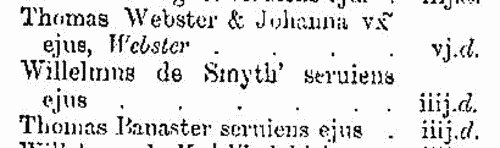
| Inhabitants of Yorkshire: Barkstone Ash wapentake
(1379)
The poll tax returns for this wapentake, the area around Selby, Sherburn-in-Elmet and Tadcaster.ALAN. Cost: £6.00. | Sample scan, click to enlarge

| Inhabitants of Yorkshire: Morley wapentake
(1379)
The poll tax returns for this wapentake, the area around Bradford and Halifax.ALAN. Cost: £6.00. | Sample scan, click to enlarge

| Inhabitants of Yorkshire: Skyrack wapentake
(1379)
The poll tax returns for this wapentake, the area around Bingley and Otley.ALAN. Cost: £6.00. | Sample scan, click to enlarge

| Inhabitants of Yorkshire: Harthill wapentake
(1380)
The poll tax returns for this wapentake, the area around Market Weighton, Pocklington and South Cave.ALAN. Cost: £6.00. | Sample scan, click to enlarge

| Court rolls of manors held by Durham priory
(1296-1384)
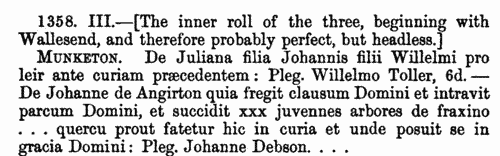
The cathedral priory of Benedictines (black monks) of St Cuthbert at Durham possessed many manors in the county. These were administered by halmotes, or manor courts, held in three sessions (tourns or turns) each year (here marked I., II. and III.), before the terrar (obedientiary), steward, bursar, and/or the prior himself. The court rolls recording proceedings in these courts survive from 1296, 1300, 1309, and from 1333, but with years missing, until becoming fairly continuous from 1365 onwards. Extracts from the rolls from 1296 to 1384 were edited by John Booth and published by the Surtees Society in 1886. The manors under this jurisdiction were Aycliffe, Bellasis, (Newton) Bewley, Billingham, Burdun, Chilton, Coupon, Dalton, Edmondbyers, Ferry (Hill, or Ferrycliffe), Fulwell, Harton, Hebburn, Hedworth, Hesledon, Heworth, Jarrow, Kirk Merrington, East Merrington, West Merrington and Mid Merrington, Monkton, Moorsley, Newton Ketton, Nunstanton, North and South Pittington, East and West Rainton, Ravensflat, Shields, Southwick, Spen, Usworth, Wallsend, Wardley, Wearmouth, Westoe, Willington and Wolviston. The main contents of the records are demises of land held by the bond tenants, neifs, cotmen and others, and of the demesne lands; and bye-laws and pains (penalties) for breach of these; and other minor delinquencies.
Normally, when a farm, cottage or piece of land was let to a new tenant, the name of the last tenant is also given, as well as the amount of the rent, and the amount of the gersum (fine on entry). These court rolls contain some of the only surviving evidence for the inhabitants of these townships in this period: but this publication was of extracts, and was not comprehensive. It should also be noted that the third tourn each year (III.) usually took place in January to March, and so by modern dating in the following year. Thus, the third tourn of 1296 was held on 4 March 1297.ALAN. Cost: £4.00. | Sample scan, click to enlarge
|
Research your ancestry, family history, genealogy and one-name study by direct access to original records and archives indexed by surname.
|