Ake Surname Ancestry ResultsOur indexes 1000-1999 include entries for the spelling 'ake'. In the period you have requested, we have the following 20 records (displaying 1 to 10): Single Surname Subscription | | | Buying all 20 results of this search individually would cost £110.00. But you can have free access to all 20 records for a year, to view, to save and print, for £100. Save £10.00. More... |
These sample scans are from the original record. You will get scans of the full pages or articles where the surname you searched for has been found. Your web browser may prevent the sample windows from opening; in this case please change your browser settings to allow pop-up windows from this site. Curia Regis Rolls
(1196-1201)
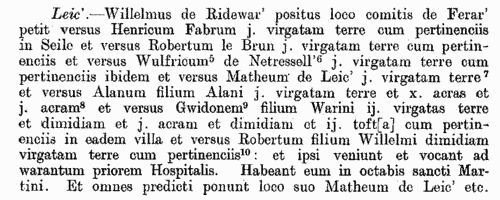
The Curia Regis, king's court, of mediaeval England took cases from throughout the country, and its records are among the most important surviving from this early period.AKE. Cost: £4.00.  | Sample scan, click to enlarge
| Yorkshire Inquisitions
(1275-1295)
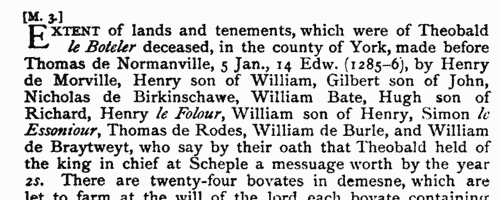
Inquisitions post mortem are inquiries as to the real estate and heir of each person holding in capite or in chief, i. e. directly, from the Crown, or whose estates had been escheated or were in ward. The age and relationship of the heir are usually recorded. Inquisitions ad quod damnum enquired as to any activities (including maladministration by local officials) that had resulted in any material loss to the Crown. Proofs of age are inquiries into the precise date of birth of an heir, usually involving local inhabitants recalling those circumstances which fixed that date in their mind. Yorkshire inquisitions for this period were edited by William Brown for the Yorkshire Archaeological Society, and printed in 1898. This index covers all names mentioned, including jurors, tenants, &c. AKE. Cost: £4.00. | Sample scan, click to enlarge
| Guisborough Cartulary
(1119-1300)
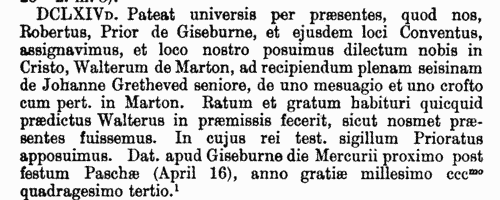
The Augustinian (black canons) priory of the Blessed Virgin Mary at Guisborough (Gyseburne) near Middlesbrough in north Yorkshire, was founded about 1119 by Robert de Brus. The 1100 or so grants of land (mostly in Cleveland) made to the priory from then well into the 13th century were copied into a cartulary or chartulary which survives as Cottonian Manuscript Cleopatra d ii (British Library). This was edited by W. Brown and published by the Surtees Society from 1889. This second part contains the charters numbered DXCIV to MCLXXXIX. The texts have been stripped of repetitious legal formulae, retaining the details of the grantors, the property, and the witnesses: so the individuals named are mainly local landowners and tenants, canons, servants and wellwishers of the monastery. The charters before 1250 are often undated. The charters in this section are arranged by place, under the heads 'Normanby; Martona; Thornaby; Ugthorpe et Pecibiggyng; Levingtona; Jarum; Castle Levington; Kepwyck; Feyceby; Atona; Thresk; Neuton; Estona; Lackenby; Lyum; Cotum; Scheltona; Brottona; Moresom; Glasedale Daneby et Moresum; Kylton; Lofthus; Esingtona; Lyverton; Daneby; Glasdale; Uggethorpe; Percybyggyng; Sletholme; Scalynge; Redker; Merske; Hesele; Lunde super le Walde; Kirkburn; Rotsea; Bainton; Tibthorpe; Ingleby Arncliff; East Harlsey; Sawcock; Scarth; Stokesley; Kirkby-in-Cleveland; Battersby; Stainton-in-Cleveland; Maltby; Ayresome; York; Sinnington; Barningham and Newsham; Aylesby; Kelsterne; Bridekirk and Appleton; Aislaby; Hart and Hartlepool; Castle Eden; and Annandale'. Three further sections are added from other sources: 1. Documents connected with the burning of the priory church in 1289; 2. Extracts from the registers of the archbishops of York relating to the priory, 1238 to 1337; 3. A rent roll of the priory of about 1300 (pp. 412 to 450), giving many names of tenants.AKE. Cost: £4.00. | Sample scan, click to enlarge
| Worcestershire Inhabitants
(1327)
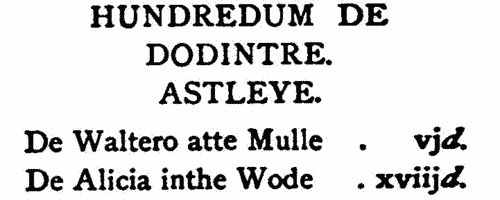
The Worcestershire Lay Subsidy roll of the 1st year of king Edward III lists lay inhabitants of each township of the shire and of the five boroughs of Droitwich (Wych), Dudley, Evesham, Kidderminster and Worcester, with the amount of tax payable by each. The roll was edited for the Worcestershire Historical Society by the Reverend F. J. Eld, and published in 1895.AKE. Cost: £4.00. | Sample scan, click to enlarge
| Close Rolls
(1343-1346)
The close rolls of the 17th, 18th and 19th years of the reign of king Edward III record the main artery of government administration in England, the orders sent out day by day to individual officers, especially sheriffs of shires: they are an exceptionally rich source for so early a period. There is also some material relating to Wales, Scotland, Ireland and the English possessions in France.AKE. Cost: £4.00. | Sample scan, click to enlarge

| Inhabitants of Scorbrough in the East Riding of Yorkshire
(1379)
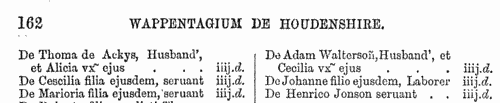
The poll tax returns of the 2nd year of the reign of king Richard II for Howdenshire, the area around Howden, were transcribed from the original in the Public Record Office (Exchequer Lay Subsidies 202/69) and published in the Yorkshire Archaeological & Topographical Journal in 1886. In editing the text, the abbreviated Latin has been extended, and those occupations that appear have been put in italics. The normal tax for a husbandman or labourer and his wife was 4d, as was that for a single person; but tradesmen paid 6d or more. AKE. Cost: £6.00. | Sample scan, click to enlarge
| Inhabitants of Yorkshire: Harthill wapentake
(1380)
The poll tax returns for this wapentake, the area around Market Weighton, Pocklington and South Cave.AKE. Cost: £6.00. | Sample scan, click to enlarge

| Grantees of offices, commissions and pardons
(1413-1416)
The Patent Rolls are the Chancery enrolments of royal letters patent. Those for the 1st, 2nd and 3rd years of the reign of king Henry V (21 March 1413 to 20 March 1416) were edited for the Public Record Office by R. C. Fowler, and published in 1910. The main contents are royal commissions and grants; ratifications of ecclesiastical estates; writs of aid to royal servants and purveyors; and pardons. The commissions of the peace issued for the English towns and counties and entered on the rolls, being largely repetitive, have been consolidated in a single appendix.AKE. Cost: £2.00. | Sample scan, click to enlarge

| The English in France
(1430)
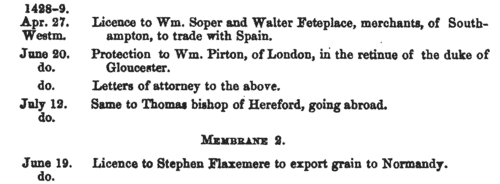
King Henry VI of England (one of the grandsons of Charles VI of France) claimed the throne of France (and quartered the fleurs-de-lis of France with the lions of England on the royal standard) as had his predecessors since Edward III, as descendants of Philip IV of France. The English had real power or influence in Brittany, Normandy, Flanders and Gascony, and actual possession of several coastal garrisons, in particular Calais, where the French inhabitants had been replaced by English. Henry VI came to the throne only seven years after his father had trounced the French at Agincourt; but his cousin, Charles VII, who became king of France in the same year, spent his long reign rebutting the English king's claim to his throne by territorial reconquest and consolidation. The English administration kept a series of records called the French Rolls. On these are recorded royal appointments and commissions in France; letters of protection and safe-conduct to soldiers, merchants, diplomats and pilgrims travelling to France from England and returning, and to foreign legations. There are also licences to merchants to export to the Continent, and to captains to transport pilgrims. As Henry VI's reign progressed, and the English grip on northern France loosened, the French Rolls also increasingly include entries concerning the ransoming of English prisoners.AKE. Cost: £6.00. | Sample scan, click to enlarge
| Tradesmen of York
(1272-1558)
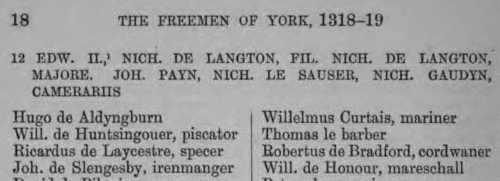
No man or woman could trade in the city of York without having obtained 'freedom' of the city.Their names were recorded on the 'Freemen's Roll', or Register of the Freemen of the City of York, which contains about 19,900 names for this period. A list of names was prepared for each year, the year being here reckoned as starting at Michaelmas (29 September) until 1373, and thence at Candlemas (2 February). Each annual list starts with the name of the mayor and the camerarii or chamberlains. The chamberlains were freemen charged with the duty of receiving the fees of the new freemen; of seeing that only freemen traded in the city; and of preparing this roll, which was compiled from the names on their own account books from the receipts for the fees. There are three groups of freemen: those who obtained freedom after serving out an apprenticeship to a freeman; the children of freemen; and those who claimed freedom by 'redemption', i. e. by purchase or gift from the Mayor and Court of Aldermen.
AKE. Cost: £2.00. | Sample scan, click to enlarge
|
| 1 | 2 |  |
Research your ancestry, family history, genealogy and one-name study by direct access to original records and archives indexed by surname.
|