Affleck Surname Ancestry ResultsOur indexes 1000-1999 include entries for the spelling 'affleck'. In the period you have requested, we have the following 183 records (displaying 1 to 10): Single Surname Subscription | | | Buying all 183 results of this search individually would cost £936.00. But you can have free access to all 183 records for a year, to view, to save and print, for £100. Save £836.00. More... |
These sample scans are from the original record. You will get scans of the full pages or articles where the surname you searched for has been found. Your web browser may prevent the sample windows from opening; in this case please change your browser settings to allow pop-up windows from this site. Scottish litigants, rebels and cautioners
(1585-1592)
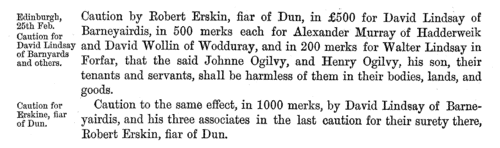
The Privy Council of Scotland exercised a superior judicial authority in the kingdom, and consequently received and dealt with a constant stream of petitions, as well as dealing with the internal security of the state. This register of the council from 1 August 1585 to 31 July 1592, in the reign of king James VI, was edited by David Masson, and published under the direction of the Lord Clerk Register of Scotland in 1881. Some of the individuals mentioned are the complainants, those of whom they complained, and the sureties on both sides: at this period, some of the complainants are alleging serious attacks, often of a feuding nature. Many of the bonds entered into by the cautioners are promises to keep the peace towards such enemies. Failure to answer to the council when summoned was a serious contempt, leading to being denounced a rebel, with serious consequences. But 'horning' was also used in the pursuit of debts: there was no imprisonment for debt in Scotland, but a creditor could have an obstinate debtor ordered, in the sovereign's name, to pay what was due, failing which, the debtor could be put to the horn, denounced as a rebel, and imprisoned as a rebel. The main text (to page 774) is from the Acta Secreti Concilii, containing the minutes of the Privy Council, with intermixed Acta Proper (political edicts), Decreta (judicial decisions), Acta Cautionis (acts of caution) and Bands (registration of bonds). After that are printed some miscellaneous Privy Council documents from the same years: additional acts of caution (775-778); ordinances and acts anent the Borders and the North (779-814); and miscellaneous privy council papers (815-834). The sources most productive of names, the Acta Cautionis and Registration of Bands, are also the most repetitive in form, and are not transcribed verbatim and literatim: nevertheless, one of the editor's rules was for 'All proper names and names of places occurring in the originals to be preserved in the abstracts without exception, and in the exact original spelling.'
AFFLECK. Cost: £4.00.  | Sample scan, click to enlarge
| Scottish litigants, rebels and cautioners
(1592-1599)
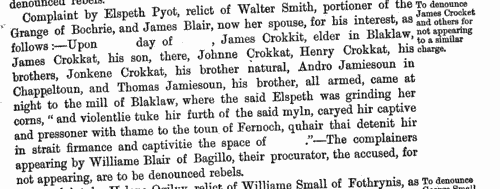
The Privy Council of Scotland exercised a superior judicial authority in the kingdom, and consequently received and dealt with a constant stream of petitions, as well as dealing with the internal security of the state. This register of the council from August 1592 to May 1599, in the reign of king James VI, was edited by David Masson and published under the direction of the Deputy Clerk Register of Scotland in 1882. The publication brings together the contents of the principal register (Acta Secreti Concilii) with acts and bands (bonds) of caution (surety) from the registers called Acta Cautionis (pp 561-730); Acts and Ordinances relating to the Borders and the North (731-748); and Miscellaneous Privy Council Papers (749-769). Many of the individuals mentioned are the complainants, those of whom they complained, and the sureties on both sides: at this period, many of the complainants are alleging serious attacks, often of a feuding nature. Many of the bonds entered into by the cautioners are promises to keep the peace towards such enemies. Failure to answer to the council when summoned was a serious contempt, leading to being denounced a rebel, with serious consequences.
AFFLECK. Cost: £4.00. | Sample scan, click to enlarge
| Scottish litigants, rebels and cautioners
(1610-1613)
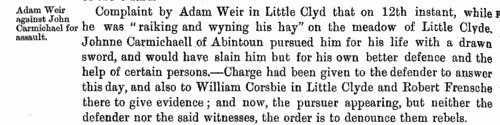
The Privy Council of Scotland exercised a superior judicial authority in the kingdom, and consequently received and dealt with a constant stream of petitions, as well as dealing with the internal security of the state. This register of the council from July 1610 to February 1613, in the reign of king James VI, was edited by David Masson and published under the direction of the Deputy Clerk Register of Scotland in 1889. The publication starts with the Acta and Decreta, a chronological consolidation of material from Acta Secreti Concilii proper, the Decreta, the Book of Commissions, the Book of Sederunts, the Minute Book of Processes, and The Book of the Isles. There is then a section of Royal and Other Letters (pp. 565-644); then acts and bands (bonds) of caution (surety) from the registers called Acta Cautionis (pp. 647-690); and Miscellaneous Privy Council Papers (693-746). Many of the individuals mentioned are the complainants, those of whom they complained, and the sureties on both sides: at this period, many of the complainants are alleging serious attacks, often of a feuding nature. Many of the bonds entered into by the cautioners are promises to keep the peace towards such enemies. Failure to answer to the council when summoned was a serious contempt, leading to being denounced a rebel, with serious consequences.
AFFLECK. Cost: £4.00. | Sample scan, click to enlarge
| House of Lords Proceedings
(1704-1706)
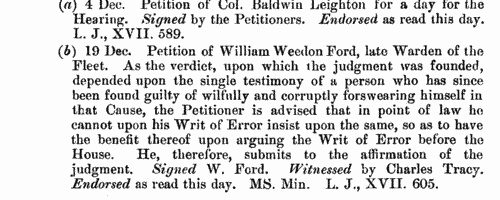
Private bills dealing with divorce, disputed and entailed estates: petitions, reports and commissions: naturalisation proceedings. This abstract of the archives from the beginning of the third Session of the first Parliament of queen Anne, 24 October 1704, to the end of the first Session of her second Parliament, 19 March 1706, was prepared by Cuthbert Headlam and J. B. Hotham and printed in 1912 in continuation of the volumes issued under the authority of the Historical Manuscripts Commission.
AFFLECK. Cost: £4.00. | Sample scan, click to enlarge
| Licences for marriages in southern England
(1632-1714)
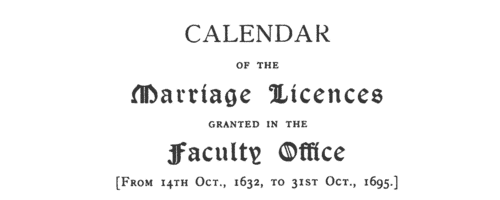
The province or archbishopric of Canterbury covered all England and Wales except for the northern counties in the four dioceses of the archbishopric of York (York, Durham, Chester and Carlisle). Marriage licences were generally issued by the local dioceses, but above them was the jurisdiction of the archbishop. Where the prospective bride and groom were from different dioceses it would be expected that they obtain a licence from the archbishop; in practice, the archbishop residing at Lambeth, and the actual offices of the province being in London, which was itself split into myriad ecclesiastical jurisdictions, and spilled into adjoining dioceses, this facility was particularly resorted to by couples from London and the home counties, although there are quite a few entries referring to parties from further afield. Three calendars of licences issued by the Faculty Office of the archbishop were edited by George A Cokayne (Clarenceux King of Arms) and Edward Alexander Fry and printed as part of the Index Library by the British Record Society Ltd in 1905. The first calendar is from 14 October 1632 to 31 October 1695 (pp. 1 to 132); the second calendar (awkwardly called Calendar No. 1) runs from November 1695 to December 1706 (132-225); the third (Calendar No. 2) from January 1707 to December 1721, but was transcribed only to the death of queen Anne, 1 August 1714. The calendars give only the dates and the full names of both parties. Where the corresponding marriage allegations had been printed in abstract by colonel Joseph Lemuel Chester in volume xxiv of the Harleian Society (1886), an asterisk is put by the entry in this publication. The licences indicated an intention to marry, but not all licences resulted in a wedding. AFFLECK. Cost: £4.00. | Sample scan, click to enlarge
| Treasury Books
(1717)
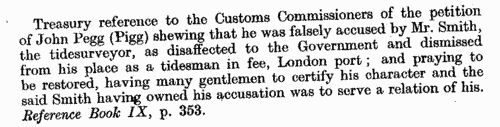
Records of the Treasury administration in Britain, America and the colonies, for 1717. These also include records of the appointment and replacement of customs officers such as tide waiters and surveyors.AFFLECK. Cost: £4.00. | Sample scan, click to enlarge
| Boys entering Rugby School
(1719)
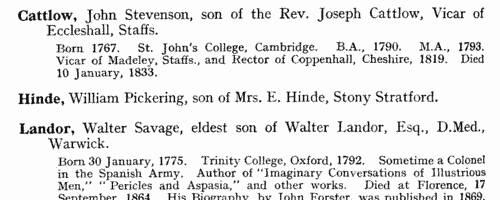
This edition of Rugby School Register was published in 1933: the volume covering 1675 to 1857 contains 6480 entries, based on the original school admission registers, but elaborated with general biographical information wherever the editor was able to do so. The entries for the 17th and early 18th centuries are much less detailed than those for later years. The arrangement of the fullest entries was to give the boy's full name (surname first, in bold); whether eldest, second, &c., son; father's name and address as of when the boy entered school; the boy's age at entry and birthday; name of the house (in the school) to which he belonged; then a brief general biography; and date and place of death. AFFLECK. Cost: £4.00. | Sample scan, click to enlarge
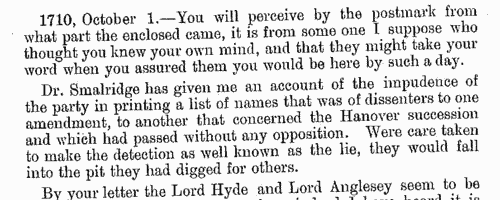
| Letters from Oxford
(1710-1729)
Letters from Dr William Stratford of Christ Church, Oxford, to Edward Harley: full of political and personal gossip.AFFLECK. Cost: £4.00. | Sample scan, click to enlarge
|  Apprentices registered in Scotland
(1754) Apprentices registered in Scotland
(1754)
Apprenticeship indentures and clerks' articles were subject to a 6d or 12d per pound stamp duty: the registers of the payments usually give the master's trade, address, and occupation, and the apprentice's name, as well as details of the date and length of the apprenticeship. There are central registers for collections of the stamp duty in London, as well as returns from collectors in the provinces. These collectors generally received duty just from their own county, but sometimes from further afield. The indentures themselves can date from a year or two earlier than this return. (The sample entry shown on this scan is taken from a Liverpool return. Each entry has two scans, the other being the facing page with the details of the indenture, length of service, and payment of duty.) IR 1/52AFFLECK. Cost: £8.00. | Sample scan, click to enlarge

| Subscribers to The Accomptant's Oracle: Egremont
(1771)
Wardhaugh Thompson 'many years an accomptant in London' published 'The Accomptant's Oracle; Or, Key to Science. Being a Treatise of Common Arithmetic: With the Doctrine of Vulgar and Decimal Fractions. Upon a Plan Entirely New. To which are added Decimal Tables, with their Use and Construction.' The work was printed in Whitehaven, attracting a large subscription, mainly from northern England and southern Scotland.AFFLECK. Cost: £6.00. | Sample scan, click to enlarge
|
Research your ancestry, family history, genealogy and one-name study by direct access to original records and archives indexed by surname.
|