Abbay Surname Ancestry ResultsOur indexes 1000-1999 include entries for the spelling 'abbay'. In the period you have requested, we have the following 19 records (displaying 1 to 10): Buy all | | | Get all 19 records to view, to save and print for £96.00 |
These sample scans are from the original record. You will get scans of the full pages or articles where the surname you searched for has been found. Your web browser may prevent the sample windows from opening; in this case please change your browser settings to allow pop-up windows from this site. Landowners and tenants in Yorkshire
(1345-1485)
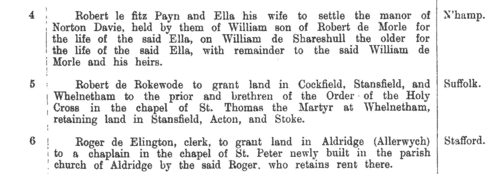
Inquisitions ad quod damnum were held by the appropriate sheriff or escheator (or other officer in whose bailiwick the matter in question might lie) to investigate cases in which the royal or public interest might be damaged by proposed alienation or settlement of land (especially alienation to religious uses, into mortmain). The key findings from these inquisitions were as to the tenure of the land and the service due from it; its yearly value; the lands remaining to the grantor, and whether they sufficed to discharge all duties and customs due from him; and whether he can still be put upon juries, assizes and recognitions, so that the country be not burdened by his withdrawal from them. Generally speaking, this process had the makings of a system of licensing such alienations, and raising money in proportion to the valuations. Equally, there are many items that deal with subjects such as the closing of public roads, the felling or inclosing of woods, or the proposed grant of liberties or immunities. A calendar of these inquisitions from the 19th year of the reign of king Edward III to the 2nd year of Richard III was prepared by the Public Record Office and published in 1906. We have now indexed this calendar by surname and county. Most of the individuals appearing in the calendar are either pious individuals seeking to make grants to religious bodies for the sake of their souls; or landowners securing the disposition and settling of their real estate. But some other names do appear - tenants, trustees, chaplains and clerks.ABBAY. Cost: £6.00.  | Sample scan, click to enlarge
| Tenants, founders and incumbents of Yorkshire chantries
(1546-1548)
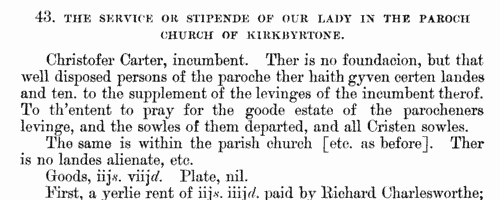
Chantries were established to perform services for the souls of their founders and other faithful dead, including annual obits and anniversaries at which alms were usually distributed. The chantries could be at an existing altar in a parish church, a new altar in a side chapel of an existing church, in a new chapel in the churchyard or some miles from an existing church: few were founded before 1300, and most date from 1450 to 1500. Hospitals were places provided by similar foundations to receive the poor and weak; there were also religious guilds, brotherhoods and fraternities, and colleges (like large chantries at which three or more secular priests lived in common). An Act of Parliament of 1545 gave king Henry VIII the power to dissolve such chantries, chapels, &c., the proceeds to be devoted to the expenses of the wars in France and Scotland. Commissioners were appointed 14 February 1546 to survey the chantries and seize their property, and from 1546 to 1548 the commissioners produced these certificates giving brief details of the establishment and nature of each foundation, with an inventory of valuables and rental of lands. The individuals named in the certificates are thus the founder, the present incumbent, and the tenants whose rents provided the chantry's income. All the surviving certificates were edited by William Page for the Surtees Society, and published from 1892.ABBAY. Cost: £6.00. | Sample scan, click to enlarge
| Tradesmen of York
(1272-1558)
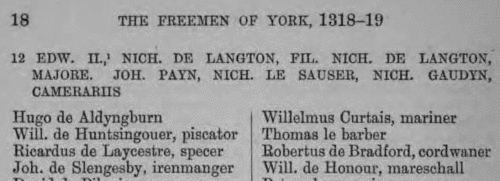
No man or woman could trade in the city of York without having obtained 'freedom' of the city.Their names were recorded on the 'Freemen's Roll', or Register of the Freemen of the City of York, which contains about 19,900 names for this period. A list of names was prepared for each year, the year being here reckoned as starting at Michaelmas (29 September) until 1373, and thence at Candlemas (2 February). Each annual list starts with the name of the mayor and the camerarii or chamberlains. The chamberlains were freemen charged with the duty of receiving the fees of the new freemen; of seeing that only freemen traded in the city; and of preparing this roll, which was compiled from the names on their own account books from the receipts for the fees. There are three groups of freemen: those who obtained freedom after serving out an apprenticeship to a freeman; the children of freemen; and those who claimed freedom by 'redemption', i. e. by purchase or gift from the Mayor and Court of Aldermen.
ABBAY. Cost: £2.00. | Sample scan, click to enlarge
| York Will Calendar
(1660-1665)
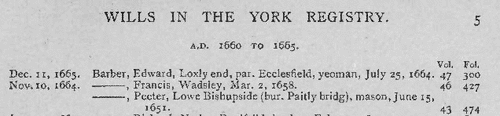
The diocese of York comprised most of Yorkshire, and Nottinghamshire: the York Exchequer court was the ordinary probate jurisdiction for the Yorkshire part of the diocese, but some wills from Nottinghamshire and other parts of the province of York were also proved there. Dr Francis Collins compiled this index to the wills in the York registry proved from 1660 to 1665. The date of the probate precedes the name of the testator: during the period covered by the volume the dates of probate are very rarely given in the registers - they were therefore supplied from the Act Books. However, the Act Book for Ainsty, City and Craven deaneries is missing for this period, and in those cases no date could be given. In a very few instances (marked with an asterisk) in these deaneries in which the date has been supplied it has been taken from the registers. Additional matter from the Act Books is given within square brackets. Testators' names are given in full, surname first; then parish or place of abode, and in some cases occupation; then date of the will itself; and volume and folio number in the probate register. Where a place of burial, or intended burial, was indicated, that is also added, with the word 'bur.', within round brackets. All wills between 1652 and 1660 were proved in London; in practice, many Yorkshire wills had remained unproved at the date that the York Exchequer probate court was restored, and so there is in this list a large number of wills dating back through the 1650s.ABBAY. Cost: £2.00. | Sample scan, click to enlarge
|  Apprentices registered at York
(1741-1745) Apprentices registered at York
(1741-1745)
Apprenticeship indentures and clerks' articles were subject to a 6d or 12d per pound stamp duty: the registers of the payments usually give the master's trade, address, and occupation, and the apprentice's father's name and address, as well as details of the date and length of the apprenticeship. There are central registers for collections of the stamp duty in London, as well as returns from collectors in the provinces. These collectors generally received duty just from their own county, but sometimes from further afield. (The sample entry shown on this scan is taken from a Norfolk return)ABBAY. Cost: £8.00. | Sample scan, click to enlarge

| Tradesmen of York
(1559-1759)
No man or woman could trade in the city of York without having obtained 'freedom' of the city. Their names were recorded on the 'Freemen's Roll', or Register of the Freemen of the City of York, which contains about 16,600 names for this period. A list of names was prepared for each year. Each annual list starts with the name of the mayor and the camerarii or chamberlains. The chamberlains were freemen charged with the duty of receiving the fees of the new freemen; of seeing that only freemen traded in the city; and of preparing this roll, which was compiled from the names on their own account books from the receipts for the fees. There are three groups of freemen: those who obtained freedom after serving out an apprenticeship to a freeman; the children of freemen (per patres); and a handful who claimed freedom by 'redemption', i. e. by purchase or gift from the Mayor and Court of Aldermen.
ABBAY. Cost: £2.00. | Sample scan, click to enlarge
| Proprietors of Knaresborough and Claro Banking Company
(1838)
The provincial banks of England and Wales made annual returns to the Stamp Office of their proprietors or shareholders. These returns, registered in March 1838, from the 103 banks then in existence, contain the full names and addresses of about 30,000 shareholders.ABBAY. Cost: £6.00. | Sample scan, click to enlarge
| Electors for Dunsforth Lower
(1848)
On 14 and 15 December 1848 an election took place for a Knight of the Shire for the West Riding of Yorkshire in the House of Commons. The candidates were Edmund Denison and sir Culling Eardley Eardley, gaining 14,743 and 11,795 votes respectively. The county franchise at this period included freeholders of land worth 40s or more a year; £10 copyholders and long-leaseholders; and £50 short-leaseholders and tenants. This poll book was published in 1849.
Former poll books had been compiled from the sheriff's returns; but as these were now transmitted to the Home Office immediately after an election, in this instance the polling was marked from the check-clerk's returns, carefully compared with the registers marked in the poll booths at the time of voting.
The votes for the respective candidates are indicated by the numerals 1 (Denison) and 2 (Eardley). The omission of these numerals indicates that the elector did not vote. Many names which appear on the register of particular townships are completely omitted in this poll book: in all these cases, the same name will be found recorded in some other township, the elector having two or more qualifications. In such cases, his name only appears in the poll book in the actual township for which he chose to vote; or, if he did not vote at all, in that township for which he was qualified that lay closest to his actual residence.
The townships are arranged alphabetically within polling district; and within each township the names are arranged alphabetically by surname and christian name, and the elector's residence is given. Many of the electors resided outside the township for which they were qualified - some in other counties. Moreover, at the end of each polling district there is a list of persons registered to poll in that district, from townships is other districts. ABBAY. Cost: £6.00. | Sample scan, click to enlarge
| Electors for Dunsforth Upper-with-Branton Green
(1848)
On 14 and 15 December 1848 an election took place for a Knight of the Shire for the West Riding of Yorkshire in the House of Commons. The candidates were Edmund Denison and sir Culling Eardley Eardley, gaining 14,743 and 11,795 votes respectively. The county franchise at this period included freeholders of land worth 40s or more a year; £10 copyholders and long-leaseholders; and £50 short-leaseholders and tenants. This poll book was published in 1849.
Former poll books had been compiled from the sheriff's returns; but as these were now transmitted to the Home Office immediately after an election, in this instance the polling was marked from the check-clerk's returns, carefully compared with the registers marked in the poll booths at the time of voting.
The votes for the respective candidates are indicated by the numerals 1 (Denison) and 2 (Eardley). The omission of these numerals indicates that the elector did not vote. Many names which appear on the register of particular townships are completely omitted in this poll book: in all these cases, the same name will be found recorded in some other township, the elector having two or more qualifications. In such cases, his name only appears in the poll book in the actual township for which he chose to vote; or, if he did not vote at all, in that township for which he was qualified that lay closest to his actual residence.
The townships are arranged alphabetically within polling district; and within each township the names are arranged alphabetically by surname and christian name, and the elector's residence is given. Many of the electors resided outside the township for which they were qualified - some in other counties. Moreover, at the end of each polling district there is a list of persons registered to poll in that district, from townships is other districts. ABBAY. Cost: £6.00. | Sample scan, click to enlarge
| Owners of Merchantmen
(1852-1853)
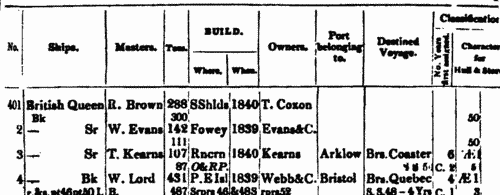
Lloyd's Register of British and Foreign Shipping was issued annually, listing ships that had been surveyed preparatory to being insured. This is the register issued 1 July 1852 and then annotated as ships were re-surveyed through to 30 June 1853. The ships were numbered by the first letter of their name, and then by number alphabetically through the ships' names and within ships of the same name alphabetically by surname of the master. After the name of the ship there is the type of vessel (Bk, barque; Bg, brig; Bn, brigantine; Cr, cutter; Dr, dogger; G, galliott; H, hoy; K, ketch; Lr, lugger; Pol, polacre; S, ship; Sk, smack; Sp, sloop; Sr, schooner; St, schoot; Stm, steamer; Sw, snow; Yt, yacht), master's name (as at the time of the last survey); tonnage; place and year of build; owners; port belonging to; destined voyage; number of years first assigned; and character for hull and stores (e. g., A 1), with the year or month (e. g., 50 for 1850, or 2 for February 1852) of inspection. Underneath some entries details were given of construction and repair, with year - s., sheathed; d., doubled; C., coppered; I. B., iron bolts; c. f., copper fastened; M., sheathed with marine metal; Y. M., sheathed with yellow metal; G., sheathed with galvanised iron; Z., sheathed with zinc; F., felt; C. lm., coppered to light water or ballast mark; C. T., copper bolts substituted for treenails; Cl., clincher; len., lengthened; lrp., large repairs; trp., thorough repairs; Drp., damage repaired; ND., new deck; N TSds., new top-sides; W. C., wales cased; NW., new wales; NB., new bottom; NK., new keel; plk, Plank; N Klsn, new kelson; alm. rb., almost rebuilt; pt O. M., part old materials (timbers or plank); Srprs, some repairs - and, in italics, the timber of the ship is described - A, ash; B B, black birch; Bh, beech; C, cedar; E, elm; F, fir; G, gum; Ght, greenheart; Hk, hackmatack; Hm, hemlock; L, locust; Lh, larch; L O, live oak; M, mahogany; P, pine; P P, pitch pine; R P, red pine; Y P, yellow pine; S, spruce; T, teak; Tam, tamarac; W H, witch hazel; W O, white oak. The sample scan is from the main list. The third column, reserved for masters' names, is not particularly wide; with short surnames, an initial will be given; but longer surnames omit the initials, and even longer surnames are abbreviated. This is the index to owners in the main list. Often a ship would have changed hands by the time of re-survey, and the new owners' names are added in slightly smaller type under the original owners in the seventh column. These new owners are also included in this index. It should be borne in mind that the owners in the main list are those at the time of the respective previous survey for each ship, not necessarily as of 1 July 1852.ABBAY. Cost: £6.00. | Sample scan, click to enlarge
|
| 1 | 2 |  |
Research your ancestry, family history, genealogy and one-name study by direct access to original records and archives indexed by surname.
|